- Tuesday, 2 June 2026

AI Transforming Jobs Worldwide

Is Artificial Intelligence (AI) wiping out human jobs? Is a robot ´an alternative to a human? While AI is assured to eliminate millions of contemporary jobs, will it create at least thousands of new ones? Will the human role in the economy shrink? Various significant concerns have been raised against AI and its risk of generating unemployment.
AI has directly influenced our daily lifestyles and decisions. Knowingly or unknowingly, we interact with AI while using smartphones. Today, AI, machine learning, and automation are applied in the diagnosis of illness, delivery of products and groceries, cooking, autonomous vehicles, content creation to prevention of fraud, and so on.
AI has commenced its domination in education, medicine, science, security, surveillance, accounting and finance, transportation, entertainment, business, customer services, and many more. Humanity has made a breakthrough with successive waves of advancement in technology. Since 2000, the gradual elimination of jobs in manufacturing sectors has been noticed. Additionally, COVID-19 emerged as a catalyst for the acceleration of digitalisation and transformation of jobs.
Fascination
McDonald's launched its robotic and automated restaurant touch screen, conveyor belts, and drive-thru employing only a small team of workers. Amazon has manufactured and deployed its first fully autonomous mobile robot at fulfilment centres and sort centres and thousands in distribution warehouses. Tesla aspires to develop autonomous driving technology through self-driving cars threatening the jobs of drivers. Several companies including LinkedIn have deployed ChatGPT for replying to our answers replacing customer service representatives.
According to the World Robotics Report 2022, the global annual installation of industrial robots showed an all-time high with 517,000 in 2021. Industrial robots continue to dominate the market in Asia with 74 per cent of newly deployed robots. Corporate houses strive for robotics and AI´s for cost control, enhanced productivity, and persistent quality of products and services. Apparently, AI has become a ´must-have´ tool for creating better customer experiences. However, the expansion in the installation of robots has flooded technological anxiety in the entire tech world.
The intellectual, economic, and academic debates have amplified fears of eliminating jobs through AI and automation. Various empirical assessments, including one by McKinsey Global Institute, have claimed the mechanisation of approximately half of the jobs in Western countries in the next 10 to 20 years. According to Oxford Martin School, in the next 20 years, 57 per cent of jobs in the Organisation for Economic Cooperation and Development (OECD), 69 per cent in India, and 77 per cent in China will be automated.
Intellectuals have put forward issues of genuine ethical concerns about the possibility of AI becoming uncontrollable and hostile towards humans. Stephen Hawking had warned AI might replace humans altogether by improving and replicating itself. Elon Musk has insisted that AI could be more dangerous than nukes and might pose a serious threat to human existence.
According to a study conducted by Boston Consulting Group on ´The Future of Jobs in the Era of AI´, for instance, in the United States, one additional job will be required to develop, implement, and manage those new technologies for every six jobs that are being automated or augmented. In total, these novel jobs will envelop 63 occupations in data science and programming. The Automation and Job Loss Statistics show while automation is predicted to eliminate 73 million jobs by 2030, it could create 58 million new jobs.
Meanwhile, the deficiency of AI has been identified in the field of empathy, strategic planning, and emotional intelligence. Despite AI´s influence in all domains, the entire replacement of humans is difficult. Human creativity and the capability of imagination are irreplaceable. AI could be more powerful and faster than human brains, however, yet not capable. Given its humans to decide how to shape the tech world, AI is not detrimental per se. However, automation and AI have been crucial. The wiping out of various tasks, including routine tasks, for instance, time bookkeeping, record keeping, clerk responsibilities, and time-consuming data entries, widens the opportunities for employees to participate in more strategic roles. Moreover, it generates new scopes in the field of digitisations, software development, data analysis and cybersecurity.
Given the rapid changes in demands for labour skills to adapt the automation and advanced technologies, huge gaps will be identified in the labour market. The inability to supply an adequate skilled workforce to fulfil the new emerging roles and functions will impose an economic threat. Apparently, the requirement of redefining the jobs meanwhile, upskilling and reskilling human resources is significant.
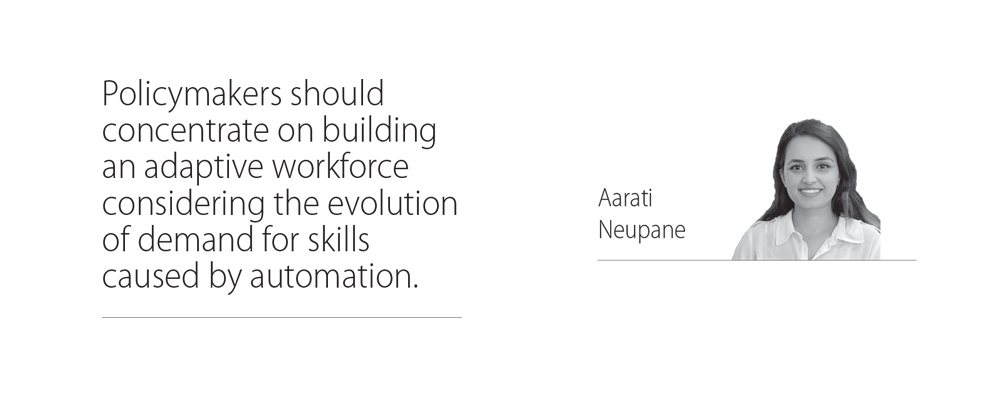
The government, corporate sector, and individuals should comprehend the transformation of the nature of jobs while embracing the drastic technological development. Policymakers should concentrate on building an adaptive workforce considering the evolution of demand for skills caused by automation. To catch contemporary trends in the labour market (demand and supply), educational institutions require revising and rethinking academic courses, syllabi, and programmes.
Emotional intelligence
Meanwhile, the government and corporate sector should formulate a strategic human resource development plan to match the balance between labour demand and supply. Human resource development programmes should reorient on enhancing systems thinking, creativity, leadership, and emotional intelligence. Employee recruitment systems and strategies should be revised while refocusing the training programmes and workshops towards constant skills upliftment to address the digital economy.
The Nepali academic sector requires a robust transformation from its conventional education system to a more flexible and demand-based system. Advanced educational platforms encouraging logical reasoning, data analytics, software development, and programming should be widened. Moreover, each employee should develop a culture of learning new, acquiring novel skills, and career flexibility. The state and non-state actors and individuals should prepare themselves for the transition to jobs anticipated by AI and automation.
(A section officer at the Ministry of Federal Affairs and General Administration, Neupane is currently pursuing her Post-graduate in International Relations at Geneva Business School.)