- Tuesday, 2 June 2026

Checking Intellectual Decay

It might be offensive to some of us, but I ask for forgiveness for being rather discourteous to make a harsh comment on the role we have been playing as intellectuals. Assuming that the main task of intellectuals is to produce knowledge that can advance society further, every state spends money, energy, and time. But we seem to have been more orthodox than we used to be in previous ages. We have become blind followers of dogmatic ideologues who look at the world from parochial perspectives. Instead of looking at things and events independently, we think stereotypically without knowing we could have better contributed to the nation and its people by being impartial. To our utter distress, this has become more common in the aftermath of the democratic revolutions in our country.
The aphoristic saying "knowledge is power" is as relevant today as Francis Bacon said in the sixteenth century and Thomas Jefferson referred to in the eighteenth century. Bertrand Russell, in the early twentieth century, also admitted that human intellect had lightened menial labour through scientific inventions of various kinds – tractors in place of the plough, motor vehicles in place of horse-drawn carriages, and electricity in place of a candle. We prefer the latter set to the former to lighten our burdensome tasks, save our energy, and shorten the work duration. With his immense power of logic, our life has become easier and more comfortable in our time than in former times. Undoubtedly, intellectual development has done more good than bad.
Human intellect
Human intellect has produced epoch-making cultures at different times in different locations. Undeniably, with the power of the mind, the Vedic culture produced all-time appealing scriptures, which are as important today as they were at the time of their production. Buddhist scriptures also contain universal appeal because they were made by the best minds of the time. The same applies to the Judeo-Christian and Islamic scriptures that have made their epoch with intellectual vigour. All these products are excellent cultural products of respective communities. They are also the best intellectual property of all time.
With the development of science and technology, tremendous achievements have been made. Galileo's discovery of the telescope, the Copernican explanation of heliocentrism, the Newtonian theory of gravitation, and the Darwinian principle of natural selection can be regarded as supreme examples of intellectual property. They have inculcated into our minds the scientific worldviews that have made our lives different from those of any former times. Some other examples are the invention of the steam engine, the internal combustion engine, and airplanes have brought about unprecedented changes in locomotion.
Likewise, the telephone and the internet have made our communication so rapid that we can communicate with people from any corner of the world in no calculable time, in a fraction of a second, so to speak. Unquestionably, human beings have immense intellectual worth to bring about substantial changes in the quality of human life. Can we undervalue this intellectual worth by any means? But the same intellectual power has some unwanted aspects also. An unprecedented boon though it is to our lives, it might as well be an agent to decay of our moral standards.
Using it without considering its possible consequences may bring misfortunes that otherwise could be easily avoided with wisdom. Have we, for instance, imagined the imminent menace of overpopulation by discovering life-saving drugs? Can we do immediate good when we foresee that the possible consequence is bad? Have we considered the possibility of the devastating end of our habitat by the misuse of nuclear physics, which otherwise could profitably be used for the entire society? Is it moral to develop nuclear physics if we already know that the possible consequence is our doom?
It has been commonplace today that we use devices for even the easy tasks that the human mind could have easily covered more accurately. We are thus mistaken to think that intellectual standards grow in proportion to the development of machines. An unwanted by-product of using labour-saving devices is that our minds can be dull if we are over dependent on machines. Russell argued even the best intellectuals might make mistakes in recalling the names of books they have read and the people they have met in the last few days. This tendency is as common among the teachers and students in educational institutions in our times as it used to be in Russell’s time. The loss of the sense of accuracy is an alarming sign of intellectual decay.
False belief
We are facing a different intellectual problem. It is not the problem of high intellect that can oftentimes be misused but the problem of low intellectual growth that is inadequate for enhancing the quality of life. The educational institutions have been engaged in average routine activities guided by the fixed curriculum. So we have not been creative, analytical, and critical. The more we are confined to the formal education system, the less intelligent we become. We may have a false belief that university graduates are high-level intellectuals. But that is not true. Only a few individuals can develop substantial intellectual qualities; all others are average or even below average. This is more than embarrassing.
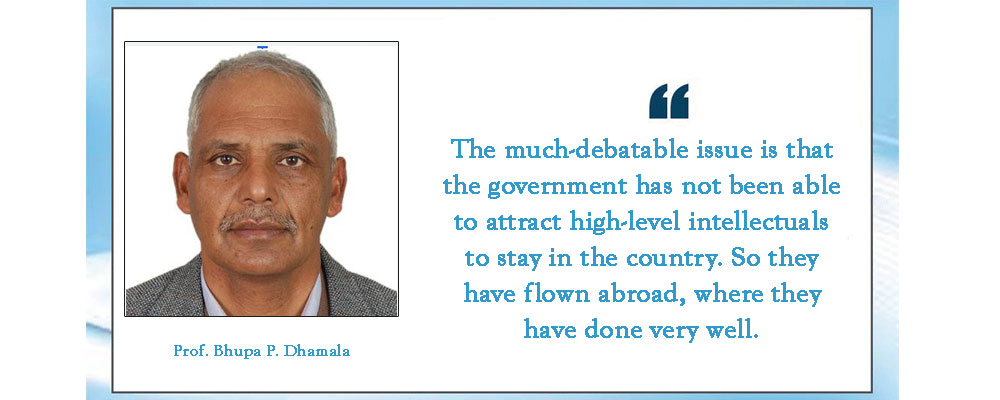
For the best intellectual production and its use for positive purposes, the government has to make a sustainable plan to create an academic environment in the country. I wonder if this is intellectual growth, as many people assume this is apparently an intellectual decay. This is not to say, however, that Nepali people are born unintelligent. Some Nepali intellectuals have shown their unparalleled capacity to produce and disseminate knowledge at home and across the world. They have contributed to society with the utmost use of their intellect. The much-debatable issue is that the government has not been able to attract high-level intellectuals to stay in the country. So they have flown abroad, where they have done very well.
(The author is the chairman of Molung Foundation. bhupadhamala@gmail.com)