- Tuesday, 2 June 2026

COVID Vaccine Aid

Nepal has once again witnessed the resurgence of COVID-19 infections. On Wednesday, the country recorded a total of 121 new cases of COVID-19, with one death. On Tuesday as well, one COVID-related death was reported after a gap of about three months. As of Wednesday evening, the number of fatalities concerning COVID has exceeded 12,000. With the reappearance of the pandemic, the country has seen a steady increase in the number of active cases. Taking the current scenario into serious consideration, the Ministry of Health and Population (MoHP) has lately appealed to one and all to take necessary precautions in order to stay safe from the deadly viral disease. Washing hands with soap and water frequently, wearing a face-mask and maintaining social distance are the key safety measures to keep the virus at bay. The MoHP has directed hospitals to remain on standby for the treatment of people infected with COVID-19 and seasonal influenza. Various health facilities like Bir Hospital, Sukraraj Tropical and Infectious Disease Hospital, TU Teaching Hospital, Patan Academy of Health Sciences, Civil Service Hospital, Armed Police Force Hospital and Nepal Police Hospital have been instructed to be prepared for dealing with the possible critical situation.
What is more worrying is that cases of mutated Omicron sub-variant XBB1.16.1 of the contagion found in different parts of India have been recorded recently even in Nepal. This sub-variant that is a mutation of Omicron's infectious XBB1.16 variant is reported to be more infectious than others. It may also evade the vaccine-induced immunity. Another concern is that India has continued to record more COVID infections over a couple of days. As Nepal and India share a long open border and many people crossing it freely, there are chances of the contagious viral disease to spread rapidly. However, the government has strengthened COVID screening along the Nepal-India border for the past few days. Virologists say that those having underlying health conditions and children are more vulnerable to this sub-variant. They, however, state that there is no need for people to get panicky.
As vaccination is a major tool for people to protect themselves from COVID-19, the government has urged them to take a booster dose without delay. It has made necessary arrangements for immunising people against this highly contagious and life-threatening virus. It is notable that Nepal was among the first countries in the world to have launched COVID-19 vaccination campaign in January 2021. As of March 28, 2023, about 83.1 per cent of the total population has been inoculated against COVID-19, with 9,418,479 having received booster shots. Anti-COVID vaccine is administered to people aged 12 years or above. Meanwhile, the nation has received more than 1.5 million doses of Pfizer-BioNTech's bivalent COVID-19 vaccines through the COVAX Facility. These vital shots have been donated by the governments of Austria, the Czech Republic, France, Greece and Italy.
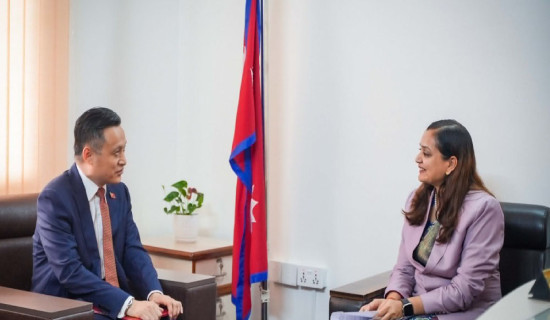
According to a news report published in this daily on Thursday, Nona Deprez, Ambassador and Head of the Delegation of European Union to Nepal, handed over the vaccines to Secretary, Ministry of Health and Population Dr. Roshan Pokharel at the latter’s office on Wednesday. The donation included 400,320 doses from Austria, 362,880 doses from the Czech Republic, 195,840 doses from France, 348,480 doses from Greece and 195,840 doses from Italy. Together with these vaccines, Nepal has received over 8.4 million COVID shots from the EU member states. France and Italy had earlier given 685,400 and 663,600 doses of COVID-19 vaccines to Nepal, respectively. On behalf of the Government of Nepal, Secretary Dr. Pokharel appreciated the timely and generous support from the EU member states. The support will be critical in strengthening the nation’s vaccination drive.