- Tuesday, 2 June 2026

Fruit import falls along with consumption
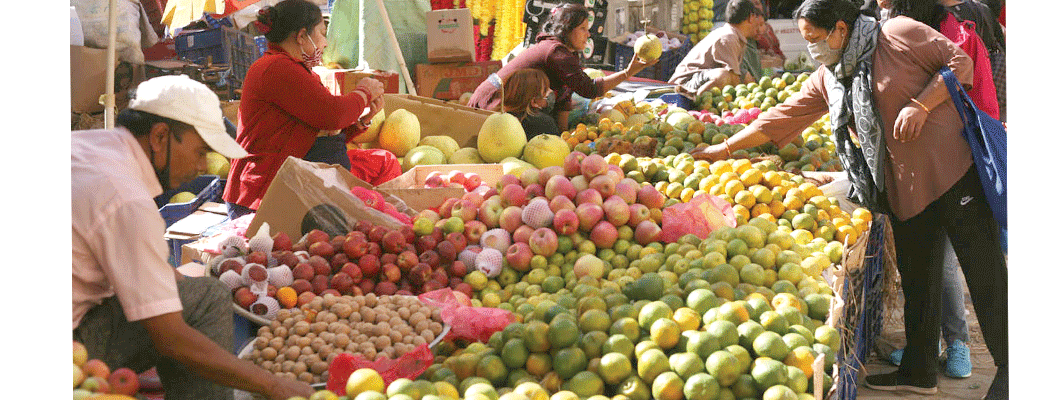

By Laxman Kafle,Kathmandu, Apr. 2: The import of fruits has decreased significantly this fiscal year. According to the latest trade statistics of the Department of Customs, fruits worth around Rs. 8.85 billion have been imported during the first eight months of the current fiscal year 2022/23.
The import of fruits during the first eight months of the current fiscal year is 22.50 per cent lower than its import in the same period last fiscal year.
Fruits worth Rs 11.42 billion were imported during the first eight months of the last fiscal year 2021/22.
Fruits worth Rs. 17.46 billion had been imported during the fiscal year 2021/22. Similarly, the country had spent Rs. 16.52 billion for the import of fruits in the fiscal year 2020/21 and Rs. 14.90 billion in the fiscal year 2019/20.
Downturn in business
Amar Baniya, president of Nepal Fruit Wholesalers Association, said that the import of fruits had fallen this year due to the increase in local production and decrease in consumption.
“The production of oranges, apples and bananas has been increasing in the last few years. In the meantime, consumption of fruits has decreased lately due to the decrease in people’s income. As a result, there has been a significant reduction in imports,” he told The Rising Nepal.
According to Baniya, the consumption of fruits, which had been increasing for the past few years, has started to decrease after the COVID-19.
“In more than 20 years of business experience, I have never seen a downturn in business like this year. Consumption has decreased due to the fall in people’s income,” he said.
He said that the business of all sectors was affected, not only fruits.
Of the total fruit import, the import of apples is significantly higher, he said.
Nepalis have spent more than Rs. 4.45 billion for apple import alone in the first eight months of the current fiscal year.
About 57.1 million kg of apples worth Rs. 4.45 billion have been imported during the review period. From that, the government has also collected revenue equal to Rs. 494 million.
Apples worth Rs. 2.52 billion have been imported from India while worth Rs. 1.92 billion have been imported from China during the review period of the current fiscal year.
Around 63.6 million kgs of apples worth only Rs. 5.07 billion had been imported during the first eight months of the last fiscal year.
Apples grow in various places in the northern Himalayan region of Nepal. The climate is also suitable for growing juicy apples, he said. However, local apple production meets only 5 per cent of the annual consumption, Baniya said.
Similarly, pomegranate worth Rs. 636 million, lemon worth Rs. 406 million and orange Rs. 729 million have been imported.
The country imported bananas worth Rs. 475 million during the first eight months.
According to the Department, around 24.1 million kg of bananas have been imported from India alone during the review period.
The country imported 38.3 million kgs of banana worth Rs. 1.16 billion imported during the first eight months of the last fiscal year.
According to the statistics, pineapples worth Rs. 92 million, avocados worth Rs. 29 million and watermelons worth Rs. 202 million have been imported. During the review period, the country imported kiwi fruits worth Rs. 60 million and guavas and mangoes worth Rs. 252 million.
Even with high potential for high quality production of fruits, the country is still unable to increase production which has led to spending more for import annually, he said.
Quality of Nepali fruits best
According to Baniya, all kinds of fruits produced in Nepal are best in terms of quality among the fruits imported from other countries.
“If the state encourages farmers to increase fruit production, a huge amount which is spent on fruit import can be saved inside the country. Not only this, Nepal can earn money by exporting,” he said.
Despite the huge potential for fruit production in the country, local production of apples can meet only 5 per cent of the total annual demand while oranges and bananas can meet 30-35 per cent, he said.
“All kinds of fruits produced in the country are available only in season (two-three months). During the season, the supply of fruits increases and farmers cannot get reasonable price. If the government supports constructing farmer-friendly cold storages, fruits can be stored during the season and sold when supply falls, he said.
Farmers tend to sell their produce without grading and packaging, which forces them to sell at a low price, he said.
He also stressed on the need to supply fruits with grading and good packaging as consumers of urban areas want to buy quality goods even paying higher price.