- Tuesday, 26 May 2026

Celebration Of Rusticity
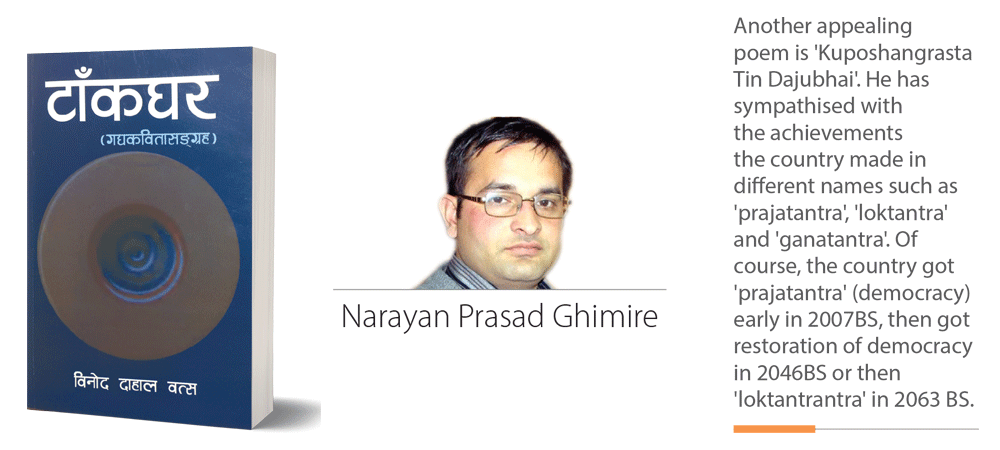

The book under review is an anthology of poems, 'Taankghar' (Buttonhole). It is a collection of 40 poems penned by Binod Dahal 'Batsa'. Most of the poems are devoted to rural life and common people. The concerns of the commoner are meticulously presented in it. All poems are written in free verse. The poems as 'Mato', 'Bhitto', 'Bato', 'Pokhari', 'Khet', 'Gabharaharu', 'Antha, Fagata and Pataharuko Kisan', 'Madal', 'Aama', 'Ful' are devoted to the themes of soil, rusticity, water, farmers, agriculture and cultivation, creation, love, childhood and villages.
The book begins with the poem 'Aama' (creation, origin, love) and ends with 'Gavaraharu' (borer, infection, destruction, erosion and decay). Beginning from creation and ending with erosion reflects the life cycle of a living being. In the middle, he places other poems that describe struggle and difficulties. In this sense, a natural proceeding of life is depicted in the anthology. Moreover, other themes in the poem are politics, change, struggle, development, peace etc.
The title poem, 'Taankghar' connotes sex. The sexual partners are in romance. Interestingly, even the stages of sexual life and course- from youth to adulthood and towards late adulthood -are mentioned in this poem with both implicit and explicit words. It is indeed a defining part of one's life.
What's the soil for? It is evidently for the existence of life. The soil is important for human and plant life. Soil is the ultimate thing to remember when you make a strong decision. Human and plant life have such attachment to the soil that they can neither be created nor grown and flourished without it. 'Mato' (Soil) is such a celebratory poem. It is also linked to patriotism. In Nepali culture, we touch the soil and make the promise of doing a new thing. The poet worries about the degradation of soil. His worry is genuine that if the soil is eroded, Nepal cannot run on its own - agricultural production is reduced and food security is threatened.
The poem, 'Barud, Buddha Ra Ma', concludes in a biting tone and message. Hope and despair, happiness and disappointment, war and warriors, peace etc are connoted with the words 'sun', 'light', 'cloud', 'blood', 'Buddha' etc. The title of the poem is a true reflection on how
contradiction controls one's life, society and country.
The words 'Barud' and 'Buddha' are used in the title of the poem while calling for security for Buddha. One can interpret this poem from various angles. If one has explosives, why does he/she talk of peace or Buddha? The last lines in the poem go like this: 'Buddha needs peace/Rule of law is needed here/Buddha himself says it/So, not for me, but for Buddha/For Buddha and his attire/Peace needed, security needed.' Similarly, the callous treatment of common people by cruel rulers can also be guessed from it. As the country home to the birthplace of Lord Buddha, this poem also reflects the insurgency the country suffered. Finally, peace is inevitable. However, peace or Buddha is not safe, peace may face assault time and again.
The poet calls for continuous protection and promotion of Buddha or the prevalence of peace. Buddha is for peace, harmony and nonviolence.
Another appealing poem is 'Kuposhangrasta Tin Dajubhai'. He has sympathised with the achievements the country made in different names such as 'prajatantra', 'loktantra' and 'ganatantra'. Of course, the country got 'prajatantra' (democracy) early in 2007BS, then got restoration of democracy in 2046BS or then 'loktantrantra' in 2063BS. But these systems are yet to thrive and flourish, which people can reap benefits from. When the 'prajatantra' is renamed as 'loktantra': Is it a reformed democracy? If so, how is it delivered to the people? Are people's expectations and aspirations fulfilled as per the promises made? These are serious questions dogging the writer and, of course, all Nepalis.
Through the poem, the poet has called on the political parties and national actors to correct mistakes and pay heed to people's voices and demands. He laments that we failed to nurture the democracy that we obtained in 2007BS. It did not get the proper care. Still, we are wrangling after power and ignoring the growth and nature of the republic gained with much struggle.
It is a close observation of the national system. Therefore, he calls 'democracy', 'loktantra' and 'republic' three brothers but they are suffering from malnutrition. It is the writers' clarion call to all concerned ones to nurture these significant achievements.
The poem, 'Khet', (Rice field) takes the reader to a rural setting where the farmers are busy in cultivation. They are preparing the field for planting rice. He remembers the hali, bause and ropahar. This poem undoubtedly makes one nostalgic on monsoon days. Similarly, the poem, 'Aama', is appealing.
The love, affection, and fuss of a mother for her child can be found in this poem. It shows mother-child relations, generosity, childhood
and homesickness. The use of common words is defining feature of
this poem.
The most striking aspect of Dahal's poems is a celebration of a common thing, common places and common people. We can dub his poems rural poetry.
Despite spending much time in the city, he is much in love with his village where he was born, grown and taught. The writer has suffered from nostalgia as well.
Similarly, there are no complicated words and lines found while reading. Simplicity attracts the readers to read the anthology.