- Thursday, 28 May 2026

System Violation Costs Dearly

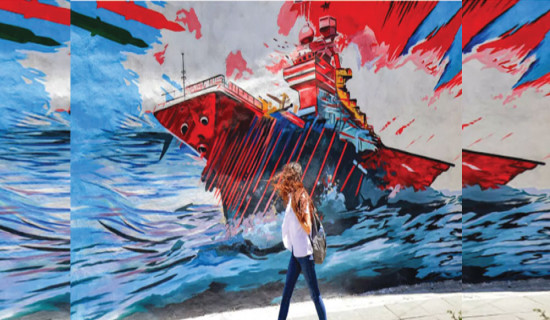
I begin with an ancient Greek myth that may look weird to adult readers of modern times, but I think it is universally appealing in some respect. This myth tells a tale of an enthusiastic but stupid hero named Icarus who flies too high near the sun and eventually falls into the fathom of the deep sea, sadly leaving behind him only splashes on the water’s surface. Much of our contemporary daily life is similar to the incident detailed in the ancient myth. This teaches humanity a lasting lesson that excessive ambition leads to a tragic fall.
Extremely infuriated by the betrayal, King Minos imprisoned Daedalus and his son Icarus in the infamous labyrinth, which Daedalus had supposedly made to imprison King Minos’s enemies so they would be eaten up by a monster notoriously known as Minotaur. But Daedalus was a high-level architect who could even think of making complicated plans. Since the father and the son could not escape through the land or the sea, the only way to escape from the labyrinth was through the air. So, Daedalus made wings of an osier tree, sticking each of them together with wax.
Then he taught his young son how to fly cautiously. But as soon as they flew, the young Icarus was too enthusiastic about flying up to salute the sun and dive down. As he went on this way, the waxed wings began to melt, disjointing the osier wigs, which would no longer hold him. Suddenly Icarus fell into the sea, never being able to come up again. The apparent consequence of the ever-soaring flight with wax wings was the tragic fall of Icarus, an individual, a man of blood and flesh, who once existed on earth but unfortunately ceased to live.
Implications to life
Simple though it looks, the Icarian myth has profound implications to human life. The fall was not simply of a single ambitious individual who violated the system of the universe but an epitome of the inherent nature of many humans, perhaps all. The system of the universe, be it likable or unlikable to humans, dictates that if one violates the system governed by inscrutable force, the possible consequence is the inevitable fall of the violator.
The system of the universe, which can also be defined as a scheme of things, consists of the rules of how everything runs – from the rule of the innocent-looking birth and death of a living organism all the way up to the rule of the whole cosmos. Nobody knows for sure why things happen as they do. But one thing is sure, that is, we ordinary beings can have no control over the process of existence. There are also human-made systems developed for smoothly operating social activities and are human-controlled to some extent, and if humans violate the system they themselves have so hard developed, the consequences are unexpected.
The human-made system is applicable in the field of politics, business, and everyday situations. Thousands of people inherit the tendency of system violation on this planet and face the consequences.
Of all the political systems that have existed in the world so far, democracy is the best system despite some weaknesses. This is the least debated, widely practiced, and most popular system in nooks and corners of the world. This is the most agreed-upon system since it is centered around the people and operates within the limitations of rules – the rule of law, as it is popularly called. If a ruler violates the democratic system established with some universal norms and values, they are very likely to fall into the abyss.
This has already happened in the political history of the world. To take a spectacular example from the politics of modern times, Hitler, who began with the simple desire to get to the state office and work as he wished, eventually flew too high as Icarus did with wax wings. For some time, he worked well in the interest of others also, but after a while, his ambition rose to the illimitable height of knowing no bounds. He liked to exterminate all Jews from the earth, killing thousands and millions who were not in his political line. No sooner had his aggression exceeded the limit than public resentment surfaced. Angry reactions came from home and abroad, resulting in rebellion. His insatiable hunger for power, triggered by his ulterior motive, wickedness, and notoriety, which were so conspicuous as could be seen with the naked eye, became the fundamental cause of his imminent fall.
Violation of norms
In the field of business, too, thousands and millions of people venture to do the undoable. While some businessmen are involved in earning much more than what they had invested, others choose to violate the norms of business, and still, others violate the rules and regulations of the state. I still remember Tolstoy’s story “How much land does a man need?” that I read when I was an undergraduate student some four decades ago. Although the story seems too ideal, it nevertheless represents the tragic fall of many humans due to their extreme greed and avarice for hoarding much more than they need for survival. There is an extremely greedy character Pahom who runs so far as his strength does not allow him to acquire more land, which leads to his ultimate tragic death, vomiting blood.
The incidents of wax-winged flights like those of Icarus and Pahom can also be found in everyday life situations, such as trying to foolishly cross the flooded river, jumping into the burning fire to show hollow bravery, vainly spending sleepless nights in the study for the highest grade, and trying to catch a flying bird by simply jumping on the ground and, a host of other incidents. It is vain to fight against the laws of nature and society, as Icarus did to fight against the rule of gravity.
(The author is the chairman of Molung Foundation. bhupadhamala@gmail.com)