- Thursday, 28 May 2026

Address People’s Primary Concerns

A new seven-party alliance has formed a new federal government in Nepal. The CPN-UML and the CPN (Maoist Centre) are the main coalition partners, with 78 and 32 members in the House of Representatives (HoR), respectively. Five years back, these two parties had been unified into the Nepal Communist Party (NCP).
However, an internal bickering led to the split of the party. The then NCP chairman KP Sharma Oli had headed the government until July 2021 when the Supreme Court (SC) restored the dissolved HoR for the second time within six months. These two parties have now joined hands to form the new government. Rastriya Swatantra Party (RSP), Rastriya Prajatantra Party (RPP), Janata Samajwadi Party-Nepal (JSP-N), Janamat Party and Nagarik Unmukti Party are other parties in the ruling alliance.
Poll alliance
The Nepali Congress (NC), CPN-Maoist Centre, CPN (Unified Socialist), among others, had forged an electoral alliance. The NC was able to win the largest number of seats in the November 20 elections. But the party has lost the opportunity to form the government as one of its main allies—CPN (Maoist Centre)— left the five-party alliance to join the new one. With this, the country’s politics has taken a new turn.
The nation’s politics has been highly influenced by greed for power, geopolitics, and money. Ideological values were at one point the main ideals for Nepali politicians and parties. Such principles now seem to be taking the back seat. Greed and petty personal interests along with egos appear to take the topmost concerns when the politicians move to form a government.
Now, there is a shock and disbelief among the NC supporters that its president Sher Bahadur Deuba was unable to use this golden chance to form the government due to lack of his own foresight and the incorrect advice from his close allies and advisors.
No doubt, the new government should address the pertinent issues facing the nation and grievances of the people. It must be acknowledged that this government definitely is a mixture of old and new faces. Prime Minister Prachanda is now leading an eight-member cabinet with three Deputy Prime Ministers and four ministers. Television anchor Rabi Lamichhane is among the DPMs. At least a capable woman leader should have been appointed as a DPM which is lacking.
It is yet to be seen how stable and successful this government will be. But the shock wave this new development created is not just within Nepal. It has created ripples across the border as well.
In an article titled ‘Nepal: How did India lose the Plot?’ published in Rediff.com, Indian Ambassador MK Bhadrakumar writes: “By treating Nepali politicians as shabby buffoons to be pampered one day and collard another day, India badly exposed itself. A belief got entrenched in the Nepali mind that we are a dangerous neighbour”.
Bhadrakumar says that there is a lack of far-sightedness in Indian foreign policy. The time has come for all friendly countries to start working for the development of the country rather than keeping their geopolitical needs at the forefront.
The left and nationalistic forces have been steadily on the rise in Nepal. There is still an exercise going on to make the federal republic values embedded deep within the systems here to benefit the people. This government is interesting in yet one more aspect. It has the combination of some parties that have said they do not believe in the federal system and those who have staged revolutions to make Nepal a federal republic. Therefore, it can be analysed that the current political alliance is definitely not an outcome of ideological values having a far-sighted need for stability and sustainable development strategies. It is more a combination driven by immediate power play desired by Pushpa Kamal Dahal 'Prachanda' and cemented by Oli’s unification strategy of the nationalists and leftists.
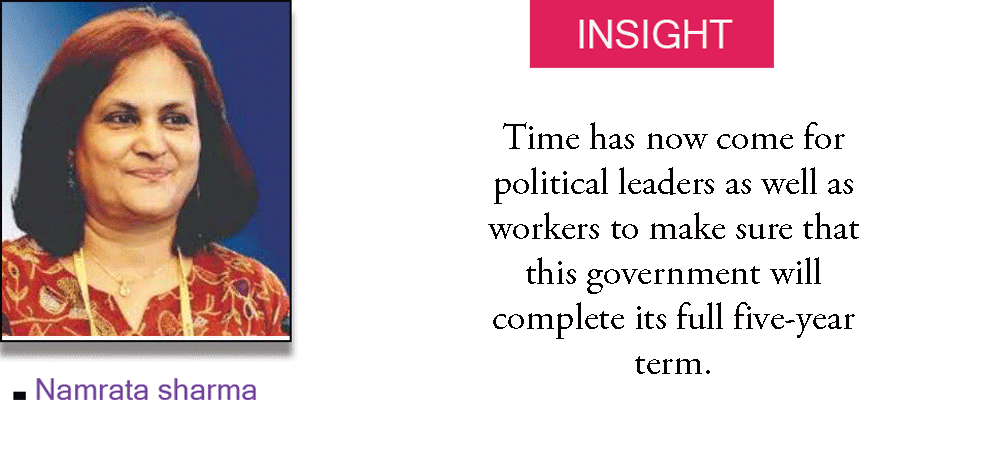
Nepal is in need of far-sighted and visionary leaders who could alone take the nation out of the trap of poverty and underdevelopment. Time has now come for political leaders as well as workers to make sure that this government will complete its full five-year term. The government and the political parties have a combination of both old and new faces. So, experiences and skills are there. But now the direction of how to lead with unconditional devotion to the country and its citizens should be there.
Foreign policy
The leadership should be able to have practical foreign policy and strategies to enhance relations with neighbouring countries and other friendly nations, but to only benefit Nepal by adopting a ‘for the people and by the people’ strategy. As long as Nepal adopts a peaceful strategy and does not allow our land to be misused for any external interests, the neighbours and other friendly countries will always support us.
(Namrata Sharma is a journalist and women rights advocate. namrata1964@yahoo.com Twitter handle: NamrataSharmaP)