- Thursday, 28 May 2026

Challenges Of Reporting During Pandemic

For the past three years, the COVID-19 pandemic has impacted the entire world and has become an unprecedented news story. Every person, rich or poor, young or old, on earth was impacted in one way or another, be it by the virus, the travel bans, isolations, or lockdowns imposed by most governments. In such complex times for humanity, when people were unsure what the next week or months would be like as the COVID virus spread rapidly like fire, it was the sole duty of journalists and reporters to make people more aware of the then-newly emerging deadly virus. In Nepal, since the first COVID case was officially reported in late January 2020, the role of journalists has become even more critical.
Infodemic
The relentless news cycle and an infodemic of misinformation followed in the initial days and months, creating suspicion, fear, and uncertainty among people. When the restriction was imposed by the government to contain the spread of viruses, people had to stay home or isolate. While all other employees worked from home during the pandemic, we as journalists had no choice but to manage and get news from the field carefully. A bottle of hand sanitizer and masks were always with us. Luckily, we had the provision of alternate days of physical presence at the office while working relentlessly every day.
On one of those days, I visited Sukraraj Tropical and Infectious Disease Hospital in Teku, the only hospital providing treatment for the COVID-19 patients during the initial days. I was afraid of myself if I had coughing symptoms for a few days.I even had a nightmare due to the fear that it was the Corona virus. But fortunately, it turned out that they were just general symptoms.
As a reliable source of information, I used to check updates from the Ministry of Health and Population (MoHP), which used to provide media briefings. Although we were allowed to move with press passes during the government lockdown period, most of us had to work from home because we have children, elderly relatives, and immunocompromised loved ones at home and do not want to risk spreading the infection. The risk of infection during reporting work, as well as maintaining high journalistic standards, added to the mental stress. Being reporters for mainstream media, we had greater responsibilities to raise public awareness about the new virus, its symptoms, and precautions. While the risks of the virus were not to be underestimated, we had adopted an alternative path to make the situation more bearable. by giving hope and making people realise that there is a solution to the virus.
While writing news, we suffered confusion and panic as there were not any experts at first who could speak and provide reliable information. As the virus was new, so many fake experts were born, and we were confused about whom to believe. We were working day in and day out to communicate information and the views of health professionals, experts, government officials, and representatives of World Health Organizations.
COVID Emergencies
Nepal recorded her first COVID-19 case in January 2020. The government then imposed a four-month nationwide lockdown in March 2020. The country maintained a stagnant rate of virus spread due to the strict prohibitory orders during the first wave. When things were getting back to normal, the second wave of the pandemic again engulfed the country between April and July of 2021, which was substantially more devastating than that of the first wave.
The government had imposed a prohibitory order in selected cities. The cases peaked in mid-May, when the weekly average was as high as 9,000 cases. The number and severity of cases in the second wave were more intense. The health care facilities were overburdened, and the number of deaths owing to COVID-19 was the highest of all time. The number of deaths peaked in May with a single-day death total of 246.
With the lessons learned from the experiences with lockdowns in 2020, the government has been able to tackle the second wave. The government has asked all three tiers of government to undertake COVID-19 treatment, and it has also announced reimbursement of costs based on the severity of cases. However, Nepal's healthcare system remained frail in the face of the hospitalisation surge. Most of the government hospitals found shortages of beds and ICU units during the peak of the second wave.
With the increase in COVID-19 patients, hospitals faced a short supply of medical oxygen. Existing healthcare resources, including human and physical resources, were inadequate. It was the time when the Sukraraj Tropical and Infectious Hospital provided treatment facilities from the hospital corridor and open spaces. Despite limited human resources and space, the hospital did not release anyone without first consulting with them.
The first wave of the pandemic was caused by the virus variant first detected in Wuhan, China. The second wave was triggered by the Delta variant affecting public health. The Omicron variant, which infected the majority of people in the country, was responsible for the third wave.
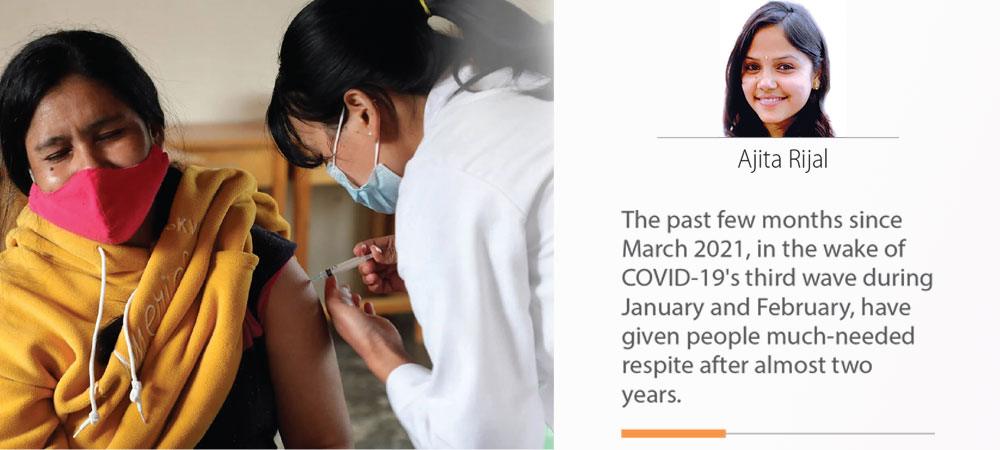
The past few months since March 2021, in the wake of COVID-19's third wave during January and February, have given people much-needed respite after almost two years.
Just as people’s lives got back to normal, thinking the pandemic was over, the rising cases of COVID-19 again alarmed the public during the month of July 2021. COVID-19 continued to evolve with reports of sub-variants of Omicron’s BA.5 variant. Because of COVID-19 vaccination, the third variant has had little impact on people's lives and is slightly less contagious than the second, with a low fatality rate.
Tackling Rumours
While the nation was reeling under the unprecedented surge of the Corona virus, we were facing misinformation, disinformation, and fake news related to the virus. As journalists, we were learning new skills and methods to deliver factual and reliable information to the public as research on COVID-19 was underway. Some of the prominent rumours include: the Nepalese are less likely to contract COVID-19 as a large number of the population is vaccinated against BCG; taking turmeric water or drinking warm water would kill the virus; taking Gurjo can cure COVID-19.
There was a lot of misinformation and rumour, particularly through social media platforms. It was very important for us to rely on the correct source. complaints. The Epideomology and Disease Control Division (EDCD) of the Ministry of Health and Population established a call centre (1115) in March 2020 to address the public's questions, concerns, and complaints. This had also aided in the identification of rumours and misinformation.
Fake experts were presented through YouTube, Facebook, and other social media. It was a huge responsibility for journalists like us to stay away from misinformation. With the surge in cases, despite capacity limitations, the government was more effective in communicating during the second wave.
The government also disseminated information by creating portals for hospital bed availability and call centres where infected people could get counselling and other essential information. Our main focus was to inform people about the adoption of precautionary measures including hand washing with soap and water, using hand sanitizer, wearing face masks, and maintaining social distance to keep viruses at bay. It was also very challenging for us to report news as it was impacting the mental health of people.
Individual preventive measures were critical in controlling the spread of COVID-19, but vaccination was a critical protective strategy. The government started the vaccination campaign against COVID-19 in January 2021, vaccinating the frontlines with the AstraZeneca vaccine provided by the government of India under the Vaccine Maitri Programme. However, many people, including journalists, health workers, and other frontliners, were sceptical of the COVID-19 vaccine. It was our responsibility to persuade people of the vaccine's efficacy and how it works to develop immunity against COVID-19. At first, many people were reluctant to receive the COVID shot. Vaccine efficacy, on the other hand, was discovered following the second wave of infection. -19.
(A TRN journalist, Rijal writes on health issues)