- Tuesday, 26 May 2026

Reflections And Memories Of A Civil Servant
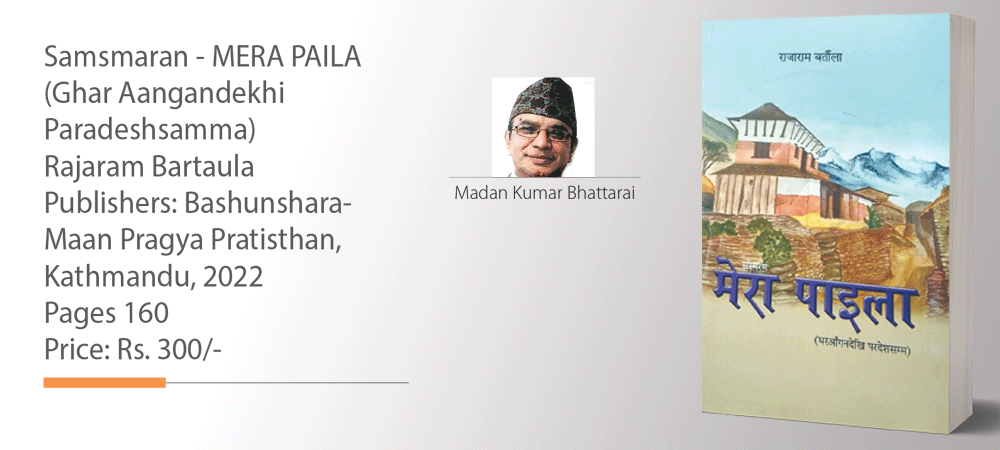
Rajaram Bartaula retired as a senior diplomat after putting in a long service in the Government of Nepal. He has published his memoir entitled, "Samsmaran - Mera Paila (Ghar Aangandekhi Paradeshsamma)."
This can roughly be translated as Memoirs – My Steps (From Native Courtyard to Alien Lands) but the author himself has preferred to translate words in parenthesis simply as From Home to Abroad.
Bartaula remained an intimate colleague for many years at headquarters and even missions as he once visited Tokyo during my ambassadorship from Seoul where he was posted. I am happy to make a personal assessment of the book as we share the same school, Bhutan Devi High School, Hetaunda and comparatively shorter stints in Dhaka. The inimitable Badri Prasad Khatiwada, who had two tenures as Headmaster and many other teachers who guided and shaped our destiny at Hetauda, has remained a matter of common pride for us.
Though a comparatively small volume with the front cover depicting his native home in Chuniya, Nawalpur, painted by his enterprising son, Sanjay Bartaula, the work is conveniently divided into 32 write-ups with each section provoking readers to know more about the whole content.
Despite possible pitfalls involved in the first attempt at writing a book (he has, in the meantime, published another work too) that Bartaula has humbly confessed in his introduction, this is an admirable task.
The book is sure to not only present an account of the practical experiences of a civil servant who has an interesting record of balancing both domestic and foreign services in his long career but also encourage many of his peers to write stories that can benefit a whole range of readers.
At least 17 essays are either on foreign affairs or pertain to diplomacy that the author saw, learnt, experienced and confronted during his stay in the service. 12 of them are essentially related to internal aspects with three more as a mixture of both.
The unique part of the book is a foreword written by a critic, Badri Prasad Dhakal. Interestingly, Dhakal has only made a passing reference to the contents of the work, calling it not a solid product of any discipline but rather a conglomerate of four areas, essays, memoirs, travelogue and autobiography. Instead, Dhakal has digressed to give a succinct history of the evolution and growth of travelogues in Nepal during a period of more than five hundred years, quite useful for those interested to study this aspect.
Bartaula started his government service with a short stay at the Auditor-General's office and then a longer stint under the Comptroller-General that led him to serve the country starting from the remote district of Kalikot at the local treasury office.
He was also posted in the Foreign Ministry as such for two years, passed the foreign service test and came to the diplomatic stream after 16 years of his essentially domestic service with accumulated experience as an efficient accounting man. As a diplomat, he not only accompanied high-level visitors from Nepal on their tours of many countries but he was also posted in four diplomatic missions.
Among those who were ambassadors when Bartaula was posted, including a good mix of career appointees and political inductees. Professional diplomats as his bosses included Shyamanand Das Suman and Madhu Raman Acharya in Qatar and Bangladesh respectively, with Acharya even becoming Foreign Secretary and later Ambassador to the United Nations. While his association with Acharya was barely two months long, that with Suman was the longest, more than three and half years.
Even in the context of the three political appointees that Bartaula worked under, the share, as we fondly and even derisively call Bhaagbanda (divisions on political grounds), was two from the Communist Party of Nepal (Unified Marxist-Leninist) and one from the Maoist Centre as represented by Tanka Karki (Beijing) and Kamal Prasad Koirala, and Kaman Singh Lama (both Seoul) respectively. Lama is sadly no more. His experience with ambassadors was a combination of pleasant feelings and otherwise as normally happens when you serve together.
Among the highlights of the book, six things may particularly be noted. First and foremost, the author dwells on negative and even painful aspects of diplomatic service taken at its face value by outsiders as glamorous.
He paints a grim picture of the dislocation of family bonds and problems of education for children with the conclusion that the realm of foreign service encompasses several ordeals tantamount to making it simply an admixture of truth and illusion.
Second, he has given pertinent reference to roles of protocol, etiquette, sartorial aspects and even behaviour on the part of diplomats as compulsorily required diplomatic niceties.
Third, he has given a virtual rejoinder to Saurav's book that speaks of the inability on the part of the Nepali Ambassador in Seoul to sufficiently react against Indian Ambassador Vishnu Prakash's erroneously misleading statement that Mount Sagarmatha was stationed between India and China.
Fourth, Bartaula makes a highly touching prognosis of severe problems faced by Nepali workers abroad, blaming Nepali touts and agents as a major factor behind their grief.
Fifth, the writer makes a passing reference to Prime Minister Girija Prasad Koirala's attendance at the Twelfth Summit of the Non-Aligned Movement held in Durban, South Africa, when passports of the entire delegation were lost, a matter that has occupied copious references in other publications mostly on a negative note.
Last but not least, Bartaula strongly defends existing provisions that prevent politically appointed ambassadors from evaluating the performance of civil servants. He also refers to Professor Bishwambher Pyakuryal's grievance in this regard as he probably made it one of the reasons for his resignation from ambassadorship.
While the book is nicely written in plain language, presentations are not in sequential order but rather written randomly. The other aspect is obvious reticence as far as possible on the part of the writer to assess his bosses. Despite such minor weaknesses, I extend congratulations to Bartaula for writing such a succinctly wholesome volume.
(Dr. Bhattarai is a former Foreign Secretary, ambassadorand author)