- Saturday, 11 April 2026

Droupadi Murmu Keeps Hope Alive
 Namrata Sharma
Namrata Sharma
Namrata Sharma
With the election of Droupadi Murmu as the 15th and current President of India, it is a global achievement for the indigenous communities, especially women. It is a message that with hard work and diplomacy, one can reach the topmost political position in one of the most populated countries on earth.
The National Democratic Alliance (NDA) strategically fielded Murmu for the 2022 presidential election and they were successful. She is now serving as the President, since 25th July 2022, of one of the largest democratic countries. Murmu is a member of the Bharatiya Janata Party (BJP), which is the leading party in the NDA government in India. Prime Minister Narendra Modi put up Droupadi Murmu to contest against the opposition party’s candidate Yashwant Sinha.
The movement of asserting the rights of the marginalised communities in India has a long history. Election of Droupadi Murmu has created one more history in India as she is the first person belonging to the indigenous community or the scheduled tribe. The Scheduled Castes (SCs) and Scheduled Tribes (STs) are officially designated groups of people in India who belong to the most disadvantaged socio-economic groups.
Both these terms are recognised in the constitution of India. During the British Rule in India they were known as the depressed classes. The SCs and the STs comprise about 16.6 per cent and 8.6 per cent respectively of India’s population according to their census 2011. Murmu was proposed as the Presidential candidate of the NDA, especially to capture the votes of the SCs and STs. There have been several criticisms of Modi’s government with regard to numerous atrocities against the minority communities of India.
Political experiences
However, Murmu is not a token representation she has a history of political experiences. Born in June 20, 1985 in a Santali family in Odisha State of India, she has been a teacher and a politician throughout her life. She is a member of the BJP and had served in several political positions in her state before becoming the first indigenous female President of her country. In 2000, she became a member of the Vidhan Sabha of Odisha. In 2002, she became the Minister of State there, and then in 2015 she became the Governor of Jharkhand. Before entering Indian politics in 1997, she was a clerk in the State Irrigation and Power Department and a teacher too.
After the establishment of Independence in India, education and development works were focused on the marginalised communities, including the tribal communities. There were several reservations and strategies targeted at bringing them to the economic mainstream. There is criticism and dissatisfaction related to the speed of the actual achievement, but due to the spread of education, transportation and access to various governmental entitlements, there have been fundamental differences in the lives of the tribal communities in India, writes Sheela Bhatt in The Print. However, she stresses on the fact that most of the substantial promise made to the tribal still remain unfulfilled so a stronger push is required for them to access all the constitutional provisions they are entitled to.
There are many in India hoping for this push to happen with the advent of Droupadi Murmu as the President of India. The tribal communities in rural India still struggle for their daily existence. The presidential position in India is the nominal head of the executive. Like in Nepal, India’s President is the first citizen and is also the commander-in-chief of the Indian Armed Forces. The office of the president was created when India became a republic on 26th January 1950 after gaining independence from the British rule.
The tribal population in one of the most populous countries does comprise a significant electoral constituency. After the election of Droupadi Murmu and her taking the oath of the first citizen of the country, the morale and hopes of the Tribal and other marginalised communities may have increased. The communities who struggle every day to fill their bellies and manage their livelihoods now pin their hope on President Murmu to facilitate in access their rights. The speculation that Murmu might just become a ceremonial position without being fully able to bring the issues that the Scheduled Tribes in India face currently is rampant among the development communities of India.
Positive step
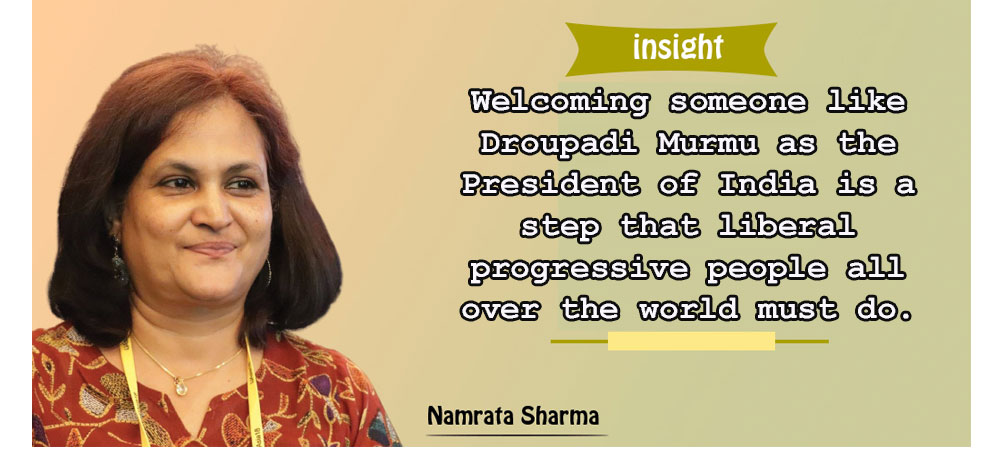
Welcoming someone like Droupadi Murmu as the President of India is a step that liberal progressive people all over the world must do. The rights’ movement and the main objective of democratic values and principles are always focused on giving voice to the voiceless. Having an individual who comes from one of the communities that has lacked representation of its voice in all aspects of the nation is indeed a positive step towards realising the democratic dream.
Prime Minister Modi and his Bharatiya Janata Party (BJP) have often been criticised of taking populistic approaches in their stance of Safronising India. Many in India are observing the advent of Murmu as the president as one more Modi’s strategies to retain its populistic stance rather than bring the issues of the Tribal communities to the forefront. Now the ball is in the court of President Droupadi Murmu to make her oath of office beneficial to the most deprived communities for whom she has become a flicker of hope - now more than ever.
(Namrata Sharma is a journalist and women rights advocate. namrata1964@yahoo.com Twitter handle: @NamrataSharmaP )