- Saturday, 11 April 2026

The children-bestowing god at Maruhiti
 Aashish Mishra
Aashish Mishra
Aashish Mishra
Kathmandu, July 26 : Nepali Hindus, especially those living in the Kathmandu Valley, usually associate the Santaneshwor Mahadev with two things. The first is the form of Lord Shiva that blesses childless couples with children and the second is the famous Santaneshwor Mahadev Temple in Lalitpur in the former Jharuwarasi Village Development Committee, now Godawari Municipality.
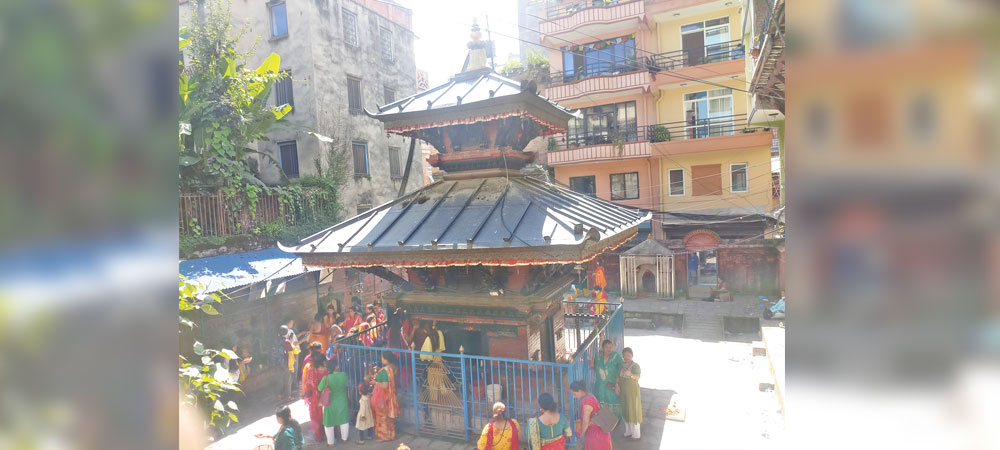
But the Santaneshwor Mahadev Temple near Maruhiti, Kathmandu, does not seem to get as much attention despite being an important shrine in Kathmandu’s core city visited by devotees every Monday of Shrawan.
“This is a very powerful Mahadev who listens to the prayers of his worshippers,” said Kalyani Thapa, who was at the temple on Monday. Her sister, Aagya Khadka, was also with her and she told The Rising Nepal that she had been blessed with a child after praying to Santaneshwor two years back. “My husband and I had been trying for five years to no avail. But a few weeks after I visited the temple, we were able to conceive.”
This is a story Mohan Maiya Jha has heard countless times from countless people over the years. People come from all over Nepal, she said, bringing gifts and offerings because they bore children after worshipping Maruhiti’s Santaneshwor.
From her maternal side, Mohan Maiya belongs to one of the four Jha Brahmin families from two ancestry lines that serve as the priests for the temple. And she shared that the two-storeyed pagoda temple was built some five hundred years ago by one Sardar (high-ranking nobility) Bishnu Dhwoj Joshi.
However, it must be clarified that Joshi only built the temple, not the Shiva Linga inside. Mohan Maiya’s brother Prachanda Jha, who lives behind the Joshi-constructed temple of Santaneshwor Mahadev and is registered as its caretaker and Pujari in government records, clarified that the Linga existed long before the temple did.
“But it was underground,” Prachanda clarified. “The place where the Santaneshwor Temple stands today was once a field. One day, when some people were digging in the area, their mattock hit a stone object. Upon excavation, they discovered the Shiva Linga and Joshi established it in the temple he constructed,” he elaborated.
There is a small crack at the top of the Santaneshwor Linga here which Prachanda claims is where the mattock’s stout head hit it nearly half a millennia ago.
Santaneshwor Mahadev held such significance in Kathmandu Valley that the royal palace used to send pujas and offerings on special occasions, Prachanda informed. The locals of the area also recall several instances of high-ranking members of the Shah and Rana families visiting the temple to pray for a son. However, numerous break-ins and thefts in the 1990s and 2000s disheartened the pilgrims and caused a decline in visitor numbers, they lamented.
According to residents, the original metallic cobra standing behind the Shiva Linga with its hood spread has been stolen and replaced with a replica. Thieves also peeled off and took the plate covering the base of the Linga many years back. Many smaller ornaments and objects in and around the temple have also been lost.
The temple may have also had 24 struts depicting the five Pandavs of the Mahabharat and Hanuman and Sita from the Ramayan, as mentioned in Austrian architect Carl Pruscha’s 1975 book ‘Kathmandu Valley: The preservation of physical environment and cultural heritage, protective inventory.’ If that is the case, Santaneshwor Mahadev was once one of the few temples of Kathmandu with the images of the five brothers, Yudhisthir, Bheem, Arjun, Nakul and Sahadev, carved on its wooden roof supports.
However, the community members do not remember such icons and there are no documents describing the features originally present in the temple. Pruscha does present a black and white photograph in the book but it is not clear enough to make out the carved structures. The temple was dismantled in 1997 for reconstruction during which, some structures were reported lost. However, they have since been restored or replaced, Prachanda claimed.
Presently, the struts contain images of Shiva below which are figures in suggestive poses. Nepali and foreign scholars have interpreted such erotic imagery in temples to be a way of educating the populace about sex and sexuality and an instrument to prevent lightning strikes as well as ward off evil spirits. Heritage interpretation practitioner Rishi Amatya though presents a more interesting hypothesis and one that is directly related to Santaneshwor i.e. the act of child-bearing.
“The story goes that once upon a time, a cholera outbreak decimated the population of Kathmandu,” Amatya, who holds a master’s degree in heritage management from the University of Birmingham, UK, explained. “This caused a shortage of people for work and risked pushing the society to collapse. So, such graphic representations were displayed in public places to get people to copulate and repopulate.”
Aside from the loss of artefacts, out-migration also looks set to affect the temple’s worship in the future. Mohan Maiya informed that the families in charge of performing the priestly duties had begun moving out of the area and choosing not to involve themselves in the deity’s daily rituals. “I am worried that the next generation may not care for the god as their elders have.”
In addition to the Santaneshwor Mahadev, the temple premises also holds an abode for Rameshwor Mahadev, colloquially called Gwara Mahadya, and idols of Saraswati, Bhagwati and Ganesh. All are worshipped with equal devotion by devotees who come to the temple in relatively large numbers on the occasions of Shivaratri, Teej, Rishi Panchami, Ekadashi, Purnima, the month of Swasthani and the Nepali month of Shrawan, especially when it has five Mondays like this year.

-square-thumb.jpg)