- Sunday, 10 May 2026

Budget draws mixed reactions

By A Staff Reporter Kathmandu, May 30: The budget for the next fiscal year 2022/23 unveiled on Sunday received mixed reactions from economists, politicians and businessmen.
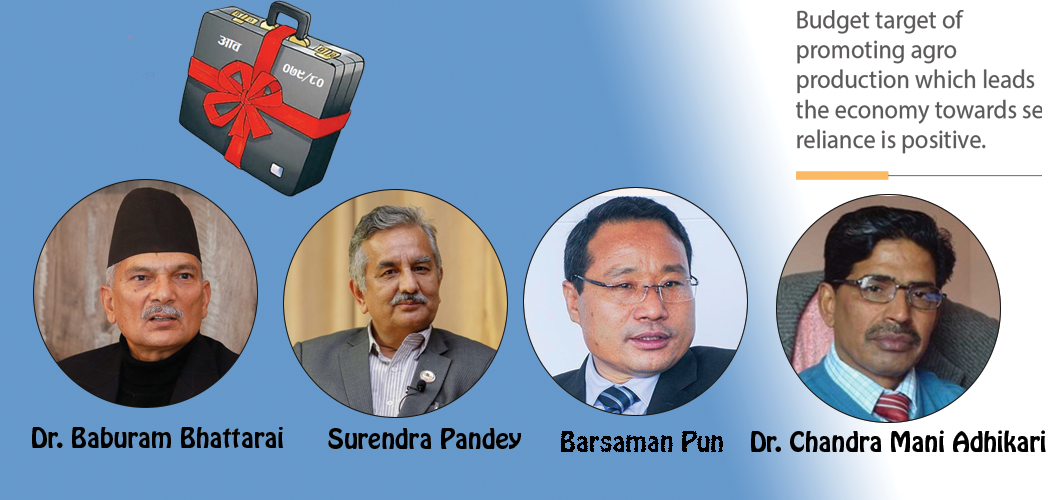
Former Finance Minister Barsaman Pun said that the budget estimate for the next year was positive as it targets production sector. “Budget target of promoting agro production which leads the economy towards self-reliance is positive,” he said.
CPN UML leader and former Finance Minister Surendra Pandey, however, said that the government brought a baseless and distributary budget targeting the election.
“Except for promoting the use of electric stoves in households there is nothing exciting in the budget,” he said, adding that policy and priority was somewhere and the budget directed elsewhere. He also said the budget neither can maintain fiscal discipline nor can it meet the targets.
Similarly, Dr. Baburam Bhattarai, former Prime Minister, said that the budget excluded plans for transformation, rather it preferred improvements with gradual progress. “Ambitious targets cannot be met, it could be a better spice for the election to lure voters,” he said.
Likewise, economist Dr. Chandra Mani Adhikari said that the priorities and thoughts carried by the budget are comparatively good, but it has not maintained concrete policy for addressing the present challenges of the economy such as liquidity crunch and foreign currency reserves.
The budget is large in size and it is difficult to manage resources for the budget such as revenue mobilisation and foreign grants and loans, he said.
“Proper implementation of the budget within the existing implementation mechanism and institutional setup is almost impossible,” he said.
The revenue target of the government for the next fiscal year is difficult to meet while it is also not easy to achieve the target of 8 per cent economic growth and control inflation at 7 per cent, he added.
Senior vice-president of Nepal Chamber of Commerce Kamlesh Agrawal said that the programmes included in the budget are positive and industry-friendly.
“Most of the priorities of the budget are good but implementation of the budget looks challenging. It will be challenging to collect revenue of Rs. 1,240 billion while the government has tightened the import,” he said.
The target of fulfilling the deficit of the budget from domestic borrowing is also challenging, he said.
He said that the budget has failed to focus on export promotion.
Senior vice president of the Federation of Nepalese Chamber of Commerce and Industry (FNCCI) Chandra Prasad Dhakal said that the government has introduced the budget by incorporating suggestions made by the FNCCI which has encouraged the private sector in the field of investment.
The budget has given priority to give discounts on tax while investing in Karnali and Sudurpashchim provinces for a certain period which is also positive, he said.
“The government plans to open Sports University with the participation of the private sector and open medical colleges outside the Kathmandu Valley which are encouraging for the private sector,” he said.
He, however, said that the implementation part of the budget is more challenging in the coming year.