- Sunday, 7 June 2026

Physician deficit hamstrings health sector reforms
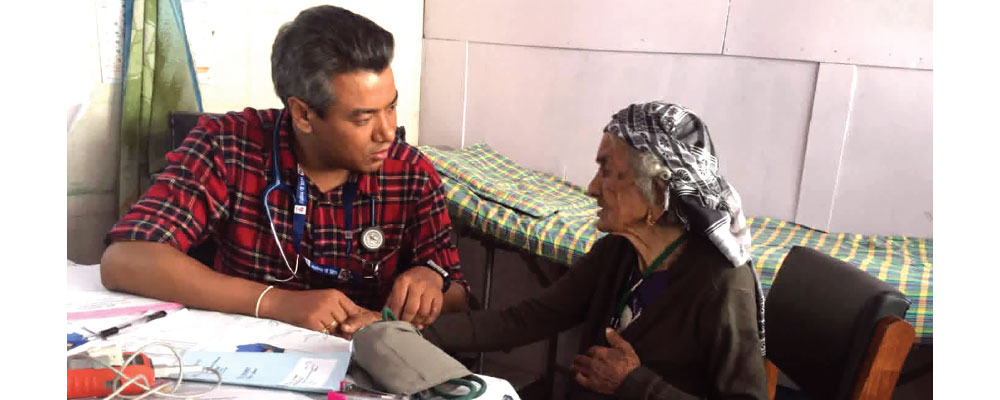
Kathmandu, June 7: Last week, the Ministry of Health and Food Safety launched a free health portal, aiming to disseminate information about the hospital beds allocated for free.
Through an online health portal, everyone can be informed about the real-time status of the 10 per cent free beds allocated for underprivileged, helpless and destitute patients in hospitals across the country.
The system has been developed through the free health portal to allow real-time monitoring of available free beds and details of patients currently receiving this facility. The government informed that it has taken this concrete step to make the system, which was previously limited to paperwork, transparent through technology.
However, almost all Nepali citizens are unaware of the facts how many doctors are in their area or community.
According to the World Health Organisation (WHO), there should be one doctor for every 1,000 people. However, in Nepal, there are 16 times fewer positions of doctors in the government service than the WHO recommendation. Experts, including health officials, are concerned that due to the shortage of doctor positions, patients have not been able to easily get quality services.
According to government data, the total number of doctors in government services across the country is currently 1,916. They have to serve the country’s population of 29.6 million. However, recently, the new government has decided to add 977 more permanent posts in the health sector. The news posts of doctors have been created after more than three decades. A total of 2,893 posts have been approved in the federal structure under the Ministry of Health and Food Safety.
Out of the 1,916 doctors on duty, there are 884 medical officers of the 8th level, 808 specialist doctors of the 9th and 10th levels, and 224 consultant doctors of the 11th level. All these doctors on duty are not active in serving patients at the current time. Of them, some are on study leave, while some are active in administrative work.
Due to this, patients have to wait in long queues in hospitals to get medical treatment, wait for months for surgery, and one doctor has to look after hundreds of patients every day, so the patients are not able to get a timely diagnosis of the disease.
Experts argue that the huge disproportionate ratio of service recipients to doctors is quite difficult to address. This requires drastic changes in the health structure.
The WHO has listed Nepal as a country with an acute shortage of health workers. Experts have argued that this will lead to a loss of confidence in Nepal's health syste, in the international community and will directly affect the Sustainable Development Goals (SDG) in the stipulated time frame.
In its report, 'WHO Health Workforce Support and Safeguards List 2023,' the global agency states that the objective of achieving health goals by 2030 will not be achieved due to the lack of health workers in Nepal.
Consequently, the majority of Nepalis are being deprived of affordable health services from the government health institutions. They have been forced to buy even basic health services from private institutions in expensive price. This also deprives them of the fundamental right to health services as spelt out in the constitution.
Uneven distribution of doctors
Dr. Roshan Pokharel, former secretary at the Health Ministry, said that the imbalance in the distribution of doctors and health workers has been created due to a lack of coordination among the three tiers of government.
Speaking with The Rising Nepal, Dr. Pokharel argued that the new posts the federal government is adding are unlikely to correct this imbalance.
“Unless the provincial and local governments have sufficient budget and financial authority to recruit new doctors, the right of citizens to health services in their own areas and communities cannot be ensured. Even the current policy will not change the unbalanced distribution of doctors,” Dr. Pokharel said.
Dr. Pokharel added that federalism has not been implemented in a real sense. According to him, the new 977 doctors’ posts only belong to 22 federal hospitals.
He also informed that even though 10 doctors have been recruited through the Public Service Commission earlier, they are not ready to go outside the Kathmandu Valley.
“It would be effective if provincial and district hospitals were given a limited basket budget with financial authority and allowed to recruit doctors as per need. But so far, no initiative has been taken for this,” Dr. Pokharel said.
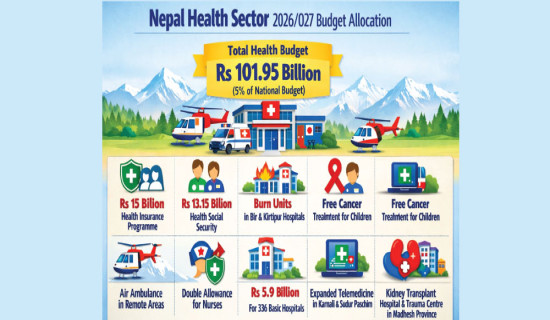
The Ministry is unlikely to carry out reforms in the health sector with fewer than 5 per cent of the total budget allocated for the new fiscal year, he added.
He also argued that a lion’s share of the budget is spent on vaccination and medicine distribution, let alone the restructuring of the health sector.
Dr. Manohar Pradhan, an advisor to the Minister for Health and Food Safety, agrees that the structural reform is essential. Speaking with The Rising Nepal, Dr. Pradhan stated that the new government has initiated to figure out the real time status of doctors and health workers currently where they are serving.
According to a senior health official, the estimation and initiatives made by the government to reform the health structure are still far from a realistic approach. He said that the huge number of doctors produced every year are forced to leave for abroad. He said that even if the government can mobilise around 2,500 new doctors produced in a year, we will see a lot of improvement.
Many doctors who graduate every year are not allowed to serve in their own country. One way to look at this matter is like this: a person gets a driving license but is not allowed to drive the vehicle. For example, the government plans to operate burn hospitals in all provinces. But it has opened a single post for a plastic surgeon,” he said.
According to various government data, around 2,500 doctors are produced every year. But the government is not able to deploy them in the health sector.
Currently, at least 40,000 doctors are working in hospitals, including private health institutions, across the country. However, it is estimated that more than 70 per cent of them are in city areas.
But the irony is that there is no accurate data on how many of them are currently working in government and private hospitals. Similarly, a large number of doctors with NMC numbers have left for abroad. Experts suggest that accurate information about this situation is essential for improving the health sector.
Amidst these challenges, the new government has initiated health reform. According to Dr. Manohar Pradhan, advisor to the Minister of Health and Food Safety, the government is preparing to recruit doctors based on demographics and geography.
Dr. Pradhan also informed that the government is currently focused on mobilising sufficient MDGPs (Doctor of Medicine in General Practice) in local communities. MDGP specialists are primary care experts who bridge the gap between routine medical care and emergency medicine.
Equipped with surgical, obstetrical, and critical care skills, they serve as holistic “family physicians” and often lead trauma and emergency teams, especially in rural settings. With this plan, citizens in remote areas are expected to receive basic health services, eliminating the challenges of traveling to hospitals in urban areas, including the capital, Kathmandu.
“Initially, there was no data available on how many doctors are working in ratio of geography and population. Also, there is no accurate data on how many doctors are currently working across the country. Just as we have taken the initiative to provide information on the status of free beds in hospitals. Similarly, we will provide information on the availability of doctors and specialist doctors. After completing some work in terms of statistics and policy, it will be easier for us to make further improvements,” Dr. Pradhan stated.
Dr. Pradhan expressed concern about the challenges in meeting international standards, including achieving the SDGs. He noted that the new government is facing difficulties in health sector reforms due to past irregularities.
Similarly, Dr. Bikash Devkota, secretary at the Ministry of Health and Food Safety, stated that the new posts that were accepted by the Minister of Finance were an achievement and a motivation to pursue reforms.
“This is the first time in history that the Ministry of Finance has approved a large number of doctor vacancies, which can contribute to improving the federal health structure,” said Dr. Devkota.


-original-thumb.jpg)