- Sunday, 7 June 2026

Smashing Phones Is Not The Answer

This week, a video from Siraha spread rapidly across social media. Many people watched it with surprise, while others watched it with concern. The video showed hundreds of mobile phones and smartwatches being destroyed after they had been seized from students during the Grade 10 and 12 examinations.
According to news reports, 489 Android phones, five iPhones and five smartwatches were destroyed. The devices were reportedly submerged in water and then broken with tools. The action was taken following a decision made by the District Examination Coordination Committee. Education officials, local administration representatives and police personnel were also involved.
Warnings
Nobody will argue that students should be allowed to carry mobile phones into examination halls. Rules are rules. Students had been warned repeatedly. Even after the warnings, many of them still brought phones with them. That itself is a matter of concern. However, another question is equally important. Was destroying those devices really the right thing to do?
The authorities seem to believe that such a dramatic action will discourage students from bringing phones to examinations in the future. But I am not convinced. Cheating is a problem, but can smashing phones solve it? I doubt it. A student may fear losing a phone. Yet that does not mean examination malpractice will suddenly disappear. The reasons behind cheating are much deeper than that. Fear alone rarely changes behaviour for long.
There is another aspect that has not received enough attention. Every mobile phone used in Nepal comes from another country. We do not manufacture them here. Foreign currency is spent to import them. Whether the device costs ten thousand rupees or one lakh rupees, it still represents economic value. When hundreds of phones are destroyed at once, it is not only personal property that is lost. National resources are also wasted.
Normally, when government agencies seize property connected to an offence, there are procedures to follow. In many cases, confiscated items are auctioned through public bidding. The purpose is simple. The state should not unnecessarily destroy something that still has value. This is why many people are now asking why a similar approach was not considered in Siraha.
The mobile phones could have been confiscated. Parents could have been informed. Fines could have been imposed if necessary. After completing legal procedures, the devices could have been auctioned. The message against cheating would still have been delivered, and public property would not have been wasted.
A mobile phone is one of the most useful inventions of modern times. It helps people communicate, learn, access information and remain connected with the world. Of course, it can also be misused. People use phones for cheating, fraud, blackmail and many other harmful activities. But the phone itself is not the problem. The misuse is. If somebody receives an electric shock, we do not destroy the entire electricity system. If a road accident occurs, we do not crush every vehicle. If a house catches fire, we do not eliminate every source of fire from society. We punish misuse. We do not destroy useful things simply because they can be misused. The incident also raises questions about responsibility.
Students brought the phones into examination centres. That is true. But where were the checking mechanisms? Police personnel were deployed at the centres. Invigilators were present inside the examination halls. Superintendents were responsible for maintaining discipline. If hundreds of devices entered the halls, can all responsibility be placed on students alone?
Young people make mistakes. Sometimes they repeat them. That is exactly why adults are expected to guide them. Teachers, administrators, parents and officials carry greater responsibility because they are the ones entrusted with managing the system. Unfortunately, the destruction of the phones sends a different message. It appears more like an act of anger than an act of educational reform.
Many parents must have felt hurt while watching the video. Many students probably felt humiliated. Such actions may create frustration rather than awareness. Education should encourage correction, not revenge. There is also a legal question. If some of the affected families decide to challenge the decision in court, the issue could become much larger. The state has a responsibility to protect property and use public authority wisely. Courts may eventually have to decide whether destroying the devices was justified.
Lesson
The larger lesson is clear. Fair examinations are important. Nobody wants cheating to continue. Honest students deserve a level playing field. But maintaining discipline does not require the destruction of valuable property. The fight against cheating should focus on better supervision, stronger monitoring, improved awareness and cooperation among students, parents, teachers and local authorities. Those measures will produce lasting results.
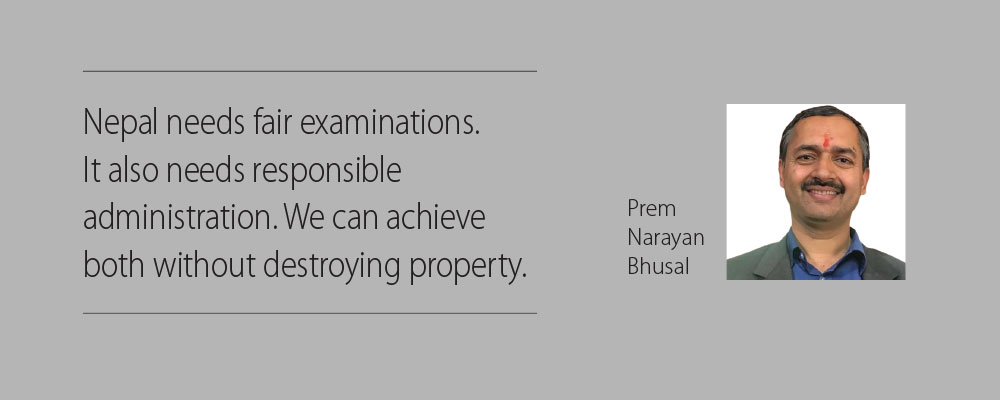
The video from Siraha may have attracted attention, but attention alone does not make an action correct. Breaking nearly five hundred phones may look tough, but toughness and wisdom are not always the same thing. Nepal needs fair examinations. It also needs responsible administration. We can achieve both without destroying property. That is the lesson we should learn from this unfortunate incident.
(The author is a Psychological Counselor.)