- Sunday, 7 June 2026

Water sources drying up as ponds disappear
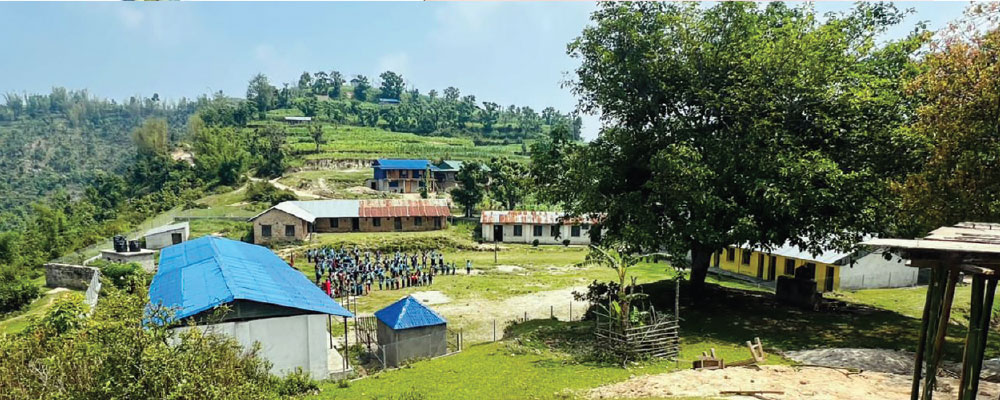
Photo: Bhakti Bilas Pokharel/TRN A school built by replacing a traditional pond in upper Mahabharat region.

By Bhakti Bilas Pokharel, Gaighat, June 7: Natural water springs in the lower hills of Udayapur have started drying up rapidly after locals filled in traditional ponds and water reservoirs (aahal) in the upper Mahabharat region to construct physical infrastructure.
These ancient ponds, which had been preserved for generations and played a crucial role in maintaining the local water cycle and storing rainwater, have gradually disappeared due to encroachment and haphazard construction. Due to this, there is an increasing shortage of drinking water sources in the hilly region.
In Tapli Rural Municipality-3, the historic Jhilke Pokhari, once filled with water throughout the year, has disappeared after locals filled the pond and constructed community infrastructure, including a school building.
Similarly, Bahun Pokhari, a large perennial pond located in Pokhari Kharka of Ward No. 4 in the same municipality, has also disappeared.
Locals reportedly filled the pond to build a community school, a health post and even a playground for students, completely erasing its existence.
Jhilke Pokhari and Bahun Pokhari are only examples among many. Several traditional ponds, including Devithan Pokhari in Thamkharka, Sani Pokhari in Jatanpur, Aahaldanda Pokhari and Pipalbote Pokhari in Thumki village and Aahale Pokhari in Thanagaun, have similarly disappeared.
According to Tej Prasad Giri, Vice-chairperson of the District Coordination Committee, Udayapur, the loss of ponds in the upper hill areas has caused dozens of drinking water sources in lower settlements to dry up.
“Earlier generations developed a tradition of constructing ponds near the forests, hilltops and settlements to maintain the local water supply system,” Giri said.
“However, the present generation has failed to preserve these historic ponds. Due to this, one water source after another is drying up.”
The disappearance of Devithan Pokhari in Thamkharka has reportedly affected water sources including Dhaap Pani, Thumki spring, Dharapani spring in Jatanpur, Kuwapani in Baspani, Saune spring and even wetlands near Miringching stream.
Likewise, after Bahun Pokhari was filled in with stuff, water sources in Dungge, Kholagaun, Khandanda and Pakhure areas dried up, creating an acute drinking water shortage for local residents.
Local resident Parshuram Pokharel said the disappearance of Sani Pokhari in Jatanpur has already caused several springs in Rajdaha and Adamara areas to dry up.
Shiva Kumar Pokharel, senior watershed management officer at the Koshi Integrated Watershed Management Centre in Udayapur, said climate change has altered rainfall patterns, with prolonged rainfall decreasing and intense rainfall occurring over shorter periods.
“In such conditions, the absence of ponds to collect and store water prevents groundwater recharge, which ultimately leads to springs drying up,” he said.
He warned that if traditional ponds are not restored, drinking water shortages in hilly regions could worsen significantly, irrigation problems could intensify, agricultural production could decline, and women and local communities may face greater burdens in collecting water.
He also cautioned that water scarcity could trigger migration and negatively affect biodiversity and ecological systems.
According to Pokharel, traditional ponds play a vital role in maintaining the local water cycle by conserving rainwater, recharging groundwater, sustaining water flow in natural springs, supporting livestock and agriculture during dry seasons, conserving biodiversity, regulating temperature and humidity, and assisting in fire control and disaster management.