- Wednesday, 6 May 2026

Poets honour labour's role
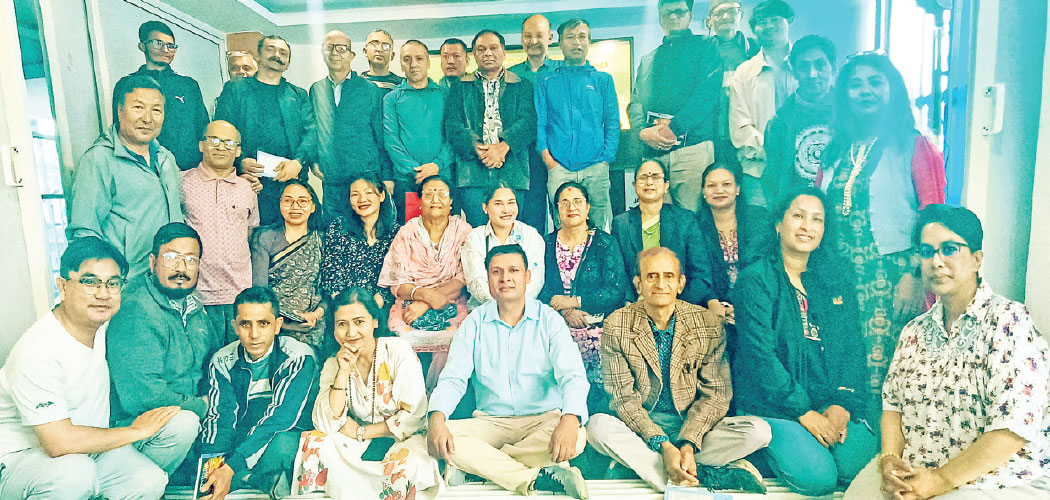

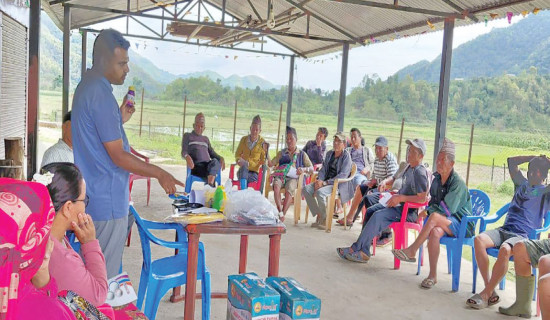
By A Staff Reporter,Kathmandu, May 6: Poets in the capital raised their voices in honour of labour and its profound role in human development, marking the 137th International Labour Day recently.
The programme, organised by the Bartaman Kabita Samuha in association with Jagaran Academy and Ratoghar Foundation in Kalanki, Kathmandu, echoed with a shared conviction: it is labour that has carried human civilisation to its present height.
"There is nothing more beautiful than labour," the poets affirmed. "Without labour, the civilisation we witness today would not exist."
Noted poet Shyamal recited his powerful poem ‘Pharak Pharak Loktantra’, drawing a sharp contrast between the democracy of labourers and that of the privileged elite. One of his striking lines read, "They win without voting; we lose everything by voting." He also recited a poem centred on labour by American poet Langston Hughes, further deepening the global resonance of the theme.
Laxmi Mali presented 'Hali Ra Maisap', poignantly expressing that without labour, one cannot truly experience the beauty of life. Sneh Sayami’s 'Sujikar' painted a moving anecdote of a poor tailor who promises to sew not only clothes but even the poverty of others.
In 'Swad', Amar Aakash offered a touching portrayal of a mother’s labour, which sustains her family with something as simple yet meaningful as bread and jam.
Representing Bartaman Kabita Samuha, Rami Priya recited 'Malik Ra Parkhal', capturing the enduring conflict between labourers and owners. Similarly, Bishwa Sigdel's 'Juice Pasalma' revealed the quiet, often overlooked labour of a young boy working in a juice shop.
Chandra Bahadur Lama, through his poem 'Thorle', unfolded a swirling narrative of suppressed Indigenous voices. In 'Bhokko Ramayan', Ram Gopal Ashutosh reflected that integrity alone cannot conquer hunger, while Chachu's poem sang a tender lullaby of labour woven into his own life. Kanchan Gajmer's 'Pasinako Mulya' portrayed the silent agony of landless squatters.
Babu Tripathi’s 'Yo Desh Kasko Ho' delivered a deeply moving account of the downtrodden, eventually raising the haunting question, "Whose country is this?"
Likewise, Shakuntala Joshi narrated the backstory of a poet who tore up his citizenship certificate in front of Singha Durbar, a symbolic act of anguish and protest. Anita Lama, also deputy mayor of Budhanilkantha Municipality, used her poem ‘Sannata’ to cast sharp satire on the silence of intellectual circles regarding the demolition of squatter settlements.
Kishan Paudel, Lumanti Chitrakar, and Pramod Snehi sang in unison of tireless, resilient hands that never cease to build the world, while Jayanti Spandan expressed a hopeful wish for labourers to one day rise as rulers.
In 'Bhariya Dai', Dhir Kumar Shrestha portrayed the harsh reality of a labourer struggling merely to survive from hand to mouth. Rita Balami honoured her mother as the truest embodiment of labour, while Premila Rai, Mithoch, Gopalkumar Mainali, Shekhar Kumar Shrestha, Namauna Sharma, Rajbabu Pahadi, and Basudev Adhikari recited poems reflecting the transformative yet often unacknowledged contributions of the working class.