- Sunday, 24 May 2026

Global call for fossil-free future
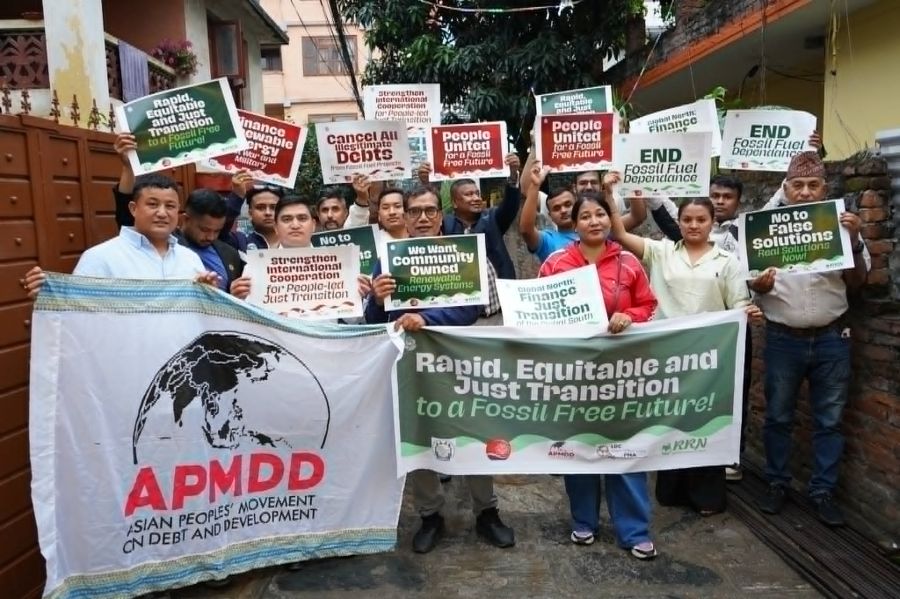
By TRN Online, Kathmandu, Apr. 28: Climate activists from Nepal joined global demonstrations, led by the General Federation of Nepalese Trade Unions, which also took place in India, Pakistan, Bangladesh, and the Philippines on Sunday evening. These protests were part of a worldwide movement, calling for a rapid, just, and equitable transition to a fossil-free future.
Protests were also held across Africa, Latin America, North America, and Europe ahead of the 1st International Conference on Transitioning Away from Fossil Fuels in Santa Marta, Colombia. This historic summit, co-hosted by the governments of Colombia and the Netherlands, aims to facilitate the global energy transition.
The mobilisations in Asia were led by members of the Asian Peoples’ Movement on Debt and Development amid a global energy crisis that has left the region particularly exposed. In 2025, 90 per cent of LNG and 80 per cent of oil transiting through the Strait of Hormuz were bound for Asian markets.
Addressing the financial requirements of the transition, Laxman Sharma, Secretary General of GEFONT, stated that international cooperation is key and that there can be no equitable phase-out without wealthy countries contributing their fair share.
He called for the delivery of trillions in public, grant-based, and unconditional climate finance. Sharma added that the Santa Marta conference must champion the operationalisation of the Just Transition Mechanism to ensure that developing countries have access to direct, non-debt-creating, and differentiated funding for climate action.
Reshma Shakya, Programme Coordinator of the South Asia Alliance for Poverty Eradication (SAAPE), highlighted the importance of the Peoples’ Summit for a Fossil-Free Future, a parallel gathering of over 900 organisations.
She explained that this independent space allows civil society to build collective power and unify demands. According to Shakya, the goal is to ensure that formal dialogue at the Assembly of the People is reflected in official outcomes.
Social activist Tikaswari Rai noted that when fuel prices surge, ordinary citizens suffer as basic commodities become more expensive and workers' wages decline in value. She emphasised that household budgets are being stretched to their limits and that women’s burdens are increasing, making a rapid, just, and equitable transition away from fossil fuels a matter of survival.


-original-thumb.jpg)






-original-thumb.jpg)