- Wednesday, 20 May 2026

Leave No One Behind To Eliminate Malaria

Malaria is still a public health challenge in many low-and middle-income countries. While easy access to diagnosis, prevention and treatment is part of the solution, more concerted efforts towards community-led health interventions must target the communities who are socially excluded and vulnerable within and across communities. More importantly, malaria elimination is possible, but only when we ensure that no one is left behind.
Drawing the timely attention of key stakeholders to the global fight against a preventable yet deadly mosquito-borne disease is crucial to inspire accelerated efforts for elimination. In this context, UNICEF reports that malaria disproportionately affects sub-Saharan Africa, where children under age five account for the majority of malaria deaths. Considering this ground reality, key stakeholders demand sustained political and financial commitments to ending malaria as a global health threat.
Elimination goals
The World Malaria Report 2025 of the WHO reveals that since 2000, 2.3 billion malaria cases and 14 million malaria deaths have been averted worldwide. Furthermore, there has been continued movement towards global elimination goals, with 47 countries and one territory now officially certified as malaria-free by the WHO. In 2024, progress in low-burden settings was sustained, with 37 countries reporting fewer than 1000 cases.
In Nepal, malaria is largely prevalent in the lowland Terai region. Despite substantial progress in controlling malaria, risks still remain. Reviewing the history of Nepal’s efforts, malaria project was first initiated in 1954 with the support of USAID. The project largely aimed to study malaria in Terai belt. In 1958, national malaria eradication programme, was launched with the objective of eradicating malaria from the country within a stipulated time period. Later, the eradication concept was reverted to control programme in 1978.
According to Epidemiology and Disease Control Division of Department of Health Services, following the call of WHO to revamp the malaria control programmes in 1998, Roll Back Malaria (RBM) initiative was launched to address the perennial problem of malaria in hard-core forests, foot hills, inner Terai and valley areas of the hills, where more than 70 per cent of the total malaria cases of the country prevail. The high risk of acquiring the disease is attributed to the abundance of vector mosquitoes, a mobile and vulnerable population, relative inaccessibility of the area, suitable temperature, environmental, and socio-economic factors.
Nepal’s elimination activities are rolled out across all districts, including the high, moderate, low, and no-risk districts. Since 2016, the programme has been updating the microstratification every year and has classified risks at a ward level. Despite noted progress, Nepal needs to strengthen leadership, governance, and accountability mechanisms to sustain the malaria response and ensure that no one dies from malaria. The technical assistance WHO, the Global Fund, and other partners have been instrumental in strengthening the institutional capacity of health institutions, human resources, laboratory facilities, implementation of the national malaria strategic plan (2014-2025), robust surveillance systems and combating indigenous malaria cases.
In the context of federal health governance, concerted efforts are focused on strengthening community systems, engaging the private sector, and enhancing the capacity of local governments to further strengthen people-centred, integrated health services and evidence-based community-led interventions. Nepal can also greatly learn from other regional initiatives that have demonstrated malaria elimination efforts and significant impacts on the communities.
For example, in the face of antimalarial drug resistance, elimination is now within reach in three countries of the Greater Mekong Subregion (GMS), namely Cambodia, the Lao People’s Democratic Republic, and Vietnam. For instance, from 2012 to 2024, the GMS has achieved an impressive 70 per cent decrease in overall cases, with Lao PDR recording a 99 percent drop over the same period. Thus, the GMS has made substantial progress over the last decade. The aim of accelerating malaria elimination across the subregion by 2030 has been further reflected by high-level political leadership, targeted use of effective treatments, robust surveillance and sustained community engagement.
Despite noted progress, gains still remain uneven. Existing interventions have not adequately reached the most poor and marginalised groups. Consequently, this scenario clearly shows that these communities are vulnerable to the preventable yet devastating differential effects of malaria. Moreover, there is still gross underrepresentation of socially marginalised groups in community engagement activities. This undermines the essence of empowering communities in the fight against malaria.
Climate change
Beyond biological threats, climate change, conflicts and humanitarian crises continue to challenge the ongoing malaria response by disrupting health systems at large. Anthropological insights into how malaria has shaped health seeking behaviour, cultural practices, social suffering and adapting mechanisms are critical in malaria response. Specific social groups such as migrant and displaced populations, ethnic and indigenous minorities, people with disabilities, and pregnant women remain disproportionately at risk of malaria. Such social vulnerability is further exacerbated by deep-rooted socio-economic and cultural barriers that limit their access to preventative measures, timely diagnosis, and effective treatment. Despite growing commitments to health equity globally, significant gaps remain between policies and implementation realities.
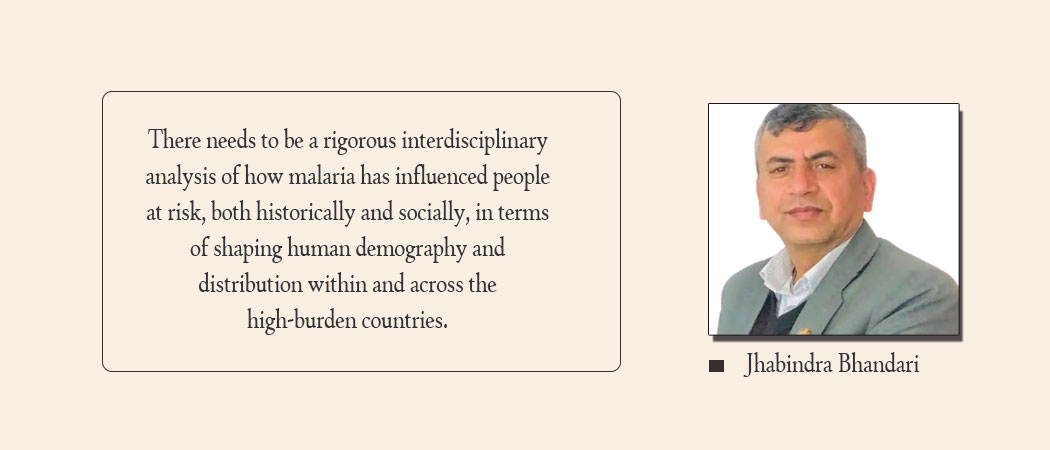
In the context of diverse health, epidemiological, political, and social landscapes, existing efforts are not sufficient to address the widening gaps in social inclusion, equity and diversity. Limited interventions are in place to address the underlying structural and social drivers of malaria among culturally, economically, and politically marginalised sub-groups in societies. There needs to be a rigorous interdisciplinary analysis of how malaria has influenced people at risk, both historically and socially, in terms of shaping human demography and distribution within and across the high-burden countries.
(Bhandari is a health policy analyst interested in anthropology.)
-square-thumb.jpg)

-original-thumb.jpg)