- Sunday, 7 June 2026

NA Chair Dahal addresses IPU 152nd assembly
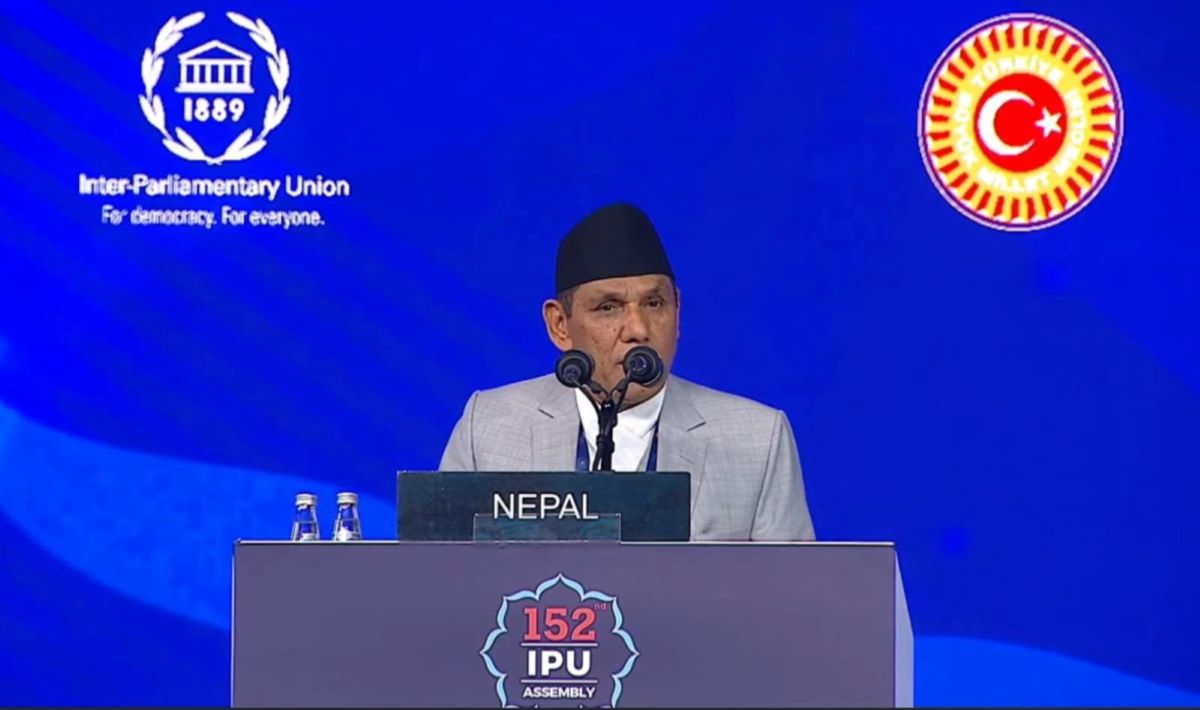
By TRN Online, Kathmandu, April 17: Chairperson of the National Assembly Narayan Prasad Dahal has emphasized on prioritizing youth-centered thinking, policies, and programs to preserve and strengthen hope and confidence in the future.
The NA Chair said so on Thursday while addressing
the 152nd assembly of the International Parliamentary Union (IPU) which
is being held in Istanbul, Turkiye from 15-17 April.
Highlighting about five main actions needed for bringing
positive changes in the lives of the people, NA chair Dahal also talked about inclusivity
and climate change.
Here is the full text of his address:
Statement by Mr. Narayan Prasad Dahal, Rt. Hon’ble Chairperson of the
National Assembly of Nepal at the 152nd Assembly of the Inter Parliamentary Union (IPU)
Istanbul, Türkiye, 15-19 April 2026
Nurturing hope, securing peace and ensuring justice for future generations
Madam President,
Excellencies Speakers, and Chairpersons of National Parliaments, Distinguished Members of Parliament,
Special Representatives, Ladies and Gentlemen,
Namaste and Warm Greetings!
I feel distinctly honored to address this August gathering of parliamentarians from around the world at this 152nd IPU Assembly hosted in this historic and beautiful City-Istanbul.
On behalf of the Nepali delegation and on my own, I would like to express my sincere gratitude to the Government, Parliament, and people of Türkiye, as well as to the organizing body- the IPU, for successfully convening this Assembly and warm hospitality extended to us. I also extend best wishes from the Federal Parliament of Nepal for the grand success of this Assembly.
Madam President,
The world today is grappling with multiple crises. Geopolitical competition, increasing global conflicts, climate change, deepening economic crises, rising inequalities, and youth unemployment are among the major challenges confronting us.
At the same time, advanced technologies including Artificial Intelligence are rapidly transforming societies. Digital and AI divides both among and within States are emerging as new challenges.
Indeed, these crises are not isolated; they are interrelated. Addressing them requires collective action grounded in foresight and inclusivity. In this context, the theme of this Assembly- “Nurturing hope, securing peace and ensuring justice for future generations” is timely and highly relevant. I am confident that as representatives of the people, our decisions today will significantly contribute to shaping the future of upcoming generations.
Excellency,
Allow me to present a few key perspectives on the roles we must play and the actions we must undertake to bring concrete and positive changes in people’s lives by translating the theme into reality and ensuring peace and security, prosperity, human dignity, and sustainability in the world:
First, it is imperative to prioritize youth-centered thinking, policies, and programs to preserve and strengthen hope and confidence in the future.
In my country, following the elections of the House of Representatives recently held in the aftermath of the Gen Z movement, nearly half of the elected members of House of Representatives are youth. Nepal has welcomed a 35-years youth Balendra
Shah as the new Prime Minister. This development has not only inspired Nepali youths, but also young people around the world. The election result has not only enhanced political inclusion and representation, but also endorsed new energy, ideas and perspective in law-making process and development vision of Nepal.
Second, inclusivity is a fundamental prerequisite for ensuring peace, prosperity, human dignity and sustainability. We must ensure inclusive representation across all organs, levels, and institutions, including parliaments.
In the current global context, where democracy faces various pressures, Nepal has set a strong example through the successful implementation of a federal democratic republic under its 2015 Constitution. Based on proportional inclusion, participation and accountability, Nepal has ensured the rights of women, Dalits, Indigenous peoples, Madhesis, and other marginalized communities that manifests our strong commitment to inclusivity. I am proud to inform this Assembly that women currently constitute 35.32 percent of Nepal’s Federal Parliament.
Our federal parliament has strengthened democracy by playing drafting legislations, effective oversight to the Government and representations of people’s voice. In addition, Parliamentary committees have enhanced people’s faith in the government institutions by playing an important role in enhancing transparency, policy oversight, and government accountability.
Third, it is essential to address development gaps and challenges. We firmly believe that there can be no peace without development, and development without peace.
We must remain committed to accelerating the implementation of the 2030 Agenda in achieving the Sustainable Development Goals (SDGs). In this regard, it is crucial to enhance support for countries in special situations, including Landlocked
Developing Countries (LLDCs) and Least Developed Countries (LDCs), and Small Island Developing States (SIDS). This includes fulfilling Official Development Assistance (ODA) commitments, expanding trade opportunities, facilitating technology transfer, supporting capacity-building, and mobilizing additional concessional financial resources.
Fourth, addressing climate change is of utmost importance. Climate change has emerged as one of the most serious global challenges of our time. Ensuring climate justice for vulnerable countries and future generations is an urgent necessity. We urge developed countries to reflect their commitment readiness to climate finance obligations towards the vulnerable countries. International communities must adopt measures to reduce dependency on fossil fuel while promoting clean and renewable energy, technology transfer and strengthening of capacity development for developing countries, effective adaptation and resilience measures.
Nepal is facing disproportionate climate risks despite its negligible contribution to the global greenhouse gas emissions. Particularly in the Himalayan region, rising temperatures are causing serious environmental problems, including changes in snowfall patterns, glacier melt, glacial lake outburst floods, and disruptions in water systems. These impacts are adversely affecting livelihoods, biodiversity, and ecological balance. Nevertheless, Nepal remains firmly committed to achieving Net- zero emissions by 2045, while promoting renewable energy, implementing climate adaptation programs, and advancing sustainable development goals.
Through parliamentary diplomacy, dialogue forum like Sagarmatha Sambaad, Nepal has actively engaged with parliaments, government and stakeholders worldwide in international forums, contributing to dialogue and consensus-building on sustainable development, climate change mitigation and resource mobilization.
It has also fostered coordination, inclusivity and policy coherence among diverse stakeholders within and beyond parliament. In addition, we must strengthen the efforts and actions to modernize agriculture, food security and environment conservation by the exchange of good practices, technical assistance and capacity development through interparliamentary cooperation.
Fifth, it is crucial to emphasize technological advancement and digital inclusion. Rapid developments in digitalization and Artificial Intelligence are playing a transformative role in public service delivery such as governance, agriculture, health, education as well as in ensuring economic growth. However, it is unfortunate that divides between AI and digital access continues to widen.
It is essential to reform policy to manage the technological changes and ensure equal access to digital inclusivity, literacy development and technology. Youth employment, digital public infrastructure, investment and technology transfer are equally important in this regard.
Nepal is moving forward with digital transformation by striking a balance between policy innovation and accountability. It is also actively engaged in international cooperation and partnerships to support this process.
Excellency
In conclusion, I wish to emphasize that hope is the foundation of positive change. Peace is not merely the absence of conflict, but a condition born out of mutual understanding, respect, and cooperation among peoples and nations. Justice is the essential foundation that strengthens both hope and peace by ensuring equal rights and opportunities. These elements are interconnected and form the foundation for a brighter future.
It’s essential to take responsible, inclusive and forward-looking steps since what we decide today shapes the future of the young generation.
Let us ignite hope, strengthen peace, and ensure justice. Let us work together to build a world where future generations can live with dignity, security, and prosperity.
Nepal remains steadfast and committed to multilateral cooperation and stands ready to move forward shoulder-to shoulder with all of you on this shared journey. Let us join hands in this collective endeavor, as our shared future depends on it.
Thank you.
-square-thumb.jpg)



-original-thumb.jpg)