- Monday, 8 June 2026

From Paper-based To Paperless Administration

The newly elected government has launched a leapfrog strategy to transform the conventional mode of state administration, harnessing app-based technology to ensure effective, efficient and time-bound service delivery. The cabinet's decision of 'one hundred actions in one hundred days' expresses an honest and steadfast commitment to reform. Hopefully, this decision, grounded in careful ratiocination and thorough analysis of present governance needs, will fan the flames of the government's burning desire to bring about positive change and curb the persistent mismanagement and disorder in Nepal's public administration.
The steps taken by the government have been widely appreciated across different corners of life. Many have observed that the government is moving in the positive direction. When compared to previous administrations, its functional style appears distinctly different. It is also commonly wished that the current approach to decision-making and policy execution should take a course of durable continuity; otherwise, it will be a case of 'all cut from the same cloth' with no meaningful difference from the past.
E-governance
One of the hundred promises is to make administrative functions paperless – a step in the right direction to achieve expected results on time. Although a paperless system shifts administration from a slow-moving hierarchical structure into a fast and dynamic mode of implementation, it urgently requires a change in the mindset of people within the bureaucracy. The use of digital technologies – such as the internet, mobile applications, data systems, and automation – demands intelligent and adaptive minds of those working as civil servants. Administrative workforces are shaped by diverse mindsets, deeply ingrained habits, attitudes, beliefs, and working cultures, which intensely influence how they discharge their duties and treat common citizens.
In the above context, it would be an arduous uphill task to change the entrenched mindsets of the persons within a short span of time. Those who have long been accustomed to delivering duties through conventional modes of paper-based procedures for decades require rigorous reorientation to keep pace with modern paperless modes of administration. Nepal's bureaucracy is still rooted in a process-oriented working culture rather than a result-oriented one, often prioritising procedure over performance. It has evolved with the flawed notion that 'when doing work, documents should speak, not the mind. If the mind starts speaking and something goes wrong, no one will stand by you. One should not try to run; instead should focus on staying within proper procedures and rules'. Since the time of the Rana regime, the pathology of bureaucracy has been marked by ' bholi', 'jhinga tasne', 'chakadi', and 'aafno manchhe'. These tendencies continue to persist in administrative behaviour even today.
Now the question comes: why did the government continue to prioritise a process-oriented bureaucratic mechanism even after introducing New Public Management as a cornerstone of state governance in the 1990s? The traditional administrative model was embedded in the bureaucracy at a time when knowledge and use of e-applications were extremely limited. At that time, academic exposure, skill-based training, availability of computers and the internet, regular supply of electricity, and awareness of the importance of e-governance were largely out of the reach of government personnel. Computers were used mainly for typing letters and preparing reports rather than as instruments for leveraging the broader spectrum of e-governance. In some government offices, the internet was misused for playing games, which was against the work culture. It must be kept in mind that e-governance succeeds not when computers are installed, but when mindsets are transformed.
Both the times and the trajectory of state affairs have undergone a profound transformation. There is no option left but to bolster the administrative efficiency through digital mechanisms. And no excuse endures for delaying the implementation of government decisions. To achieve the goals, an enabling and conducive working environment for civil servants must be established. Several Acts and Regulations that hinder the fast execution of policies should be amended promptly. One such law is the Public Procurement Act.
Performance outcomes
So many Clauses of the Act reveal an excessive emphasis given on procedural compliance rather than performance outcomes. The Act prioritises awarding contracts to bidders offering the lowest financial bids. No doubt, a lowest bidder, if delivers quality work within the stipulated time, is ideal; however, in practice, this expectation has often remained unfulfilled. A couple of months before, the government cancelled the contracts of around 50 construction companies that failed to comply with the terms and conditions stipulated in their agreements.
Another important aspect is that government officials must be assured that even if an error occurs while performing their assigned duties with sincerity and honesty, they will not be held personally responsible. But this does not mean that they do not have any accountability. Yes, they remain fully accountable. If any loss or damage arises due to intentional misconduct or malicious intent, the concerned official must be held accountable. If the relevant laws clearly demarcate the line between acceptable error and culpable wrongdoing, it will foster a congenial and confident working environment within the bureaucracy. Thus, the laws should lay down clearer provisions that establish the norm that 'results matter more than procedures, rather than allowing process more than outcomes'.
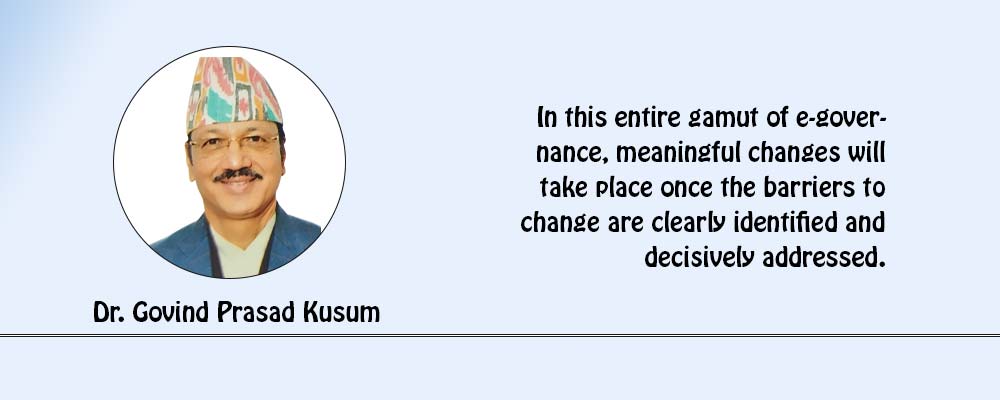
However, it is not so easy to establish a paperless administration system due to legal complexities and a risk-averse mindset. Paperless administration is not just a matter of technology; it is also intertwined with how citizens think and react. In this entire gamut of e-governance, meaningful changes will take place once the barriers to change are clearly identified and decisively addressed.
(The author is a former Nepal government secretary.)
-original-thumb.jpg)