- Tuesday, 9 June 2026

Balendra Shah sworn-in as 43rd Prime Minister
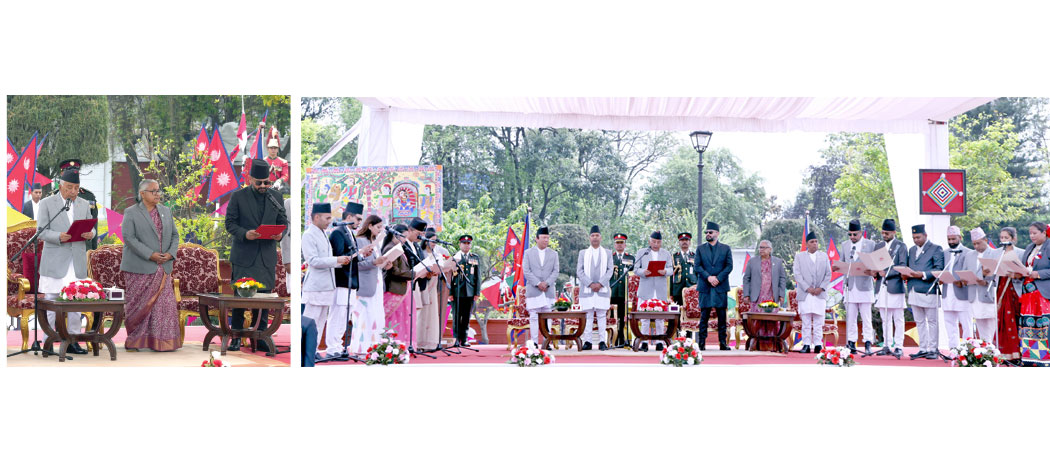
Photo: Sujan Gurung\TRN

Kathmandu, Mar. 28: President Ramchandra Paudel administered the oath of office and secrecy to newly appointed Prime Minister Balendra Shah (Balen) on Friday.
Earlier on Friday morning, President Paudel appointed Shah as the 43rd Prime Minister of Nepal in accordance with Article 76 (1) of the Constitution of Nepal. Shah is the youngest politician to assume the post of the Prime Minister after the People's Movement of 1990.
President Paudel administered the oath to the Prime Minister in accordance with Article 80 of the constitution. In a special ceremony held at the President’s Office, Sheetal Niwas.
Alongside Prime Minister Shah, the newly appointed ministers also took their oath of office and secrecy. President Paudel administered the oath to all the newly appointed ministers.
Also, on the recommendation of the Prime Minister, President Paudel formed 15-member Council of Ministers in accordance with Article 76, Sub-Article (9) of the constitution.
Born on 14 April 1990 in Naradevi of Kathmandu, Shah was elected to the House of Representatives from Jhapa-5. He secured a decisive victory over former Prime Minister K P Sharma Oli, Chair of CPN-UML, by a margin of 49,614 votes.
Shah received 68,348 votes, while his nearest rival Oli garnered 18,734.
Prior to his parliamentary victory, Shah served as Mayor of Kathmandu Metropolitan City. He resigned from the post on 18 January and joined the Rastriya Swatantra Party (RSP), which had projected him as its prime ministerial candidate during the election campaign.
Shah took the oath of office at the auspicious time of 12:34 pm on the occasion of Ram Nawami, following traditional Vedic and Buddhist rituals. The ceremony featured recitations by 108 Brahmin priests, chants by 16 Buddhist monks, and ceremonial conch blowing.
Shah has also made history as Nepal’s first Prime Minister of Madhesi origin.
Bhimsen Thapa, who ruled from 1806 to 1837 and assumed power at the age of 32, is widely regarded as the first Prime Minister of Nepal. In the 219-year history from Thapa to Shah, Jung Bahadur Rana became Prime Minister at the age of 31, though not through democratic election. Among 40 prime ministers over the period, only Marich Man Singh Shrestha came from an indigenous community.
During the Panchayat era, Tulsi Giri became Prime Minister at the age of 33 under King Mahendra’s patronage. The oldest democratically elected Prime Ministers were Manamohan Adhikari and Sushil Koirala, both of whom assumed office at the age of 74. Meanwhile, Pushpa Kamal Dahal 'Prachanda' was 54 when he became the first Prime Minister of the Federal Democratic Republic of Nepal in 2008.
New practices in oath ceremony
Prime Minister Shah, who was appointed after securing a near two-thirds majority in the post–Gen-Z Movement elections, introduced several new features during his oath-taking ceremony.
Traditionally, the Prime Minister’s swearing-in used to be limited to the formal administration of the oath. However, this time, Shah incorporated distinct ceremonial practices at the Presidential residence, Shital Niwas. The ceremony began with references to Vedic traditions. Prior to taking the oath, seven conch shells were sounded simultaneously. Additionally, 108 batuks (young Brahmin priests) recited Swastiwachan, while 16 Buddhist monks performed the Ashtamangala chanting.
According to yogic and spiritual beliefs, the human body contains seven primary energy centres, or chakras. It is believed that the vibrations produced by the sound of conch shells help activate and balance these chakras, from the Muladhara to the Sahasrara.
Similarly, the sounding of seven conch shells is considered symbolic of invoking the presence and blessings of the Saptarishis (seven sages). In Hindu scriptures, the number seven represents completeness and is associated with total victory, happiness and prosperity.
The ceremony was attended by high-ranking state officials including the Vice President, outgoing PM Sushila Karki and her Cabinet ministers, heads and representatives of diplomatic missions based in Nepal.
33 % women ministers
Meanwhile, five of the 15 members of the new Council of Ministers are women.
Sobita Gautam has been appointed Minister for Law, Justice and Parliamentary Affairs, Pratibha Rawal as Minister for General Administration, Sita Wadi as Minister for Women and Children, Nisha Mehata as Minister for Health and Population, and Gita Chaudhary as Minister for Agriculture.
PM Shah forms 15-member Cabinet
Prime Minister Shah has formed a 15-member Council of Ministers, with the highest number of appointments representing from Bagmati Province.
From Bagmati Province, Shishir Khanal has been appointed Minister for Foreign Affairs. Other ministers from the province include Biraj Bhakta Shrestha as Minister for Energy, Water Resources and Irrigation; Sasmit Pokhrel as Minister for Education, Science and Technology as well as Youth and Sports; Dr. Bikram Timilsina as Minister for Communication and Information Technology; and Sobita Gautam as Minister for Law, Justice and Parliamentary Affairs. All five were elected under the first-past-the-post (FPTP) category to the House of Representatives, representing Kathmandu-6, Kathmandu-8, Kathmandu-5, Nuwakot-1 and Chitwan-3 respectively.
Gandaki Province has been allocated three ministerial positions. Dr. Swarnim Wagle has been appointed Minister for Finance, Sudan Gurung as Minister for Home Affairs, and Khadak Raj Paudel (Ganesh) as Minister for Culture, Tourism and Civil Aviation. They were elected from Tanahun-1, Gorkha-1 and Kaski-1 respectively.
From Lumbini Province, Sunil Lamsal has been appointed Minister for Physical Infrastructure and Urban Development, representing Rupandehi-1.
Karnali Province has one representative in the Cabinet, with a proportional representation member Sita Badi appointed as Minister for Women, Children and Senior Citizens.
Sudurpashchim Province has two ministers, both proportional representation members from Kanchanpur. Gita Chaudhary has been appointed Minister for Agriculture and Livestock Development, while Pratibha Rawal has been appointed Minister for Land Management, Cooperatives and Poverty Alleviation.
From Koshi Province, Nisha Mehta has been appointed Minister for Health and Population as well as Drinking Water, representing Sunsari.
Meanwhile, Dipak Kumar Shah, elected from Mahottari-2 in Madhes Province, has been appointed Minister for Labour and Employment.