- Tuesday, 9 June 2026

Nepali Soldiers As Peace Champions

The world is marred by conflict in several places. The Russia-Ukraine war has been raging since February 2022. The war of the US and Israel with Iran has not come to a halt, although there is a fragile ceasefire in place. The Iran-Hezbollah war is also going on. Likewise, the civil war in Sudan between the Sudanese Armed Forces and the Rapid Support Forces is a matter of concern.
The world has witnessed two great wars. The League of Nations was established on January 10, 1920, after the First Great War failed to prevent the Second Great War from happening. After the Second Great War, the United Nations was established on October 24, 1945, as a replacement for the League of Nations to prevent future global conflict. In the meantime, the Security Council set up the UN Truce Supervision Organisation in the Middle East on May 29, 1948, as a UN peacekeeping mission. After joining the United Nations in 1955, Nepal embarked upon a global peacekeeping campaign by sending five observers to the UN Military Observation Group in Lebanon in 1958. Since then, Nepal has been contributing to UN peacekeeping missions.
Largest contributor
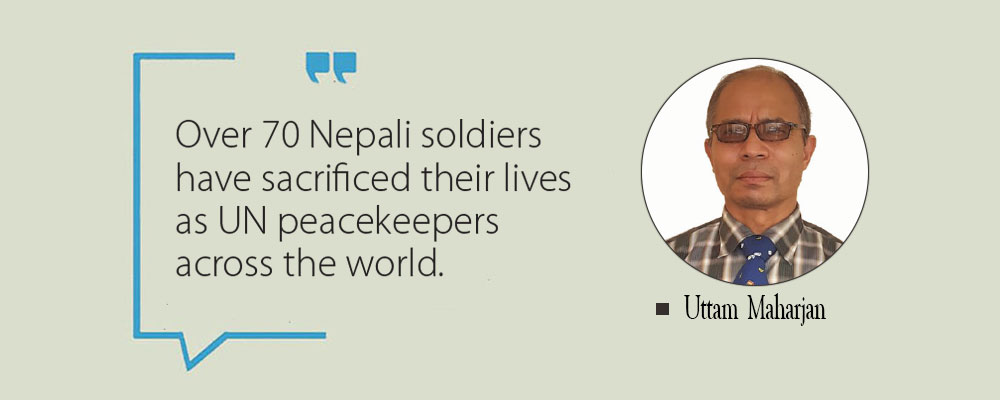
Over 50,000 military, police and civilian peacekeepers serve under the UN in various conflict zones. As many as 118 countries contribute to 11 peacekeeping missions across the world. Nepal is the largest contributor with over 4,300 soldiers and surpasses other countries such as Rwanda and Bangladesh. Nepali soldiers are deployed to Abyei (an area between Sudan and South Sudan), the Central African Republic, Cyprus, Kosovo, Lebanon, Libya, the Middle East, Somalia, South Sudan and Western Sahara. The Nepali Army, the Armed Police Force and the Nepal Police serve not only as soldiers but also as military observers and police officers in conflict zones. Over 150,000 Nepali soldiers have taken part in over forty missions, including in Lebanon, Iraq, Mali, South Sudan and the Democratic Republic of the Congo. Over 70 Nepali soldiers have sacrificed their lives as UN peacekeepers across the world.
Nepal not only contributes to UN peacekeeping missions with personnel but also financially. Although poor, Nepal pays the assessed contribution to UN peacekeeping missions as per the rules. Nepal has expressed a commitment to contribute 10 per cent of its total military size. That Nepal immediately deploys its soldiers to where they are required at the request of the UN Headquarters shows how serious the country is about global peace and security. It may not be an exaggeration to note that Nepal firmly believes in the UN Charter.
Nepal’s foreign policy is based on Panchasheel principles, favouring peace over conflict. As a country of Lord Buddha, the apostle of peace, Nepal does not believe in violence. Late King Birendra’s Zone of Peace Proposal also corroborated Nepal as a peace-loving country. However, the Maoist insurgency that raged from 1996 to 2006 turned out to be a blot on the peace escutcheon for Nepal. As the Maoists are already in the mainstream of politics, it may be expected that such activities will not take place in the future.
Nepali soldiers are hailed as Peace Champions in the UN circle. Nepal is glorified as the land of the Gurkhas (Gorkhali soldiers). Working on UN peacekeeping missions. Nepali soldiers have earned good international exposure and experience in working in uncharted conflict zones under harsh conditions. Nepal has contributed to the setting of normative frameworks designed to guide peacekeeping operations. Nepal is also an active member of the Special Committee on UN Peace Operations. The Committee focuses on the safety and security of UN peacekeepers.
Nepal has played a crucial role in enhancing partnerships among different stakeholders, protecting civilians and peacebuilders, sustaining peace in conflict zones, enhancing participation of women and youth in peacebuilding and suchlike activities. Exploitation – sexual or otherwise – and abuse may take place in UN peacekeeping missions. Nepal supports efforts to eliminate sexual exploitation and abuse (SEA). Nepal is a signatory to the Voluntary Compact on Preventing and Addressing the SEA. It may be noted that Nepal has adopted a zero tolerance policy against sexploitations and abuse by UN peacekeepers.
In a similar vein, Nepal has signed the Kigali Principles on the Protection of Civilians. Civilians may be caught in the crossfire of opposing soldiers in conflict zones. It is the duty of troops to protect civilians. Nepali soldiers are meticulous about protecting civilians. What is more, it is the duty of peacekeepers to protect vulnerable communities and support countries that want to transition from conflict to peace. Nepali soldiers contribute to enhancing the professional capabilities of fellow peacekeepers. We are proud that Nepali soldiers have been contributing to UN peacekeeping missions uninterruptedly since 1958, which has glorified the country’s image and enhanced its reputation in the world arena.
Danger zones
UN peacekeepers are always in danger zones. They have to work in unknown territory. They are constantly exposed to life-threatening conditions. Many have sacrificed their life for the sake of peace. As such, they have to avoid unnecessary risks and adapt to uncharted territory. There are emerging threats: digital tools and disinformation. These have complicated the situation in conflict zones. UN peacekeepers should have an ear to the ground.
The scope of UN peacekeeping has also expanded from ceasefire monitoring to multidimensional operations. UN peacekeeping missions require not only soldiers but also civilian administrators and technical staff as well as civilian experts from various domains such as the rule of law, justice and jurisprudence, human rights, women’s empowerment and reconstruction. Peace and development have become the main objectives of UN peacekeeping missions. As such, peacekeeping missions have been more necessary than ever. However, there are inequalities in the level of participation on the part of rich and poor countries. Such inequalities should be gradually extirpated so as to beef up UN peacekeeping missions.
(Maharjan has been regularly writing on contemporary issues for this daily since 2000.)