- Thursday, 30 April 2026

Worlds Apart Yet All Together

As a child, I was born into a family that traveled for research, education, and joy. By the time I was five years old, I had traveled across 13 districts of my home country, Nepal. Some of these were in the extreme north. I trekked 10,000 feet up the Himalayas to the Nyagin Gompa when I was only five and a half years old. Some were far in the south—the flatlands—where I saw amazing Mithila and Tharu artwork on native huts and listened as my father interviewed people and collected cultural artefacts.
Yes, I traveled the mid-hills as well—clear lakes to swim in, farmlands to help plant and harvest. I was three when I first stood in mud and planted rice. There were forests after forests to explore and hills after hills to climb. I even needed to be rescued because I slipped and fell off a cliff but managed to hang on to a branch. I was seven then and wrote an article based on the experience.
Everywhere we went, there was something different. For many years, I thought culture was about the differences—how every place had its own different music, clothing, food, languages, and festivals. I noticed how some communities decorated their homes with paintings, how the ponds and rivers were prepared for festivals, the busy, bustling weekly bazaars, Newar artisans, indigenous musicians, and processions with chariots and palanquins for gods and heroes.
The words of Clifford Geertz, a renowned anthropologist, put things more clearly. He said culture is a complex system of shared meanings and symbols that shape how people understand their world in his 1973 book, The Interpretation of Cultures.
The more places I visited, the more differences I saw – but also, I started noticing how they fit into something bigger. When I moved to the US, my family’s journeys didn’t stop. We continue to visit museums, places, and stories. Now I was not looking at local cultures of the Himalayas alone; I was an observer of the world. These visits made similarities stand out even more.
I realised that people tell stories everywhere. They remembered their roots. Made sense of themselves. And even though details changed, the foundations stayed the same. The rituals that had looked different, the foods that had tasted different, and even the distinct ways people greeted one another were, in fact, one.
When I was younger, I used to visit my relatives during Dashain. We'd gather for tika and blessings, everyone dressed in fresh clothes. That ritual, family coming together, making a good time, passing down values – had felt so specific to us. Our language, our gods, and our history were so unique and special, I felt. And so it is. But when I had the opportunity to look beyond the ways of my culture here in the US, I realised that something similar had happened around the world. This is the power of learning and viewing the opportunities available here.
Victor Turner, a British anthropologist who studied rituals and meaning, wrote in The Ritual Process: Structure and Anti-Structure, in 1969, “Rituals may vary endlessly in their outer forms, but their social functions are remarkably similar: they bind communities, mark transitions, and connect generations.”
In the US, families gather during Thanksgiving, passing on recipes and telling old family stories. It is such a special time, similar to my Dashain exposure. And during Halloween, kids go out and are gifted candies, toys, smiles, and celebrations: this rite is similar to Maha Shivaratri when kids line the roads asking for gifts. Carols are sung, such as at the Lexington Park in St. Mary’s County in Southern Maryland. The music, song, and dance during Tihar, when people visit door-to-door in celebration, are somewhat different but equally joyful.
Mexico marks the Day of the Dead altars, and Japan observes Obon to honour the spirits of the ancestors. Sherpas celebrate Lhosar with traditional feasts and pomp. These aren’t just random traditions. They're ways of holding on – connecting people to land, time, and one another.
These were not just about holidays or breaking the monotony of routine. The more we see across places and time, the more we realise how deeply festivals, clothing, feasting, agriculture, and work are interconnected across lives, families, cultures, and countries.
At school, I am studying mediaeval Europe. The Sumerian poem The Song of the Hoe describes the hoe as a divine tool created by the god Enlil. In the Inca world, agricultural ceremonies involved music from instruments like the quena and siku, to honour Pachamama, the earth goddess. The Southeastern Native American Association explains how Navajo farmers sing songs like “In the Field of the Home God” during corn planting rituals to invoke fertility and growth. In a study by Jacob and Liebowicz (2014), published by the Metropolitan Museum of Art, Inca rituals weaved music, offerings, and even the layout of the landscape to reinforce belief and power.
I recall planting rice in Nepal; farmers in the muddy fields were humming, calling out to each other, and working together in song. A documentary I saw showed West African cotton workers using work songs to stay motivated. The amazing African American work song, “Swing Low Sweet Chariot", stands out. Wallace Willis captures history with his writing, and I have sung it many times and play on the Eastern transverse bamboo flute. All of this is not just a coincidence. The result is people figuring out what it means to live together and to work together across time and geography and what it means to be human.
When I visited the National Museum of the American Indian in Washington, D.C., it wasn’t just the beadwork or pottery that I saw. It was the stories behind them. And the similarities I saw across cultures. Symbols were carved into tools. The colours and shapes had meanings and intents. These weren’t decorations. They were memories. They were ways of saying, “This is who we are, and we are all together.”
Like the Thangka paintings made by Buddhist monks in caves, which help people find healing and influence the atmosphere they exist in, and the Mithila paintings that tell the story of Sita, who was discovered abandoned in the fields by King Janak, we see humanity’s love, beliefs, and loss in them.
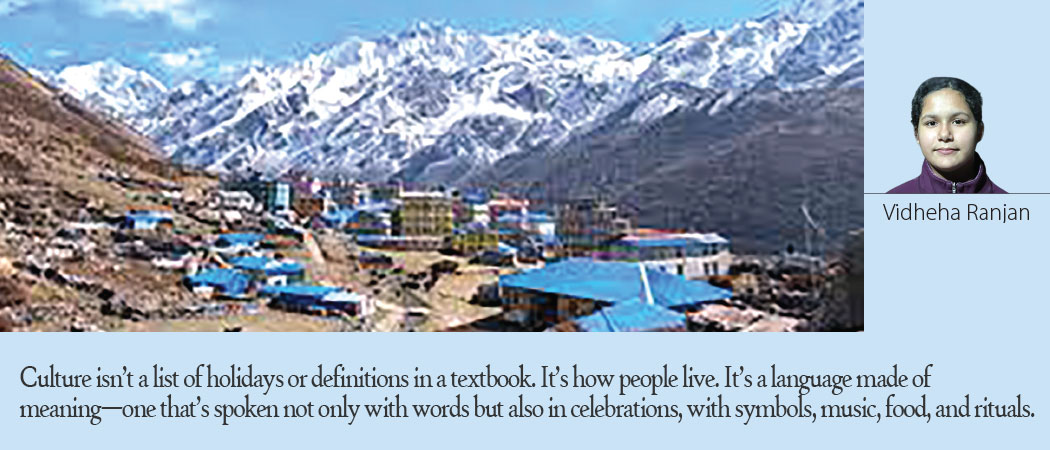
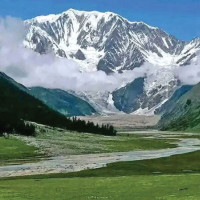
I still recall that night in Langtang – snow on the roofs, sharp stars above, the mountains looming around us, and a group of people around the fire after dinner. Talking and laughing quietly, wrapped in warmth but freezing cold at once. When the singing began, and I didn’t understand the words or know the story behind it, but I understood the feelings, the happiness and the sadness and the caring.
Halfway across the world, I stand in front of a glass case filled with centuries-old jewellery, tools, and ceremonial clothing. A native elder speaks to us. She says, “These aren’t just objects. These are how we remember who we are.” Then I stand looking at the display in the Chesapeake Beach Railway Museum.
Culture isn’t a list of holidays or definitions in a textbook. It’s how people live. It’s a language made of meaning—one that’s spoken not only with words but also in celebrations, with symbols, music, food, and rituals. We’re all doing the same thing in our different ways.
(Vidheha writes on socio-cultural, art and creative themes.)

-original-thumb.jpg)