- Thursday, 30 April 2026

Seto Machhindranath chariot procession begins

By A Staff Reporter,Kathmandu, Mar. 27: Seto Machhindranath chariot procession began on Thursday with the pulling of the chariot from Tindhara Pathsala.
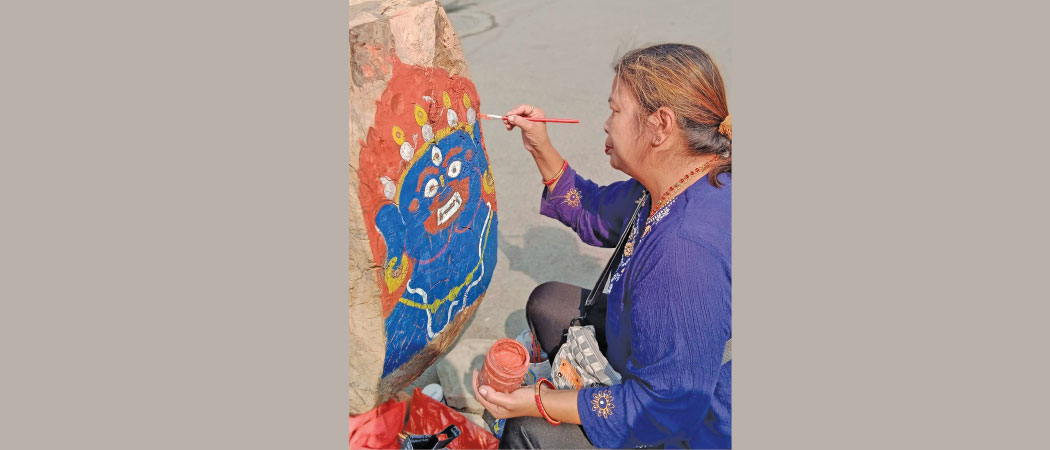
Before the chariot procession, on Thursday morning, a group of painters, Marina Chitrakar, Anita Chitrakar, Geeta Chitrakar, and Sangita Chitrakar painted Seto Machhindranath’s chariot, symbolically “revealing its vision.” This group has continued the tradition for the past 16 years.
After painting the face of Bhairav on the front part of the Dhama and the three eyes on each wheel, the chariot was readied for pulling. This ritual act is known as “revealing its vision.”
The Dhama of a chariot is a crucial component that runs from back to front and supports the entire structure. Made from a single piece of wood, it is essential for the chariot’s stability and movement.
Artist Marina Chitrakar explained that since the time of her grandparents, her family has fulfilled the traditional responsibility of decorating Seto Machhindranath’s Rath Yatra, Kumari Rath Yatra, and Makhan’s Swet Bhairav with traditional paintings.
She said, “In the past, colours for the paintings on the wheels and Dhama were made using clay pigments. However, because the colours washed off in the rain during the procession, poster colours were later introduced.”
Marina, who also creates traditional paintings such as Pouwa, shared that she has carried this responsibility for 16 years, having inherited it from her father. Although painting chariots was traditionally a male responsibility, her father entrusted her with the task because her brothers showed no interest, while Marina always assisted him during the painting of chariots.
She considers herself fortunate to carry on the tradition of her father and ancestors, and to be involved in the sacred work of painting for the chariot procession of the deity.
Sharing her experience, she said, “As the time for the Rath Yatra approaches, I feel excited that the day has come to paint, and I count the days. I also feel the energy of God while painting.”
She added that blue, red, white, yellow, black, and light blue are extensively used in the traditional paintings made on chariots pulled during festivals celebrated in the valley.
-original-thumb.jpg)