- Tuesday, 26 May 2026

Blending Spiritual Values Into Politics

Politics plays a central role in shaping the governance, development and social organisation of any nation. Traditionally, politics has often been understood as a struggle for power and authority within the state. This is a purely materialistic view. However, the eastern spiritual philosophy offers a deeper and more holistic interpretation of politics. For it, politics is not merely a competition for power but an instrument for the moral, spiritual and social evolution of humanity. Further, political ideas integrate nationalism, ethical leadership, democracy and the vision of global unity. Global unity has become crucial due to increasing economic interdependence known as globalisation.
When these ideas are examined in relation to Nepal’s contemporary political conditions, they provide valuable insights into the country’s potential future developmental direction at a time a young party has won the recent elections and is forming the government. One of the most important elements of spiritualism-oriented political thought is the concept of nationalism. It argues that a nation is not merely a geographical territory or a political structure. Rather, it is a living entity with a collective soul and spiritual identity. In his writings, spiritual guru Sri Aurobindo argued that nationalism represents the awakening of people’s collective consciousness. When citizens develop a deep sense of responsibility and unity toward their nation, the nation becomes stronger and more capable of progress. He discredits hollow nationalism.
Diversity
In the context of Nepal, the concept of nationalism has significant relevance. Nepal is a highly diverse society composed of multiple ethnic groups, languages, religions and cultural traditions. According to the latest census data, Nepal has more than 120 ethnic groups and over 120 languages. Such diversity requires an inclusive form of nationalism that respects cultural pluralism while strengthening national unity. Nepal’s geostrategic positioning also demands stronger nationalistic orientations among the citizens. The vision of spiritual and cultural nationalism provides a framework for understanding how diversity can coexist with national integration.
Another key aspect of eastern political philosophy is the importance of morality and ethical leadership in politics. It is believed that politics without moral values inevitably leads to bad governance, selfishness and social decay. Accordingly, it proposes that political leaders should possess qualities such as integrity, self-sacrifice, responsibility and commitment to the welfare of the nation. This perspective is particularly relevant to Nepal’s contemporary political challenges. Nepal has experienced significant political transformation over the past few decades, including the restoration of democracy in 1990, the end of monarchy in 2008 and the adoption of a federal democratic constitution in 2015.
Despite these institutional changes, political instability remained a major issue. Since 1990, Nepal witnessed more than thirty changes of government. This change also compromised morality and ethics in our politics and brought public distrust and disagreement among the people. Despite some notable progress in socio-economic indicators, Nepal’s quality of governance did not improve very much in the last 35 years. This situation highlights the need for stronger ethical standards and institutional accountability in Nepali politics as strongly emphasised by the eastern spiritual philosophy.
Spiritualism also emphasises the relationship between democracy and human consciousness. While democratic ideals such as political participation and individual freedom are important, it argues that democracy cannot succeed solely through constitutional structures and formal institutions. Instead, the effectiveness of democracy depends largely on the level of awareness, responsibility and participation among citizens. Despite party organisations and relatively high voter turnout in the past elections (60-78 per cent) in Nepal, challenges remain in terms of political education, civic engagement and institutional trust. Strengthening democratic culture through education, transparency and participatory governance is essential for ensuring a truly functional democracy.
Another major dimension of spiritually guided political thought is its vision of global cooperation and human unity. In his book, The Ideal of Human Unity, Sri Aurobindo argued that human civilisation is gradually moving toward greater international cooperation and integration. Although nation-states will continue to exist, global institutions and cooperation would become increasingly important in addressing common challenges such as war, conflicts, economic inequality and environmental problems. For this the United Nations must be revitalised.
For Nepal, international cooperation is especially important due to its geographic and economic context. Nepal is a landlocked country located between two major global powers India and China. Maintaining balanced diplomatic relations with both neighbours should be crucial component of Nepal’s foreign policy. In addition, Nepal relies significantly on international trade, tourism, foreign investment and remittances from migrant workers abroad. Nepal also faces structural economic challenges, such as large-scale, undesirable migration of young workers. While remittances support the economy and livelihood, excessive outmigration can create long-term challenges related to domestic employment, productivity, demographic balance and overall national development. Nepal may lose its demographic dividend.
Social justice
From the sage Sri Aurobindo’s philosophical perspective, genuine development must go beyond economic growth. He believed that the true economic progress of society depends on the development of human spiritual consciousness, ethical values, social justice and social harmony. Applying this perspective to Nepal means that the country’s future development strategy should emphasise both economic progress and human development. Investments in all-round education, healthcare, technological innovation and good governance are essential for building a stable and prosperous society that is also ethical and just.
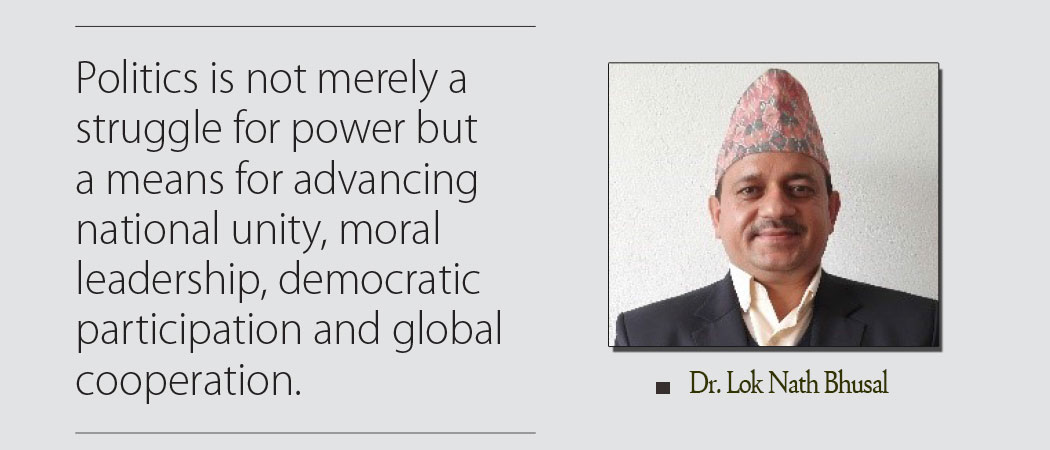
The eastern spiritual philosophy of the great sage Sri Aurobindo and other spiritual gurus offers valuable insights for understanding the true purpose of politics, especially for the recently elected young parliamentarians. Yoga is good, but they must understand the political lessons of Eastern spiritual philosophy. They should realise the fact that politics is not merely a struggle for power but a means for advancing national unity, moral leadership, democratic participation and global cooperation. Nepal’s current political challenges can be resolved by utilising these ideals for ensuring political integrity and sustainable development.
(Dr. Bhusal is a development expert.)