- Tuesday, 26 May 2026

Expectations From New Government

Nepal is soon going to have a new federal government under the leadership of Rastriya Swatantra Party (RSP)’s senior leader Balendra Shah, as the party has secured a landslide victory in the recent elections to the House of Representatives (HoR). The RSP has a historic mandate of running a majority government for a full five-year term. The four-year-old party has mustered nearly two-thirds majority in the 275-member lower house of the federal parliament by winning 182 seats. The country has witnessed a considerable entry of new and younger parliamentarians.
However, the March 5 poll has proved to be unfavourable for traditional political parties like the Nepali Congress (NC) and CPN-UML, with the former and the latter winning only 38 and 25 seats, respectively. The Rastriya Prajatantra Party (RPP), which has been campaigning for restoring Nepal as a monarchical and Hindu state, and several Madhes-based parties have also suffered a setback in the elections.
Frustration
All these parties have been forced to pay the price for their failure to perform as per people’s needs and aspirations when they remained in power for years. They are blamed for getting involved only in power play instead of working by putting the well-being of the people and the country at the centre. That led to a growing frustration among voters towards old political parties. And it was one of the main reasons for the unprecedented support extended by voters to RSP in the recent elections.
The party that came to the limelight after the elections had won just 20 seats in the HoR in 2022. Although the NC was in the election fray under the new leadership of Gagan Kumar Thapa after holding the Special Convention, the party faced a humiliating defeat. This clearly reflects people’s aspirations for change. An internal feud within NC may also be a factor behind the party’s dismal performance in elections.
Following the announcement of the election results of both the first-past-the-post (FPTP) and proportional representation (PR) categories, all parties have begun reviewing their poll performance. The poll outcomes have given a wake-up call for the traditional parties, showing poor performance. However, the poll results have been very encouraging for the RSP in view of the overwhelming public support it has gained to lead the country. That the party has received a comfortable majority, if not two-thirds majority, in HoR has proven the assumption false that no party can get majority under the existing electoral system. The loss of public trust by the erstwhile ruling parties may also be a great lesson for RSP because people have the power to punish those who only serve their partisan and petty personal interests.
The unwavering public support to the RSP is indicative of the fact that the people have expected much from the new government. They have hoped that it would make sweeping reforms in governance by cracking down on rampant corruption and making service delivery more efficient and effective. Despite assurances from the political parties and their leaders to work for public welfare, citizens have been fed up with rising levels of corruption and misuse of public resources. Even after the change in the governance system, citizens have rarely felt any tangible improvement in service delivery.
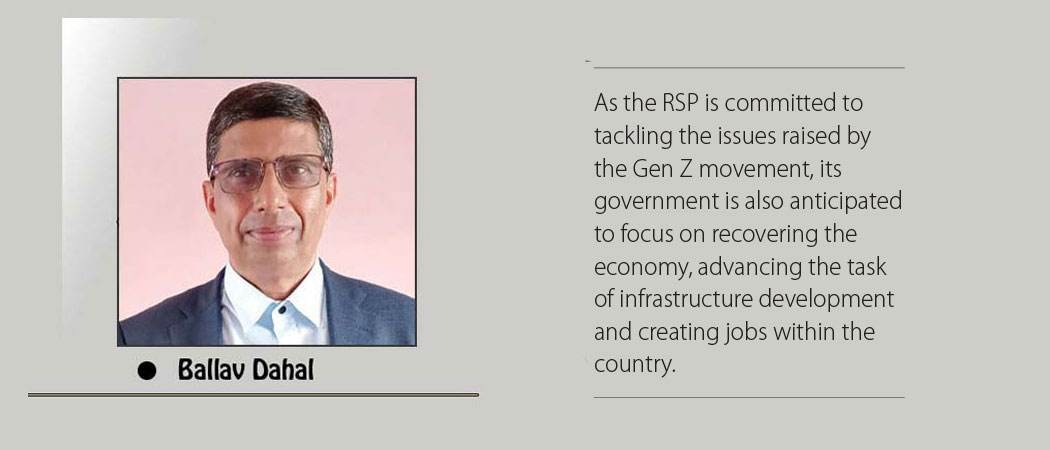
As the RSP is committed to tackling the issues raised by the Gen Z movement, its government is also anticipated to focus on recovering the economy, advancing the task of infrastructure development and creating jobs within the country. With Nepal having a good number of young population, it is necessary for the government to come up with a concrete plan for utilising the demographic dividend for the country’s overall development. For this, there should be ample employment opportunities within the country.
Such opportunities may alone help check the bourgeoning brain drain problem. Attracting investment is essential for creating jobs. But, several private industries and businesses were vandalised and burnt during the Gen Z uprising. Such activities have shied away potential investors. Therefore, the government needs to ensure security to investors and their investments in order to take them into confidence.
The government will have to make necessary efforts to remove Nepal from the grey list of the Financial Action Task Force (FATF). It has placed the country on its grey list more than a year because of the country’s inability to enforce adequate legal reforms against money laundering and terrorist financing. The country has reeled from such an adverse situation due to poor supervision of cooperatives and real estate sectors.
Government reports have shown that many cooperatives, especially saving and credit ones, have been in trouble owing to embezzlement of billions of rupees. Hundreds of thousands of depositors have been unable to get their deposits back. This is also a burning issue the new government will have to deal with.
Attention
With a significant annual increase in public debt, the country has been bearing the brunt. As of mid-March this year, the country’s total public debt reached Rs. 2.878 trillion. The amount accounts for about 47 per cent of the gross domestic product (GDP). What is a matter of serious concern is that the debt has not been spent properly on productive sectors, income generation and the sectors providing long-term benefits.
With low revenue generation in recent years, public debt is said to have been used even for current expenses, while capital spending has been falling sharply. Apart from these, the government will have to pay urgent attention to rescuing more than 1.7 million Nepalis working in the Gulf countries. If the ongoing Iran war continues, they must be rescued as soon as possible. For this, it is necessary to devise a plan and manage resources.
(The author is a former deputy executive editor of this daily.)