- Tuesday, 9 June 2026

Dalits Still Endure Violence And Exclusion

On February 21, Santa Bahadur Chandaro (Bishwokarma) of Malmul in Pokhara–32 went to attend the wedding of his neighbour Kashiram Ghimire’s son. While he was waiting in line for the reception meal, his neighbour, Sabitri Baral, quietly approached him and said, "Please do not stand in line." I will bring you food on a plate, and we can sit and eat separately. " Feeling insulted, Chandaro refused the invitation and returned home. On February 23, 16-year-old Inisha BK, a resident of Gurbhakot Municipality-6, Badakholi, and a permanent resident of Birendranagar, was raped and murdered. The family claims that Inisha's non-Dalit boyfriend, along with three friends, gang-raped her and murdered her. The initial police report states that she was raped and murdered.”
On June 1, 2011, the government implemented the Caste-based Discrimination and Untouchability (Offences and Punishments) Act. Nonetheless, even after 15 years since this legislation took effect, Dalits still experience discrimination, leading in serious situations to fatalities and displacement. On August 30, 2011, a fatal incident occurred in Dailekh as a result of caste-related discrimination. Sete Damai was attacked and killed with a khukuri following his son Santa Bahadur's marriage to Raj Kumari Shahi, a woman from a so-called higher caste. Since that event, 17 Dalits have died due to circumstances associated with caste discrimination. It's frequently claimed that there are only two genders, male and female. However, in Nepal, where Dalits represent 13.4 per cent of the population, many still fight for basic dignity. Despite the nation's adoption of a federal democratic republic framework, the marginalisation of Dalits remains prevalent. Dalits continue to struggle to access their human rights in a dignified manner. Despite constitutional guarantees, legal provisions, international agreements, and decades of Dalit activism, efforts to liberate Dalits from discrimination and oppression have yet to succeed.
Low representation
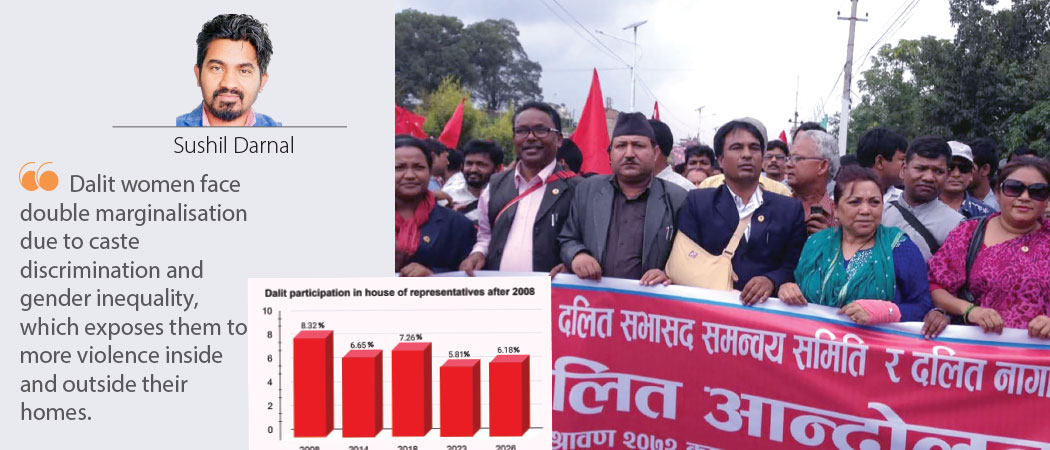
The representation of Dalits in state institutions remains fragile. Currently, only eight Dalits—about 6.18 per cent—are members of the House of Representatives. Looking back at participation in policy-making levels, King Mahendra nominated Dr Jhamanram Paswan and Siddha Bahadur Khadki to the Advisory Council (Rajya Sabha) in 1955. In 1958 and in 1959, he nominated Ganesh Yogi and Saharshanath Kapali. Similarly, between 1963 and 1987, Dhanman Singh Pariyar, Har Kumar Singh, Hiralal Bishwokarma, and T.R. were also involved in the movement. were also involved in the movement. were also involved. Bishwokarma and Tek Bahadur Bishwokarma were nominated to the National Panchayat.
In 1992, only one Dalit served in the House of Representatives (HoR). Dalit representation was completely absent from the HoR in 1995 and 2000.
Dalit participation increased somewhat in the interim legislature formed in 2007, where 18 Dalits (5.47 per cent) were represented. In the Constituent Assembly of 2008, the number increased to 50 (8.32 per cent). Later, 40 Dalits (6.65 per cent) served in the 2016 Assembly, while 20 Dalits (7.27 per cent) were elected to the HoR in 2018 and 16 (5.81 per cent) in 2023. Considering the size of the Dalit population and the centuries of discrimination and exclusion they have faced, this level of representation remains inadequate. In fact, since 2008, Dalit representation has shown a declining trend, suggesting that their presence in policy-making institutions is still not fully accepted.
Currently, six Dalits serve in the National Assembly. Historically, representation in the upper house has also been limited: one Dalit member in 1960; two in 1992; one each in 1994 and 1995; two in 2000; and two in 2002. Rampreet Paswan served as Deputy Chairperson of the National Assembly from August 8, 2001, to February 1, 2005. In 2018, the National Assembly had 12 Dalit members.
Across the seven provinces, 31 of the total 550 provincial assembly members (5.63 per cent) are Dalits. Provincial assemblies represented 34 Dalits in 2018, a decline from the previous term. Province-wise, there are four Dalits from Koshi Province, seven from Madhesh, two from Bagmati, six from Gandaki, five from Lumbini, four from Karnali, and three from Sudhurpaschim. Karnali and Gandaki show relatively better representation, while Bagmati—which includes the federal capital, Kathmandu—has the lowest. Tilak Pariyar served as provincial chief of Madhesh and Karnali provinces in 2020 and 2022.
So far, eight members of the Dalit community have served as cabinet ministers on a total of ten occasions. However, in the governments formed after the 2023 elections under the leadership of Pushpa Kamal Dahal and KP Sharma Oli, not a single Dalit has been appointed as a cabinet minister.
Altogether, 19 individuals from the Dalit community have served as assistant ministers or ministers of state on 24 occasions. At the provincial level, only four Dalits have served as cabinet ministers and six as ministers of state.
Just three Dalits were elected mayors in the 2023 municipal elections. Sixteen Dalits serve as deputy mayors or vice-chairpersons, up from 11 in 2018. Seven Dalits serve as rural municipality chairpersons, and there are 150 ward chairpersons from the Dalit community.
Furthermore, four chairpersons of district coordination committees and five deputy chairpersons are Dalits. In addition, 6,620 Dalit women serve as ward members. According to available data, Dalits account for 21 per cent of local representatives. Their representation in leadership roles outside of quotas is still less than 3 per cent, despite an increase in their presence at the ward level.
Dalit representation in the civil service stands at 2.11 per cent. Participation in the judiciary and foreign service is about 1 per cent, while representation in political parties ranges between 5 and 9 per cent. However, Dalit presence at decision-making levels remains extremely limited. Despite constituting 13.4 per cent of the population, approximately 42 per cent of Dalits continue to live in poverty.
Dalits account for 9.75 per cent of personnel in the Nepali Army, 11.09 per cent in Nepal Police, and 8.1 per cent in the Armed Police Force, though their presence in senior ranks remains low. Around 5 to 7 per cent of schoolteachers are Dalits, while about 5 per cent teach at the university level. Dalits account for about 7 per cent of the health workforce and around 1 per cent in the judiciary. The literacy rate among Dalits is reported to be under 9 per cent.
For the Dalit community to meaningfully participate in the executive and legislature, it is necessary to enact and effectively implement laws in accordance with Article 40 of the constitution. Ensuring Dalit representation through constitutional and legal provisions is essential.
Political neglect
If one looks at the statutes, election commitments, and speeches of political parties, it may appear that the problems faced by Dalits should have been resolved long ago. The Nepali Congress, the country’s oldest democratic party, adopted a resolution to eliminate caste discrimination and untouchability during its fifth general convention in 1953, yet discrimination persists.
The statutes and manifestos of the CPN-UML, the CPN (Maoist Centre), the Rastriya Swatantra Party, the Madhesh-based parties, and other emerging parties all emphasise Dalit inclusion and the elimination of untouchability. In reality, however, implementation remains limited.
In the Nepali Congress, Prakash Rasaili Snehi serves as joint general secretary, and nine out of the party’s 134 central committee members are Dalits. Similarly, the CPN-UML has one Dalit office-bearer, Chhabi Lal Bishwokarma, who serves as secretary. Seventeen members of its 301-member central committee are Dalits. The Rastriya Swatantra Party has no Dalits among its nine office-bearers, though seven Dalits are among its 79 central committee members. The party states in its manifesto that inclusion is not merely about fulfilling quotas but also a legal and moral commitment to ensuring meaningful representation for all communities.
The CPN (Maoist Centre) has only five Dalits in its 138-member central committee. The Nepali Congress has repeatedly promised in its election manifestos to ensure representation and access for Dalits at all levels of the party and the state. The Nepali Congress included similar commitments in its manifestos in 2008, 2014, 2018, and 2023. Congress had only five Dalit representatives out of 89 seats.
The UML has also reiterated commitments regarding Dalit representation and the elimination of untouchability in successive manifestos. In the dissolved HoR, six of its 78 members were Dalits. Only two Dalits were elected from its 32 seats, despite the CPN's (Maoist Centre) repeated promises. The Rastriya Swatantra Party, which won 20 seats in 2023, has two Dalit members in Parliament.
These facts suggest that political parties have not adequately addressed Dalit representation, and their commitments often diverge from their actual practices.
Legal gap
There is a law, but implementation remains weak. The Muluki Ain of 1964 originally included a provision stating that untouchability should not be practised. However, it also allowed traditional customs, effectively creating exceptions. The Constitution of 1990 prohibited untouchability in public places, but that provision was often interpreted as permitting such practices in private spaces. The Interim Constitution of 2007 also prohibited untouchability, though effective implementation remained lacking. It has been 19 years since the restored HoR declared Nepal a nation free from caste-based discrimination and untouchability on June 4, 2006. Yet discriminatory provisions and practices have persisted in various forms.
The preamble of the Constitution of Nepal 2015 commits to eliminating all forms of discrimination and building an egalitarian society based on proportional inclusion and participation. Article 24 clearly states that no person shall be subjected to untouchability or discrimination in public or private places based on caste, origin, community, profession, or other identity. Article 40 guarantees Dalits the right to participate in all state bodies according to the principle of proportional inclusion and calls for special provisions to empower the community in employment and education. The Constitution also provides for free education, with scholarships for Dalit students from primary to higher levels. However, many of these commitments remain largely on paper.
Caste-based violence
According to the National Dalit Commission, about 60 per cent of reported cases involve caste-based discrimination, abuse, and physical assault. Dalits often face denial of housing, social ostracism, and violence because of their caste. Some victims report that police have refused to register complaints when they seek justice, including in cases of sexual violence. Dalit women also face exploitation in workplaces and in relationships that break down due to caste prejudice. A study by the Samata Foundation recorded 56 incidents of caste-based discrimination and untouchability affecting Dalit human rights in the past 11 months. The foundation reported 60 such cases in 2024 and 55 in 2023. The study also recorded additional incidents indirectly related to Dalit rights.
In 2025 alone, there were 16 incidents of caste-based discrimination in public or private places. Other cases involved discrimination in employment, trade and consumption, inter-caste marriages, verbal abuse, physical assault, and exclusion from religious activities. Records also show several serious crimes in which caste prejudice played a role, including suspicious deaths, assaults, and cases of rape and murder. According to the Jagaran Media Center, 17 Dalits have been killed in caste-related incidents since the implementation of the Caste-based Discrimination and Untouchability Act.
Double marginalisation
Dalit women face multiple forms of violence. According to the National Dalit Commission, 46.55 per cent of complaints involve gender-based violence. Caste discrimination is present in 33.33 per cent of these cases. Other issues include abandonment after marriage, failure to register births or citizenship for children, and rejection by families. Police records show that 11.54 per cent of Dalit women have experienced violence in the past 15 months.
According to the National Women’s Commission, 11.34 per cent of recorded incidents during the same period involved Dalit women. Records from the Women’s Rehabilitation Center (WOREC), Nepal, show that Dalit women account for 27 per cent of all women victims of violence.
In a study conducted between October and December 2025, WOREC documented 345 incidents of violence against women, including the murder of four Dalit women from the Tarai. The National Human Rights Commission reports that Dalit women constitute about 10 per cent of victims of violence. Data from INSEC shows that 22.58 per cent of women subjected to violence belong to the Dalit community. These figures indicate that Dalit women experience disproportionately high levels of violence relative to their population. Analysis of media coverage also suggests that caste discrimination receives limited attention, with only about 11 per cent of coverage addressing the issue.
According to the 2022 census, 39 per cent of Dalit women are illiterate. In the Tarai, 31.6 percent of Madhesi Dalit women have never attended school. Illiteracy among Dalit women stands at 55.9 per cent in the Tarai and 29.9 per cent in hill regions. Only 15.7 percent of Dalit women own property in their names.
In 2007, six Dalit women were represented in the Interim Legislature-Parliament for the first time. The number increased to 25 in 2008 and declined to 22 in 2014, 14 in 2018, and eight in 2023. To date, no Dalit woman has served as a cabinet minister in the federal government. Approximately 7 per cent of rape victims in Nepal are Dalit women, according to WOREC Nepal. The World Bank has noted that Dalit women face double marginalisation due to caste discrimination and gender inequality, which exposes them to more violence inside and outside their homes.
(Darnal is a journalist at Rastriya Samachar Samiti.)