- Thursday, 30 April 2026

A Close Look At The Mᾱnas
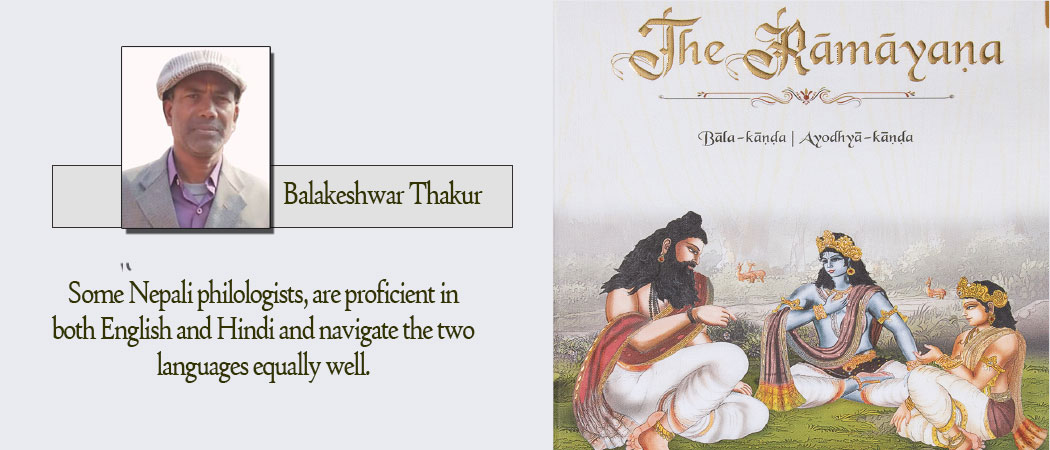

Drawing a conclusion on the basis of speculation and hearsay is a wrong trend. Recently, an Indian woman teacher at a quiz event was heard asserting that the Rᾱmᾱyaṇa, The Mᾱnas, popularly called by Tulasidas, is in the Awadhi language. On her TikTok, Sweta Pandey, also known as 'Poetess', addressed the same issues. When cross-questioned, she shied away. Some Nepali philologists, versed in both, are proficient in both English and Hindi and navigate the two languages equally well. The issue doesn't stem from their expertise, but rather from the assumptions they make.
The Mᾱnas's author was born in Ayodhya, so people think its language is Awadhi. Here they miss the point: they ought to know that Tulsidas did not live all his life in Ayodhya. Son of a Brᾱhmin, he had to leave for Kashi, the modern Banāras, where he had the privilege of studying the Vedas, Upanishads, Purans, and other scriptures for 15 years at a stretch. After completing his studies, he attended the Rᾱma Kathᾱs (narrations about Lord Rama) given by his gurus, and he also travelled to various locations to tell the same stories, familiarising himself with different languages and dialects. Truly speaking, Hindi laid its foundation at the hands of Tulasidas, assimilating, adopting and adapting contemporary languages, Awadhi in particular, and Nepali, Magahi, Bajjika, and Bhojpuri in general, all of which have branched off from Sanskrit. There is no tinge of Maithili in the epic. Does the Maithili tongue have roots in Magahi, Bajjikᾱ, and Bhojapuri? A careful reading of the Mᾱnas reveals a south-north distribution of the languages mentioned above. Just take the case of the Nepali language. There is no Kᾱnda (chapter) in it without at least a few Nepali words. The Lankā Kānḍa contains at least 74 verbs, in addition to words from other parts of speech. The following couple of vΩœerses on page 777 in the Lankᾱ kᾱṇḍa are a striking Example:
Mandodari sunyo Phrabhu ᾱyo
Kautukahi pᾱdhodi bandhᾱyo
‘Sunyo’, ‘ᾱyo’ and ‘bandhᾱyo’ are pure Nepali verb words contained by these two very short verb lines. It does not mean that the Mᾱnas are Nepali. Neither does it imply that it is in the Awadhi language simply because it resembles Hindi. The thriving of the Hindi language can be likened to the process the English language followed for putting up its empire.
The English scholar knows well that the English language has retained only about 10 percent of its original words and has built itself up on languages like French, Greek, Latin, and others. The following distinctive features determine the language of the Mᾱnas to be Hindi:
a) The gender of the verb must agree with the gender of the subject in all tenses, however, in the past when followed by the ‘ne’ case ending, it is not the subject’s gender but the object's. The verb’s gender goes with the following: i) sayan kiye dekhᾱ kapi tehee
mandir mahu na deeki baidehi (page no. 719, Sundarkᾱnda) ii) Puni, Saba, Kathᾱ, Bibheeshan, Kabee
jehi bidhi janak sutᾱ taha rahee (page no. 721, Sundarkᾱnda) iii) nara bᾱnarahi sanga kahu kaise
kahee kathᾱ bhai sangati jaise (page no. 726, Sundarkᾱnda) iv) kahahu tᾱta kehi bhᾱnti jᾱnaki
rahati karati rachchhᾱ swaprᾱnaki (page no. 741, Sundarkᾱnda)
The 'ne' case ending is deleted from (ii) and (iii) to equate the metre of the verses. b) In addition to the concord between nouns, verbs, and objects, the agreement between the object's number and its past verb is also well observed in the Mᾱnas:
i) main durbachan kahe bahu tere
kaha muni pᾱpa mitihi kimi mere (page no. 147, Bᾱlakᾱnd)
ii) nᾱth dekhi pada kamala tumhᾱre
iii) aba pure saba kᾱma hamᾱre (page no. 155, Bᾱlakᾱnd )
iv) bachan kahe kachhu janak kumari (page no. 741, Sundarkᾱnd)
‘Durbachan’ and ‘kama’ are plural nouns without the ‘ne’ case ending; therefore, the past plural verbs ‘kahe’ and ‘pure’ are matched. ‘Papa’ is being plural, the plural possessive adjective ‘mere’ is used.
c) Hindi grammar says that the gender of the noun and its pronoun must match. In the sentence "Mama Janakahi, tohee rahee mitai” (You and my father had a friendship), the feminine noun ‘mitai’ and the feminine pronoun ‘tohee’ match together in their gender.
d) The use of the first-person "main" (I) also marks the Mᾱnas as being in Hindi. These features from (a) to (d) are absent from the other sister languages. The spellings of words used by Tulasidas are those that suited the contemporary common folk. They baffle the modern readers somewhat, as Geoffrey Chaucer's do.
Pt Jawaharlal Nehru, the greatest annotator Hanuman Prasad Poddar, and noted Hindi litterateurs share the same perspective: the Mᾱnas have been written in Hindi. In the last chapter, titled Rᾱmayana and the Mahabharat, of his book Nehru Letters, Nehru writes on page 79 that Tulsidas composed the greatest epic in Hindi. Hanuman Prasad Poddar comes up with a breathtaking revelation regarding its language.
He says in his biography of Tulasidas that the latter, aged 77, first initiated writing it in the Sanskrit language. But then, what he wrote by day vanished by night. This miracle happened for seven consecutive days; thereupon, on the eighth night God Mahadeva and Parvati appeared in his sleeping room and asked him to leave Kᾱshi for Ayodhya and compose the sacred text there in the Hindi language, so that it would reach more and more devotees of Lord Rama, who too is his God who ke keeps in his meditation day and night. Tulasidas’s 15th couplet in the Bᾱlkᾱnda also hints at the language. Despite all this, Hindi litterateurs take pride in writing the epic in that language.
(The author is a retired Associate Professor of English, Janakpur.)