- Sunday, 24 May 2026

Proactive Diplomacy Still Missing In Action
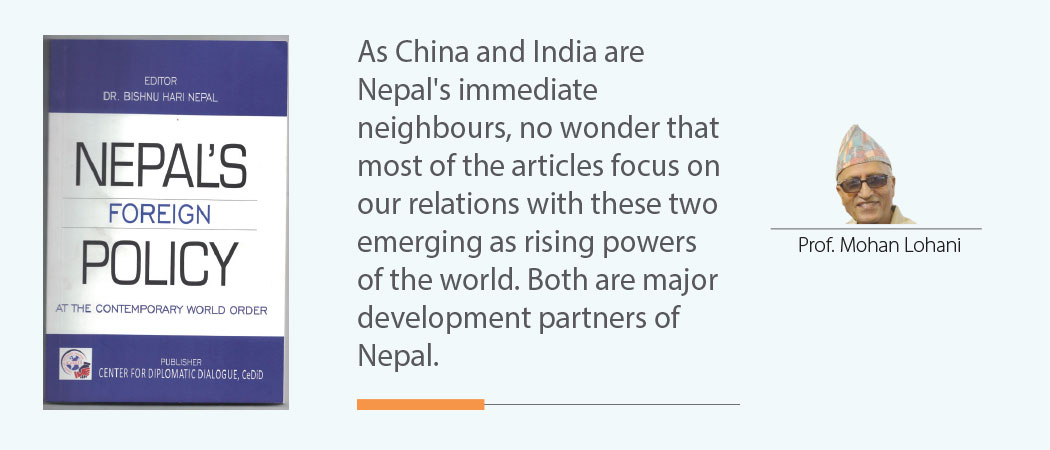

The book is a collection of 15 articles, including a foreword and a message from Dr. Bishnu Hari Nepal, editor of the book, and Chairman of the Centre for Diplomatic Dialogue Dr. Shambhu Pokharel, respectively. The contributors to this book are well-known scholars, academics, diplomats, former secretaries of the Nepal government and foreign policy experts. The contributors have examined and analysed Nepal's foreign policies from multiple perspectives.
While views and opinions differ on specific issues and the implementation aspect of foreign policy, there is a consensus that the primary objective of foreign policy is to protect and promote Nepal's national interests by safeguarding national independence, sovereignty, and territorial integrity.
As China and India are Nepal's immediate neighbours, no wonder that most of the articles focus on our relations with these two emerging as rising powers of the world. Both are major development partners of Nepal. Despite occasional setbacks and irritants in bilateral relations, balancing relations with both is in Nepal's long-term national interest.
Former foreign minister Ramesh N. Pandey, however, points out that Nepal's foreign policy, at a time when the country finds itself trapped in the strategic radar of China and the US, is both unbalanced and unstable. Elaborating further, he states there is a trust deficit in our relations with both India and China, and as a result, the country is likely to become a battleground for foreign forces. As Nepal finds itself in a critical and challenging situation, Pandey advises those at the helm to get rid of narrow-mindedness, an insular outlook and the tendency to surround oneself with sycophants. He further adds: to learn from history and safeguard geography, political stability, mature leadership and diplomatic skill are essential from a strategic perspective.
Focusing on Nepal-India relations, former secretary Surya Nath Upadhyay is critical of, to borrow his expression, India's 'hegemonic tentacles', and to break them, he recommends the need for all parties to arrive at a national consensus. It is true that as the country remains divided, India will exploit this situation to impose its own decision. Senior journalist Prakash P. Upadhyay too categorically states that the imperial mentality inherited from British India continues to shape independent India's Nepal policy.
Prof. Dr. Shreedhar Gautam, former secretary general of the Nepal Council of World Affairs (NCWA), firmly believes that playing one country off against the other does not pay today. He suggests Nepal should learn from history and become self-reliant, economically prosperous, and peaceful.
Another former secretary, Dr. DN Dhungel, discusses water policies and plans of Ganga Basin countries, describing India as a major player among such countries. While the late King Birendra of Nepal, addressing the 1st SAARC summit in Dhaka, in 1985, had referred to abundant water resources of the country and expressed Nepal's readiness to develop and share resources like the waters from the snowcapped Himalayas for the collective benefit of all the people of the region (that is, on the basis of regional cooperation), Dr. Dhungel says India has been pursuing a policy of bilateralism as against the spirit of regional cooperation. Considering the strained Indo-Pak relations, Dr. Dhungel sees no possibility of fruitful cooperation among South Asian countries in all sectors, including water and energy.
He states India's interest is primarily in water, not hydroelectric power. Commenting on the implementation aspect of some controversial treaties like the Mahakali treaty signed between Nepal and India in 1996, Dr. Dhungel said that even after more than two decades of its signing, main provisions of the treaty, including the preparation and finalisation of the detailed project report on the Pancheswor multipurpose project, remain unrealised. Nevertheless, Dr. Dhungel proposes a water relationship among Bangladesh, Nepal and India on a sub-regional basis (as the 3 countries fall under the Ganges River basin), but, again, such cooperation would depend on India's policy, he concludes.
Shital Babu Regmee, another former water resource secretary, recommends an approach based on mutual trust, cooperation and confidence building. According to him, the problem, if addressed jointly, is not too complex for a solution acceptable to both countries.
General Binoj Basnyat, a noted security expert, examines and analyses China's engagement in Nepal with its BRI project already accepted by Nepal under an MoU signed in 2017. China has come forward with three major initiatives, like Global Development Initiative (GDI), Global Security Initiative (GSI) and Global Civilisation Initiative (GCI). Nepal has not yet fully responded to three initiatives. Basnyat says a small nation like Nepal must 'watch and wait' and should be extra 'cautious' before accepting any proposal unless it meets the country's interest for prosperity or would contribute to stability. According to the writer, maintaining a balanced relationship with China and India remains Nepal's key and central component of the foreign policy. He further argues that the Nepal-China relationship is revolving around US strategic policies as well as India's approach with the US.
Dr. Upendra Gautam, a sinologist and currently general secretary, China Study Centre, writes critically about Nepal's open border with India, as it has not only affected the security of India and Nepal but has also adversely affected the security of the Nepal-China border, which is bilaterally regulated. The open border, he says, allows both extremists and terrorists to traffic innocent Tibetans to India through Nepal and to orient them to penetrate into China to disturb China's territorial security. The existing open border from the strategic perspective militates against Nepal's independence as well as political and socio-economic security.
Veteran politician CP Gajurel is critical of Nepal's hurried reaction to condemn the Russian attack on Ukraine, although Nepal claims to be a nonaligned country. Gajurel's view differs from the official statement.
In my own article 'Nepal's Foreign Policy: Challenges and Prospects' published in this anthology, my observation is: 'While India and China, Nepal's immediate neighbours, abstained from voting, the majority of countries, including Nepal, voted against the Russian invasion of Ukraine in the UN General Assembly. Nepal has stated that it has not abandoned the policy of nonalignment and has justified its vote as a 'principled stand against foreign aggression' (p. 78).
Ambassador Dr. Dinesh Bhattarai, too, comments on the ongoing Russia-Ukraine war from the perspective of nuclear threat, as the war has already destabilised the world. The concluding sentence of his article sums up his concern at the gravity of the situation: 'If the war is not resolved through dialogue and diplomacy, the use of nuclear weapons is sure to produce great and catastrophic consequences for the entire world.'
Dr. Bishnu Raj Upreti, a well-known conflict resolution expert, writes exhaustively and critically examines and analyses the lack of competent negotiating capacity of Nepal at international conferences. A mere statement at the conference is only a rhetorical exercise if it is not backed by the negotiating capacity at the negotiating table. Nepal has vigorously pleaded for climate justice and finance at international conferences, but it has yet to show its negotiating capacity to benefit from conference decisions. Nepal has not been able to achieve much due to a lack of negotiating skill.
Atul Koirala's article about digital diplomacy sounds reasonable. Likewise, Ambassador Basnyat's article provides a comprehensive survey of the evolution of Nepal's foreign policy dating back to the Divyopadesh of Prithvinarayan Shah.
Dr. Shambhu Pokharel pleads for proactive diplomacy. Such diplomacy will not only make Nepal's presence at international forums more visible but will also bring this country into prominence by actively collaborating during global discussions with other nations to address issues of global concern and seek practical and realistic solutions to them. There are two appendices included in the book in which Dr. Bishnu Hari Nepal, editor of the book, refers to a historic document to which he has contributed The International Relations and Human Rights Committee of Nepal's parliament unanimously passed it 14 years ago.
Policymakers, authorities, and other stakeholders should heed the anthology's articles' views and recommendations.
(The author is a former ambassador.)

-original-thumb.jpg)