- Monday, 8 June 2026

Incredible Electoral Wipeout

The sweeping victory of the Rastriya Swatantra Party (RSP) in the election held on 5 March has overturned conventional wisdom about psephological predictions. When the Sushila Karki government set the election date, many political analysts thought it was impossible to hold an election in the fluid political environment so soon after the Gen Z uprising. The CPN-UML had declared that it would not participate in the election. Even those who were for the election feared that the electoral results might produce as fractured a parliament as before, with no parties winning enough seats to form a majority government, giving rise to deeper instability and a more chaotic post-election landscape.
Against all assumptions, however, the voters gave a huge mandate to RSP, a party that had neither a nationwide organisational base nor any recognisable ideological orientation. In this election, the RSP wiped out entire old political parties, including the Nepali Congress, the UML and the Nepali Communist Party in a manner not experienced before during the three-decade-long exercise in multi-party democracy. This party has emerged as a formidable political force, winning 182 seats, which constitutes a near two-thirds majority, short of only two magical numbers, which would give it enough mandate to amend the constitution, restructure the political system and sign international treaties requiring parliamentary endorsement.
Shattering of perception
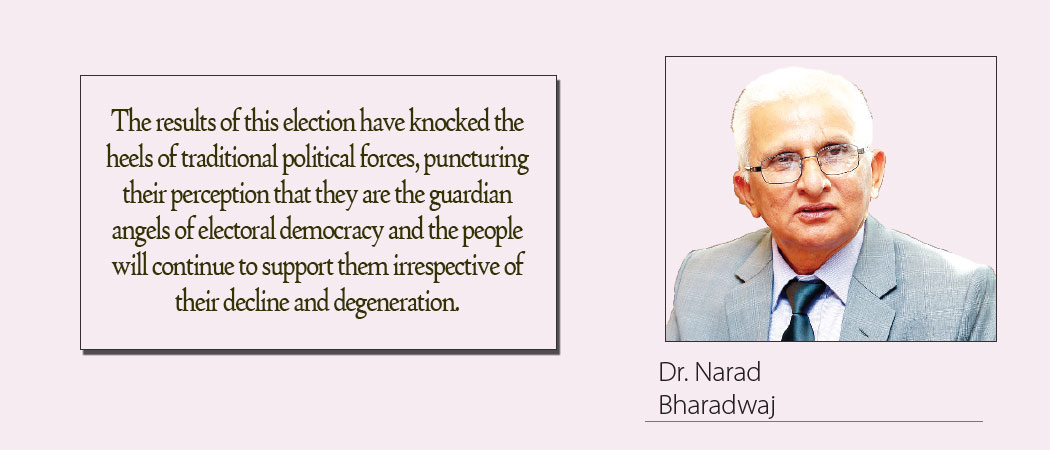
The results of this election have knocked the heels of traditional political forces, puncturing their perception that they are the guardian angels of electoral democracy and the people will continue to support them irrespective of their decline and degeneration. Another important point of insight this election has provided is that people want change but the iconic view towers, tunnels or selective stretches of elegant urban roads do not constitute change if they do not touch the lives of ordinary people.
Coming as it did on the heels of the September revolt, this election was premised on setting up a clean government consisting of youth leaders for controlling corruption, checking unprincipled alliances for clinging to power, ensuring good governance, justice, equality and inclusion. In the past, a two-thirds majority was used by coalition governments to endorse the Mahakali Treaty, promulgate the Constitution of Nepal 2015 and approve the inclusion of Limpiyadhura and Kalapani on the official map of Nepal. This time, however, the electorate has given that sweeping mandate to a single party. If this electoral power is not used in full cognizance of internal political polarisation and geopolitical shifts occurring around us, it may produce long-term negative repercussions for the country.
The RSP is a new force that has emerged from the massive public resentment against the old political parties and their poor performance. In the past, the electorate witnessed widespread corruption involving people in power, yet no one was held accountable, even when intercepted audio recordings of illegal transactions were made public by the media. Instead of taking actions, such people were appointed to high ministerial positions while putting the incriminating files on ice.
Parliamentary supremacy is inviolable in a parliamentary democracy. In the past, however, the elected prime ministers repeatedly tried to put prime ministerial prerogatives over parliamentary supremacy. The practice of dissolving parliament and calling for a new mandate became a routine affair, making it impossible for any majority government to complete its five-year term. So much so that former prime minister KP Sharma Oli opted to dissolve the parliament, not once but twice, even when he saw the possibility of losing a majority in his own parliamentary party, triggering political instability and instigating intra-party divisions.
Breaching the democratic culture refined by hundreds of years of parliamentary practice, the ruling Nepali Congress and the main opposition UML formed a coalition to share power, suppressing the voice of other minority parties. This was an egregious and unconscionable act. This was perhaps the last straw that broke the camel's back. The Gen Z revolt was a wake-up call but the political parties refused to listen. Despite the pressure from public opinion, the top leadership of the party remained impervious to the wind of change, functioning through a close circle of sycophants who always painted an optimistic scenario, keeping the party leadership ignorant of the brewing storm outside the citadel of power.
Unresponsive to winds of change
The youths within the parties, who could act as an interface, facilitating communication with the vast non-party youths growing increasingly restless, impatient and rebellious, were pushed to the fringe. Nepali Congress tried to correct the deviation by convening the Special Convention but it was too late. The UML on the other side remained completely unresponsive and went to the election despite its earlier declaration to boycott it, under the same leadership, the same slogans and the same emblem. This provoked the people who expressed their anger through the ballots.
The political parties have faced an epic wipeout in the trial of strength with the new force. The old parties, accused of betraying the trust of the people by indulging in authoritarianism and corruption, are struggling to find a foothold after being knocked to the ground. The new force, which has been crowned with victory, faces an uphill task in meeting popular expectations, safeguarding the sovereignty of the country and living up to the norms of parliamentary democracy. Both forces confront formidable challenges ahead. But only the future can tell which of them were on the right side of history.
(Dr. Bharadwaj is a former ambassador and former chairperson of Gorkhapatra Corporation. bharadwajnarad@gmail.com)