- Thursday, 30 April 2026

KMC calls for timely repair of Kumari Ghar's roof
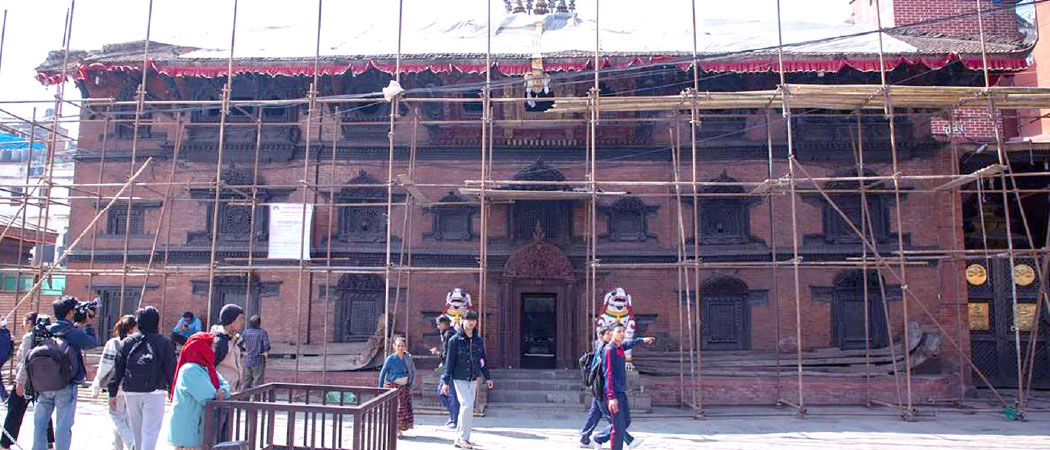

By A Staff Reporter,Kathmandu, Mar. 20: Sunita Dangol, Acting Mayor of Kathmandu Metropolitan City (KMC), has directed that the renovation of the roof of Kumari Bahal (Kumari Ghar) be completed before the start of this year’s rainy season.
While monitoring the roof renovation work on Thursday, Acting Mayor Dangol instructed the construction team to complete the work on time without affecting the religious, cultural, and social aspects associated with Kumari Ghar.
The renovation work began on March 9 after an agreement was signed with Ajay Nirman Sewa, the construction company selected through a bidding process, on February 23. The agreement period runs until February 13, 2027.
The cost of renovating roof-related components, including shingles and wood, was estimated at Rs. 12.547 million. However, the construction company selected through open competition has agreed to complete the work for Rs. 7.124 million.
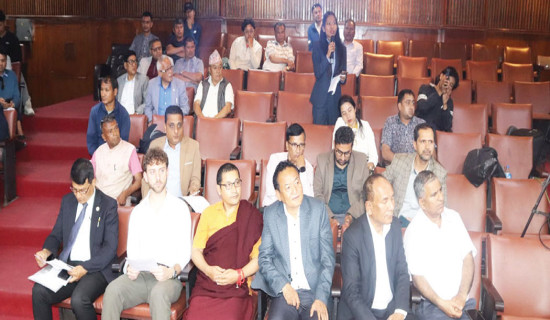
During the monitoring, Acting Mayor Dangol said that Kumari Bahal is the face of Kathmandu. Discussions were also held with stakeholders and locals regarding the religious, cultural, and social aspects of the daily operations of Kumari Ghar, the relationship of the roof with other physical structures, and the preservation of those structures during the renovation process.
Amit Bajracharya, architect of the Hanuman Dhoka Durbar Conservation Programme, said that the roof of the palace covers an area of 464 square meters. During construction, the roof on the east and north sides will be repaired first, followed by the west and south sides.
After the roof of the Kumari Ghar leaked during the last rainy season, a committee was formed on August 5, 2025, to study the technical aspects of the renovation. The committee was coordinated by Purushottam Dangol, an archaeologist from the Department of Archaeology. Members included Roshan Dangol, an engineer from the department; Kajiman Pyakurel, head of the Hanuman Dhoka Care Station; Bhim Prasad Adhikari, an engineer from the Guthi Sansthan; and Amit Bajracharya, an architect from the Metropolitan City’s Hanuman Dhoka Durbar Conservation Programme.
According to the committee’s report, cracks have appeared in the walls of all three floors of Kumari Bahal. Some pillars are out of place, while others have been damaged by insects and contain small holes. In several areas, the wood is rotting.
The wall paintings on the second floor, which are covered with glass, are in need of preservation. Apart from the pillars, most wooden components are made of reclaimed wood rather than Agarkha wood and therefore require immediate restoration, said architect Bajracharya.
He added that the Jhingati tile roof has collapsed in some places. The spindles have broken and fallen, beams have collapsed, and iron belts have loosened or are missing in some areas.
The base of the pinnacle also requires repair, and the upper walls of the structure are in a dilapidated condition. The timber has rotted in places because it was laid on soil instead of a protective material such as plastic felt.
The report recommends gradually dismantling the sections that require renovation, ensuring safe storage of salvaged materials, and maximising their reuse wherever possible.
The 2015 earthquake destroyed 10 structures in Hanuman Dhoka Durbar Square and partially damaged 21 others, including Kumari Bahal. Officials said that although Kumari Bahal was listed as partially damaged, immediate repairs were not carried out. Subsequent repairs at different times were also found to be inadequate due to the lack of subject-matter experts.
It was observed that past renovations did not prioritise durable materials such as Agarkha wood and brick. Archaeological preservation of frescoes was also neglected. As the western part of the structure has weakened, experts recommend that the preservation of floors, walls, windows, doors, and other elements be carried out comprehensively after the roof renovation is completed.
Kumari Bahal was built in 1757 (1814 BS) during the reign of King Jaya Prakash Malla. Located within the Hanuman Dhoka Palace complex in Basantapur, this Newari-style palace is renowned for its intricate woodwork, carved pillars, windows and rich architectural beauty.

-square-thumb.jpg)