- Thursday, 30 April 2026

Twin Jajarkot palaces await reconstruction
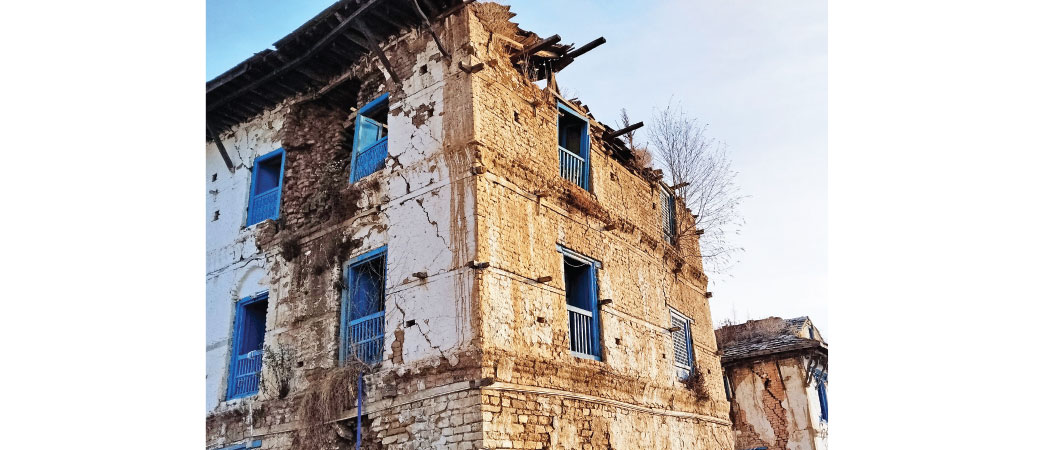

By Basudev Sharma,Jajarkot, Mar. 19: Jajarkot Palace, which is included in the list of 100 tourist destinations in Nepal, has been awaiting reconstruction. The palace was damaged by the earthquake that struck on the night of November 3, 2023 (Kartik 17, 2080), with its epicenter in Ramidanda, Barekot Rural Municipality-1, Jajarkot.
The palace has fallen into disrepair because the government has failed to rebuild it even 29 months after the earthquake. It has deteriorated further as the government paid no heed to rebuild it.
After the Red and White Palaces were damaged, the concerned authorities did not proceed with reconstruction work, and as a result, rainwater has entered and flooded the buildings.
The government has included the White Palace in the list of 100 tourist destinations in Nepal.
The White Palace was built in 1795 (1852 BS) during the reign of King Indra Narayan Shah of Jajarkot. The Red Palace, located to the west, was constructed between 1743 and 1754 (1800 BS to 1811 BS), also during his reign.
It is believed that the royal affairs of the Jajarkot kingdom were conducted from these palaces. The structures, which became uninhabitable after the earthquake, have suffered further damage in their western and southern sections due to rainwater.
Sahadev Basnet, President of the Federation of Non-Governmental Organisations, said that the palaces, built through the efforts of local people, are now in a dilapidated condition because the government seems not serious about its reconstruction.
Officials from the government and the Department of Archaeology warned that if reconstruction was not carried out promptly, it might become unsafe for people to even approach the site.
Trees have started growing on the palace walls, and locals fear the structures may collapse during the rainy season.
A campaign to develop the White and Red Palaces as historical tourist destinations in Karnali Province and convert them into museums was launched under the leadership of the Jajarkot Heritage Conservation Foundation. However, it has been stalled due to the lack of reconstruction efforts by the concerned authorities.
The palace was also damaged by the massive earthquake of 1934, and was later rebuilt in 1994 (2051 BS) after the western side was affected.
Originally a five-story structure, the palace was rebuilt as a three-story building after the earlier earthquake rendered it uninhabitable. Now, 29 months after the latest earthquake, it has again fallen into disrepair due to government negligence and lack of reconstruction.
Before the earthquake, the District Coordination Committee was operating from the Red Palace, while the District Administration Office was located in the White Palace. After both buildings were damaged, the District Administration Office shifted its operations to pre-arranged premises.
“The palaces have become dilapidated due to the government's lack of initiative in reconstruction,” said Janak KC, Chairman of the Jajarkot Heritage Conservation Academy.
There is limited knowledge about the palace’s original structure prior to earlier reconstructions. It is believed that after the 1934 earthquake, an engineer from the Newar community of Bhaktapur, known as Nakche, was brought in to rebuild it in its original style.
The intricate design and craftsmanship seen in the palace windows suggest efforts were made to preserve its traditional form. However, due to insufficient conservation and care, much of the original structure has been lost.
Chairman KC stated that repeated repairs following earthquakes have, in fact, contributed to the loss of the palace’s originality, as stakeholders and authorities have altered its authentic features.
Historically, kings from Mandir Shah to Gajendra Narayan Shah ruled from the Red Palace, while rulers from Indra Narayan Shah to the last king, Prakash Bikram Shah, resided in the White Palace.
The last known king, Prakash Bikram Shah, did not reside in Jajarkot. According to Rajendra Bikram Shah, a civil society leader, seven kings are believed to have ruled from the White Palace.
Prakash Bikram Shah later sold the palace to the Government of Nepal for Rs. 60,000 in 1968 after which it became government property. Government operations began from there after the monarchy ceased residing in 1960.
-square-thumb.jpg)