- Saturday, 2 May 2026

Lone potter rues over youth indifference to indigenous skill
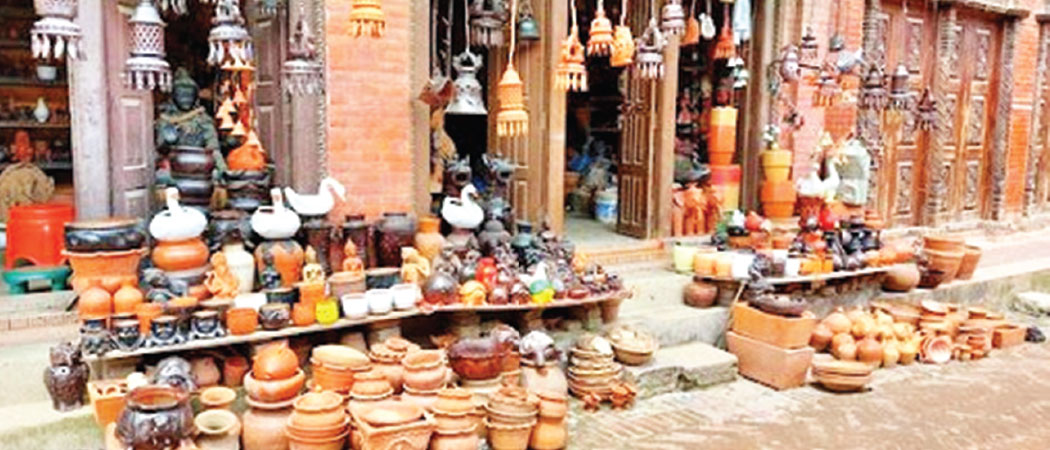

By Raman Paudel,Lamjung, Mar. 5: Many people may not recognize Suk Bahadur Kumal, 65, who hails from Duipiple (previously known as Kumal Tari) in Madhya Nepal Municipality, Lamjung.
Kumal appears to be an ordinary potter, yet his work contributes significantly to both the local market and his indigenous tradition.
In the southwestern part of Lamjung district, Suk Bahadur established his pottery centre in 2015. When he was 18 years old, he joined the Nepali Army. After serving for 16 years and eight months, he retired in 1999.
Suk Bahadur then left the country as Nepal was facing a civil strife. After 10 years abroad, he returned to his village in 2009. He spent several years unemployed there. He then felt that remaining jobless was harmful to him.
“The jobless period was really useless for me. That vacuum pushed me back to my roots. I decided to start my ancestors’ occupation, pottery, which has been forgotten in recent times,” Suk Bahadur recalled.
The area was previously known as Kumal Tari. The Kumal people belong to an indigenous community that has been deeply engaged in the pottery profession for centuries.
Senior citizens from the community recall that pottery was once the main profession of the locals in Kumal Tari. Every family had a clay collection site on their land.
After the harvest, the villagers would dig a large pit together, from which they collected clay and distributed it among all households. Before collecting the clay, digging would begin only after the eldest person in the community performed a ‘Mato Pooja,’ a ritual worship of the soil.
After collecting the clay, each family would prepare various utensils from their share. Later, they would sell those clay pots during the ‘Ekadashi Mela,’ which takes place in January.
According to Nal Bahadur Kumal, a local cultural activist and community leader, selling pottery is their ancestral profession. It is not only a matter of market and commodities but also a cultural relationship. He added that pottery represents indigenous skills and knowledge.
“On the occasion of the Ekadashi Mela, long rows of clay pots used to be displayed for sale in front of every house in our village. Passers-by going to and returning from the fair would buy those clay pots," Nal Bahadur said. "In fact, our community has a very deep connection with clay. Worshipping clay was also a form of nature worship. You can call it our original skill and knowledge.”
‘I am the only one in the community, but I want to hand over the skill’
Suk Bahadur is now the only person in his community continuing this occupation. He worries about who will carry on this indigenous knowledge after his retirement.
He wants to teach the skill to his grandson and other young people. Unfortunately, the new generation either has no time to learn or lacks interest.
“I wonder what the youths are thinking! Many times, I expect my eighth-grade grandson to learn this skill. But he has no time. He goes to school at 7 am for extra classes and returns home at 7 pm. Tuition classes are mandatory for secondary students here. How can I pressure him to learn my skill?” Suk Bahadur said.
According to Suk Bahadur, he spent more than Rs. 700 thousand on machines. He now produces more than 12 different clay pot items.
Working alone, he can hardly meet the demand. He hopes that someone will invest as a partner or learn the skill so that he can expand this cultural profession.
“I want to make my village a pottery hub, as it was recognized in history. Now modern technologies are available, and the market has expanded. Many tea shops in Pokhara, Damauli, and other big cities might demand clay tea cups," Suk Bahadur said. "But youths are seeking easy money by going abroad. They don’t want to understand the value of our ancestors’ skills and knowledge.”
Running a local pottery business has become quite difficult for him. He barely earns a return for the effort and labour he puts into making pottery. For a few months, he sold his clay pots in Pokhara, the nearest market. However, in recent times, consumers have stopped buying his utensils.
Suk Bahadur explains that his profession is not just a local industry but also a carrier of cultural values. For various castes in the region, especially the Kumal community with around 300 people, clay pots have traditionally played a significant role in birth and death rituals.
When a birth or death occurs in a family, a clay urn and lamp are essential. He worries that the new generation, in this modern era, is ignoring cultural values and allowing nature-based traditional crafts to fall into decline.
-square-thumb.jpg)