- Saturday, 6 June 2026

Why Voting Is Important ?

As Nepal approaches the historic mid-term general elections on March 5, 2026, the air is thick with a mixture of hope and skepticism. Democracy provides power through the ballot box. Voting in elections is both a constitutional right and a fundamental civic duty. In democratic systems, sovereignty rests with the people, and elections serve as the primary mechanism through which citizens exercise that sovereignty. Our democracy has evolved through decades of political struggle. It began in 1951 with the democratic movement, to the People’s Movement of 1990 and the People’s Movement II in 2006. This makes voting a deep historical, political, and moral significance.
The act of voting is not merely procedural. It is an expression of participation, exercise of right, accountability and ownership of the state. Nepal’s Constitution of 2015 establishes a federal democratic republican system. Article 84 and related provisions guarantee periodic elections to federal, provincial, and local governments. This constitutional structure makes citizens central to governance. Without active voter participation, the democratic architecture becomes hollow. Therefore, voting is essential to give legitimacy to the democratic system.
Effective leadership
The crux of voting is to choose effective leadership. Elections determine who will make laws, formulate policies, allocate budgets, ensure national unity, expand good governance, and oversee development affairs. The federal parliament, seven provincial assemblies and 753 local governments directly influence citizens’ daily lives and determine their future. For example, local governments are responsible for basic health services, local roads, agriculture support, education management and social security allowances distribution. The quality of political leadership at these levels significantly affects service delivery. By voting, citizens influence who manages these responsibilities fairly and effectively.
Past voter participation trends reveal both strengths and challenges. Voter turnout was relatively high in 2013 (78 per cent) Constituent Assembly elections than in the 1990s (61-65 per cent). In the 2017 federal and provincial elections, voter turnout was approximately 68 per cent whereas this declined to around 61 per cent. While these figures are comparatively healthy in global terms, the downward trend raises concerns. This may be due to youth fleeing the country for work and higher education. Lower turnout weakens representativeness and democratic legitimacy. When fewer citizens vote, a smaller segment of the population determines national leadership, potentially leading to governance gaps.
Voting is also crucial for accountability. Elections are the most peaceful and institutionalised mechanism for evaluating political performance. Nepal has witnessed frequent government changes since the restoration of multiparty democracy in 1990. In the absence of sound laws governing political parties, coalition politics, party fragmentation and internal party disputes have often created instability. Through voting, citizens can reward stable and development-oriented leadership or penalise poor performance, corruption and broken promises. For instance, voter dissatisfaction in certain constituencies in 2022 resulted in the defeat of long-standing political figures, indicating that voters are increasingly evaluating performance. They demand results.
Another important reason to vote is to ensure good governance and promote integrity. Irregularities remain a serious challenge, affecting public procurement, infrastructure projects, service delivery and administrative efficiency. Reports from oversight institutions and international assessments consistently show governance weaknesses. However, corruption persists partly because voters sometimes prioritise short-term incentives over long-term integrity. When voters support candidates based on competence, transparency, openness and ethical behaviour, political parties are compelled to nominate cleaner candidates. Thus, informed voting becomes a powerful tool for good governance.
Our federal structure further strengthens the importance of voting. Federalism aims to decentralise power and bring government closer to the people. But decentralisation can only function effectively if citizens actively participate in selecting capable representatives. In rural municipalities and urban municipalities, mayors and chairpersons play decisive roles in development planning. Citizens who do not vote indirectly surrender their influence over local development priorities, such as irrigation projects, school improvements or market infrastructure. Voting for the upcoming federal parliamentary elections is equally crucial to ensure the success of our federalism.
Voting also ensures inclusive representation. Nepal is a multiethnic, multilingual and multicultural society. The electoral system incorporates proportional representation to include the disadvantaged and marginalised groups. We have made notable progress in women’s political representation, with women constituting over 33 per cent of the federal parliament in the past. This inclusion is a result of constitutional provisions regarding the proportional system combined with voter participation. When citizens vote, they reinforce inclusive democracy and social justice.
Another dimension of voting the strengthening of political culture. Our political transition from monarchy to republic required collective national effort. The Comprehensive Peace Accord of 2006 ended a decade-long conflict and paved the way for republicanism. The Constituent Assembly elections of 2008 and 2013 were historic moments where citizens shaped the new and inclusive political order. Voting in those elections was not merely routine. It was transformative. Continued participation ensures that the sacrifices made during conflict and movements are not undermined.
Moral legitimacy
Furthermore, voting influences development trajectories. We aspires to graduate from the category of Least Developed Countries (LDC) and achieve middle-income status. Achieving these and other goals stated in the 16th plan requires policy continuity, investment-friendly governance, infrastructure development, e-governance and human capital improvement. These policy directions depend on the quality of elected representatives. If voters prioritise long-term development agendas, as stated in the election manifestos, over populist rhetoric, they contribute directly to national progress.
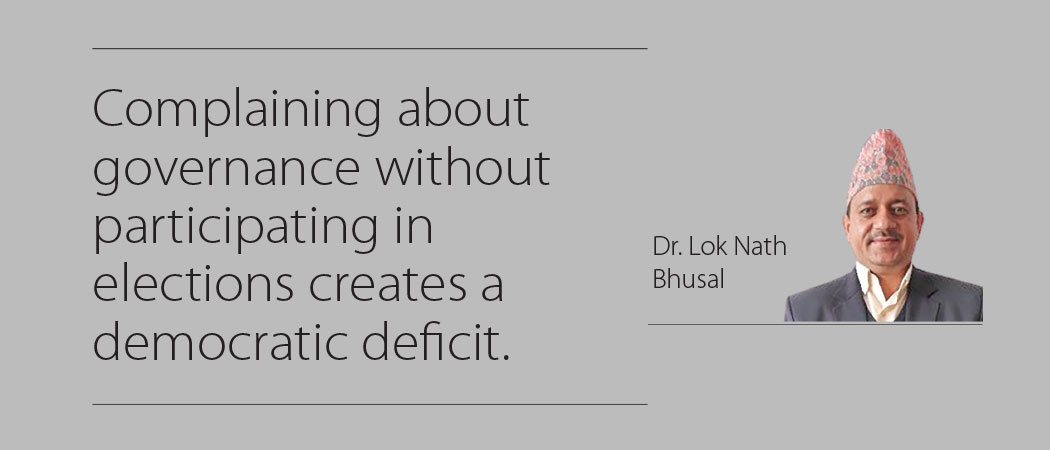
There is also a moral dimension to voting. Democracy grants rights, but it also demands responsibilities. Complaining about governance without participating in elections creates a democratic deficit. Voting provides citizens moral legitimacy to demand transparency and accountability. Our inability to ensure voting for the Nepalis staying out of the country and out of their constituency is a real problem. Ensuring this could increase voter turnout significantly, providing further legitimacy to our democracy. Some candidates will win other will lose, but must cast our vote for evolving our democracy on March 5.
(Dr. Bhusal is a development expert.)