- Saturday, 2 May 2026

Can EU Guarantee Security Without US?

The last great constant of the post-war order, the Euro-Atlantic partnership, is breaking down before our eyes. The deep currents that shape American foreign policy and its global position are challenging the deep-rooted assumption of Europe and Europeans that they rely on the US and its global power. The US is sending unambiguous signals to the EU that it will no longer bear the burden when it comes to European strategic security, and a divided EU is not ready to take on the burden of guaranteeing European strategic security.
The new US national strategy, which prioritises the Indo-Pacific and seeks to contain China and diminish Europe’s global importance, is also contributing to the decline of the transatlantic partnership as the core of Western hegemony. Beneath the surface of institutional continuity, the dynamics of power in the world have changed. Over the past 45 years, the EU’s share of global GDP has fallen from 27 per cent to 14.5 per cent, while China’s share has increased from 2 per cent to 19 per cent. In 1960, Europe accounted for 20 per cent of the world’s population; today it is only 9 per cent. Europe has literally lost its value and weight as a strategic partner for the US.
Shifting responsibility
With the Indo-Pacific as its number one strategic priority, the US is shifting responsibility for the future of the European security order to the EU. However, it is not clear that the EU’s political fabric is designed to carry this heavy burden in these turbulent geopolitical times. Beyond inadequate defence capabilities, a diffuse reflex of dependence on the US has prevented Europeans in the past from developing a common, comprehensive strategic culture – a concept of their own priorities and how to jointly advance them. In the absence of such a shared vision, difficult external challenges risk further exacerbating political differences within the EU and leading to even greater divisions.
Mario Draghi’s report (https://commission.europa.eu/topics/eu-competitiveness/draghi-report_en#paragraph_47059) presents a detailed, frank and very sharp diagnosis of the competitiveness and state of the EU economy, including the defence and security sector. Noting the high level of European defence technologies, their strong position on the global market and the presence of a very large defence industry, Draghi has pointed to several fundamental weaknesses and shortcomings that limit the European defence industry, and as a result, it is not competitive and innovative.
First, the high fragmentation of the EU defence industry, which is largely a combination of national defence industries. This leads to competition and duplication of competencies within the EU and does not allow it to compete on equal terms with the US military-industrial complex. In other words, the EU is not competitive on the global arms market with the US. According to SIPRI, almost two-thirds - 64 per cent - of European NATO countries' imports of arms and military equipment in 2020-2024 came from the US, a significantly higher share than in 2015-19, when it was 52 per cent. Of the next four largest suppliers of arms and military equipment, only two are European countries: France accounted for 6.5 per cent of imports and Germany for 4.7 per cent. Another 6.5 per cent came from South Korea and 3.9 per cent from Israel.
Secondly, the disunity of the military construction programmes of the EU member states and an acute lack of cooperation, which leads to an excessive number of different types of weapons, military and special equipment (WME), fragmentation of demand and the inability to fully use the effect of scale. This also affects the efficiency of equipment maintenance, complicates and increases the costs of logistics and material and technical support. Thirdly, a high dependence on non-regional manufacturers and suppliers, including the United States, South Korea, Israel, Turkey and even Brazil. This applies even to those sectors and niches where there are modern competitive offers from European manufacturers.
Fourth, an insufficient level of investment in research and development. In 2023, the United States spent $ 140 billion on research and development (16 per cent of military spending), while the European Union and its member states together spent only € 10.7 billion in 2022 (only 4.5 per cent of total spending). Other problems include insufficient military spending and difficulties in accessing financing for European defense companies.
Tension
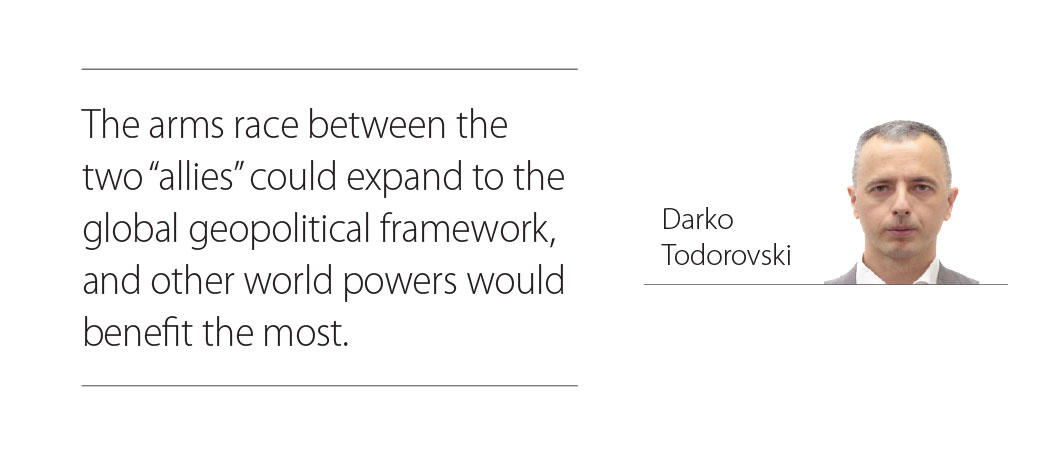
Although the US and the EU are still key military-political partners, with increasing security challenges on the global stage and political instability on both sides of the Atlantic, EU countries have started to invest in their own military-industrial resources to reduce their dependence on the US. This could cause tensions and competition on the world arms market between the EU and the US in the future. In that case, the arms race between the two “allies” could expand to the global geopolitical framework, and other world powers would benefit the most. With the start of the militarisation of the EU, member states will be provided with an easier and more tolerant approach to the militarisation process, many of which see their neighbouring EU and NATO member states as a greater threat than Russia and China.
The continued dependence of European states on the United States is forcing the EU, especially Berlin and Paris, to pursue their desire for rearmament even more aggressively, which must include imposing an attack on the social position of the working class that is unprecedented since World War II. In order to raise the funds of 800 billion euros that the European elites have collectively pledged for military spending, the ruling elites will be forced to make cuts to the social and democratic rights of workers, as well as to education and healthcare. In the past, the militarisation of Europe has not led to anything good for Europe and for humanity, as well as for workers. Former Italian Prime Minister Giuseppe Conte has stated that the rearmament of the European Union will be the beginning of the disintegration of the EU.
(The author is a military analyst and doctoral candidate at the Russian Presidential Academy of National Economy and Public Administration.)


-square-thumb.jpg)