- Monday, 8 June 2026

Paradigm Shift Imminent In Nepali Politics?

The chief aim of the September Gen Z revolt was to shift the paradigm in the country's entire political system. Despite several other revolts of this kind in Nepali history, the latest was the most popular and also the most controversial. After the massive destruction of life and property, an army-mediated interim government was formed with the mandate of investigating the wrongdoings, as well as holding a general election on March 5 for a fresh mandate. While the second task is near the door, the first is being procrastinated on for what are called 'technical reasons'.
As the election approaches, many people are forecasting which party will win and form a stable government. Their predictions, however, lack substantial ground. Most of them are value-laden, ideologically loaded opinions, far from grounded reality, mere fantasies floating in the empty sky. In appearance, their speculations look beautiful, forming their abode in the heavenly paradise. In reality, their speculations may go awry, leaving them with yet another dose of bitter frustration and disillusionment. And this possibility is not without valid arguments. There are some genuine grounds to prove this point.
Historical context
What Nepal has been desperately expecting since 1990 is a single-party government with the full consent of parliament that can decide matters without undue interference from other minority parties and without any need to compromise with them. But that has not happened since 1994, when the single-party government led by Girija Prasad Koirala, representing the Nepali Congress, failed to complete its tenure due to intra-party conflict.
The governments that followed have never been stable since then. After the midterm polls, a minority government led by CPN-UML leader Man Mohan Adhikari was formed with much enthusiasm to introduce socialism, which would proclaim equal opportunities for all people and improve the socio-economic status of the downtrodden; it lasted only six months, after which a coalition government took office. Several governments were later formed and toppled by foul play in parliament, making people increasingly unhappy and indifferent to politics as such, rather than merely disliking a particular political party.
As a consequence, the September Gen Z movement erupted in the streets. Blame and counterblame have surfaced in the political arena, leaving innocent people more confused about what is true and what is false in the accuser’s statements. The barriers to good governance in the constitution needed to be removed before the election. One obvious case was the requirement that a party win a majority of seats in parliament to form a government. Owing to the hung parliament in each election, the government has been unstable for more than three decades. Without considering this issue, any such periodical election may yield the same result.
In the context of the upcoming general election for the HoR, as many as 75 political parties, with 68 electoral symbols, have been registered with the Election Commission, and 3,017 males and only 388 females (a total of 3,405) are contesting. Due to the apparent failure of mainstream parties to meet public expectations, a mushroom-like proliferation of new parties is on the electoral battlefield, with many political actors possibly not knowing what politics is or what they do to the country when they plunge into politics. As the electoral system goes, parties can contest for both first-past-the-post (FPTP) and proportional (P) seats, but 11 contest only FPTP, 5 only P, and the remaining contest both. It appears that the current election campaign led by new parties focuses on the need to replace mainstream political forces with cross-current themes of corruption-free government that ensures good governance across all spheres of the state mechanism.
Among the 75 parties contesting this time, many are unnoted. The conventional parties, such as NC, CPN-UML, Nepali Communist Party (NCP), and a newly emerged party, Rastriya Swatantra Party (RSP), are widely discussed. The ways these parties are organised are rather unusual. Ideologically, NC and RSP should have been based on the principles of liberal democracy, while CPN-UML and NCP should have been grounded in socialist theory. If such a thing happened, the first two would tilt toward the right-wing political group, and the second two toward the left-wing political group. And this would be quite natural if they had been unified in one party or at least allied, if only for the election purpose.
Now, each contesting party, be it conventional or newly emerged, has gone into the field with a utopian dream of making the country a paradise. In reality, even if all parties have documented their dreams in their manifestos, the critical thinkers say their promises are mere rhetoric, fine for saying and showing, but not for doing and delivering. Promise appears beautiful, but the constitutional barriers and cultural constraints bring it back down to reality's gutter.
Likelihood of results
In this context, predicting which party will win is perhaps the most difficult task, since we cannot see an unstoppable wave in favour of a single political force. So far, two conventional parties, namely NC and CPN-UML, still seem to maintain a stronghold. But the popularity of the new political force, most notably RSP, cannot be denied. Owing to this popularity, the new force appears to have gained more seats but remains unlikely to secure a majority in parliament.
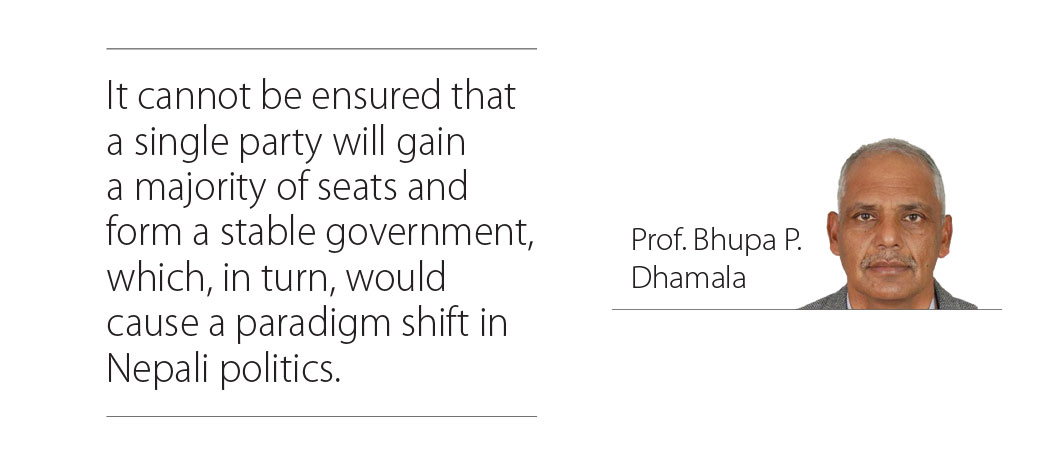
But the new party is also rife with contradictions in its principles and practices, like the conventional ones. They have no substantive political agenda per se, despite their relatively fair practices. If a party does not establish a fixed programme guideline, it may ultimately get lost in the fog. Therefore, it cannot be ensured that a single party will gain a majority of seats and form a stable government, which, in turn, would cause a paradigm shift in Nepali politics. Most likely, there will be a hung parliament again, repeating the same political phenomena. However, we are still waiting to see what really happens after the polls with a positive note.
(The author is the chairman of Molung Foundation. bhupadhamala@gmail.com)