- Sunday, 7 June 2026

Three Dalit candidates face tough battle in Sudurpaschim

BY PRAKASH BIKRAM SHAH/GOKARNA DAYAL, Dhangadhi, Feb. 26: In Sudurpashchim Province, three Dalit candidates fielded by major political parties are facing an uphill battle in the House of Representatives elections, as strong rivals and past voting patterns cast uncertainty over their prospects.
While major parties had previously limited Dalit leaders mostly to proportional representation lists, this time they have fielded them as candidates under the First-Past-The-Post (FPTP) electoral system.
The three candidates have been nominated by the CPN-UML, Nepali Congress, and Nepali Communist Party (NCP). However, the Rastriya Swatantra Party, which has been gaining attention as a new political force, has not fielded any Dalit candidates from the province.
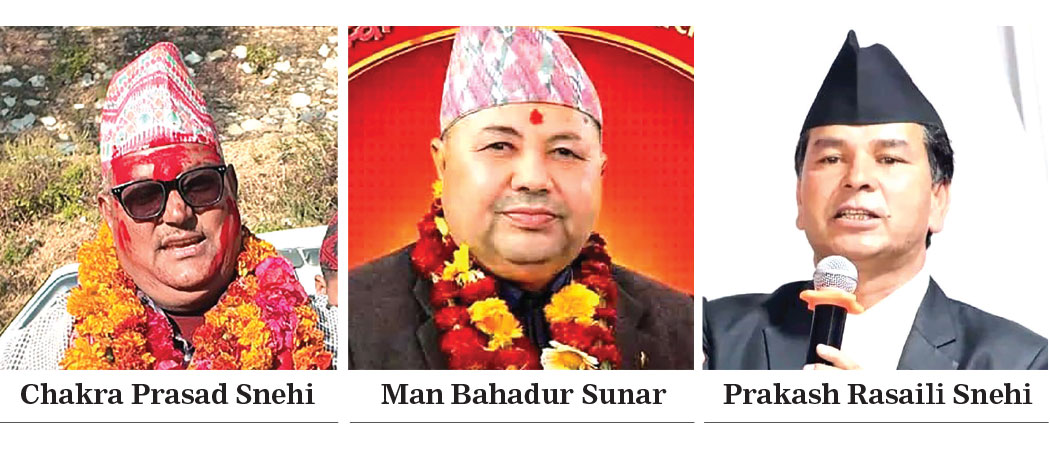
In Dadeldhura, CPN-UML has fielded Chakra Prasad Snehi. Similarly, in Kanchanpur-3, the NCP has nominated Man Bahadur Sunar, and in Bajhang, the Nepali Congress has fielded Prakash Rasaili Snehi. All three leaders have previously held key party responsibilities and have served in legislative bodies. Snehi has been a member of the National Assembly, while Rasaili is a joint general secretary of the Nepali Congress and was previously elected to the House of Representatives through the proportional system. Sunar was directly elected to the provincial assembly in 2017 from the then CPN (Maoist Centre) and later served as a province minister in the provincial government.
All three candidates are contesting direct elections for the first time and are facing strong competition. Based on the proportional vote share secured by their parties in the 2022 elections, their chances of victory appear challenging.
In Bajhang, CPN-UML has nominated Aina Bahadur Mahara, who narrowly lost to the alliance candidate in the last election. A three-way contest is expected among UML’s Mahara, Congress’ Rasaili, and NCP’s Min Bahadur Kunwar, while Rastriya Swatantra Party’s Shailesh Singh is also expected to secure a notable vote share. Proportional vote results from 2022 show UML leading with 22,674 votes, followed by Congress with 19,437, the then Maoist Centre with 8,295, and the then Unified Socialist with 5,001 votes.
In Kanchanpur-3, Sunar is expected to compete against Dr. Dipak Prakash Bhatt and Nepali Congress candidate Hari Prasad Bohara. The former Maoist vote base in the constituency has historically been smaller than that of Congress and UML. In the 2022 proportional vote, Congress secured 20,571 votes, UML 11,816, the Maoist Centre 4,462, and the Unified Socialist 3,933.
Similarly, in Dadeldhura, Congress candidate Nain Singh Mahara represents a party that has won every election there since 1991. NCP’s Man Singh Mal and RSP’s Dr. Tara Prasad Joshi are also considered strong contenders. UML’s proportional vote share in the district has been significantly lower than the Nepali Congress. In 2022, Congress received 18,582 votes, UML 9,214, the Maoist Centre 8,711, and the Unified Socialist 611.
Despite the challenges, UML candidate Snehi expressed confidence, stating enthusiasm among Dalit voters in Dadeldhura would ensure his victory. Likewise, Sunar, contesting his first parliamentary election, said his previous win in the 2017 provincial assembly election had strengthened his chances this time. Dalit intellectual and social activist Ganesh BK said it was encouraging that three Dalit candidates were contesting direct elections from Sudurpashchim. He stated that they earned their nominations due to their own political influence and experience rather than solely their identity. “Sudurpashchim is the only province with three Dalit candidates in direct elections. No other province has fielded Dalit candidates in direct contests,” he said.
However, he added that the number of Dalit candidates remains low compared to their population. According to the 2021 national census, Sudurpashchim Province has a population of 2,694,783, with Dalits making up 18.9 per cent--higher than the national average of 13.4 percent.
District-wise data shows Dalits make up 21.1 per cent of Dadeldhura’s population (139,420 total), 15 per cent in Bajhang (189,085 total), and 16.2 per cent in Kanchanpur (517,645 total).
Despite a significant Dalit population across all nine districts of the province, their representation in local and provincial elections has remained low.
Community leader Rajuram Bhul said Dalit voters often become decisive in elections, but when Dalit candidates run, votes tend to split across parties, leading to their defeat. He recalled his own loss in the 2022 local elections while contesting for deputy mayor of Dasharath Chand Municipality.
He also stated that Dalit candidates often struggle to secure party tickets, and even when they do, caste-based bias among non-Dalit voters affects outcomes. A similar trend was seen in Dhangadhi Sub-metropolitan City, the temporary capital of Sudurpashchim, where a Dalit candidate who won the mayoral post in 2017 was defeated in 2022.