- Saturday, 2 May 2026

Navigating Geopolitics
 Ganesh P Paudel
Ganesh P Paudel
Ganesh P Paudel
In a casual small talk, I directed a question to one of my colleagues. I asked whether there was anything our political actors could do to bring the widespread spillover effects of geopolitics down to a bare minimum. While posing this question to him, I reminded him that, ideally, a nation cannot fully get rid of the effects of geopolitics; it is merely a matter of how much is too much.
He opined that what we seriously lack in our political realm is a leader’s confidence in their own leadership. To prove his point, he cited former prime minister KP Sharma Oli and his role during the India-imposed 2015 blockade. He mention his role in publishing the current westward-protruding map—often called the “Chuche Naksha”— of Nepal.
However, I believe the holistic approach to dealing with geopolitics is, first and foremost, to gradually minimise foreign aid, which entails treading the path toward economic self-reliance. This would essentially lead us to a situation where we can say “no” to INGOs when necessary. Yet politicians turn this into a populist agenda, whereas it should have been a rallying point for the whole nation.
Foreign aid is a luxury, if not a trap, for a nation. It never truly develops a country. If it had the capacity to develop our nation, we would not be where we are today in terms of economic prosperity. To shed more light on this, let us consider an example. Over 400 organisations are working for the betterment of the Bagmati River. Directly or indirectly, scores of them are supported or run by INGOs. Why, then, is the river still in such a sorry state ?
I recall the days when Radio Nepal used to be the only convenient source of news for us. Back then, I remember frequent reports about the jaw-dropping amounts of Nepali rupees bestowed upon Nepal as foreign aid. Posterity will ask us either to show them the development or the money. Sadly, what we have now is an all-time fragile sense of nationality and a debilitating economy.
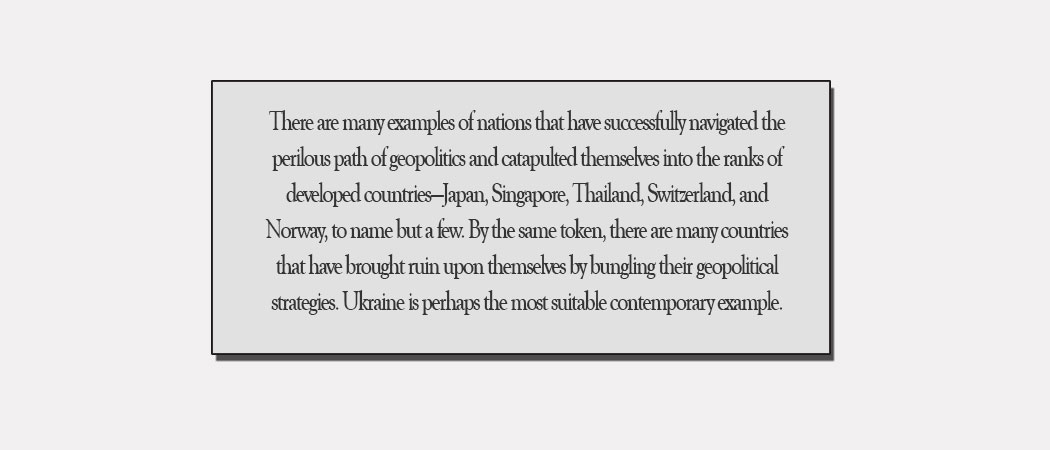
There are many examples of nations that have successfully navigated the perilous path of geopolitics and catapulted themselves into the ranks of developed countries—Japan, Singapore, Thailand, Switzerland, and Norway, to name but a few. By the same token, there are many countries that have brought ruin upon themselves by bungling their geopolitical strategies. Ukraine is perhaps the most suitable contemporary example.
Although my friend tried to argue why it necessitates a modicum of confidence in our political leaders, the analogy of a beggar at your doorstep suggests otherwise. How can a beggar remain blithe and assertive as long as he is begging? Likewise, so long as we protrude a begging bowl in front of foreign powers, it is only natural that they will always have the upper hand over us. After all, he who pays the piper calls the tune.
Recapitulating my point, if we continue to regurgitate the sentimentality and grandiloquence on sovereignty and nation-building without first standing on firm domestic ground, geopolitics will continue to take its toll on us. Can anyone show me a political leader in our country who has demonstrated genuine geopolitical acumen while simultaneously keeping the wheels of development turning and national sentiment high? History bears witness that only King Mahendra seemed to fit that image.

-square-thumb.jpg)