- Saturday, 2 May 2026

Empty Promises

Education has long been a significant component of the political parties' election manifestos. They have promised to expand access to quality education, enhance teachers' capacity, provide technology-friendly education and offer free meals in school to win the hearts of voters. However, they have proven to be empty promises, and the people find it hard to believe that those promises will be upheld.
Manifestos of all political parties are filled with ambitious rhetoric, but the same old questions remain: What are the concrete plans of the political parties to achieve these ambitious promises? Sadly, no political party or candidate has engaged in a serious debate on education reform, despite only a few days remaining until the election.
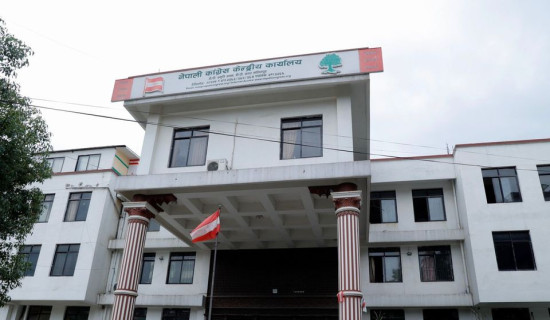
In its poll manifesto, the Nepali Communist Party (NCP) has expressed commitment to ensuring equal access to quality education, improving community schools, and making technology-friendly education by implementing ' one municipality, one smart school. Likewise, the Nepali Congress (NC) has stated that schools connecting learning from pre-primary to university level with technology and practical experiment will be developed into centres to maximise and encourage student creativity and innovation.
The UML has introduced agendas such as distributing free menstrual pads to schoolgirls and including teachers in the Social Security Fund to help build human resources that contribute to national strength in its manifesto. It has proposed to develop Nepal as a centre of peace studies, Ayurveda, meditation, mental health and oriental philosophy. Meanwhile, the Rastriya Swatantra Party (RSP) has pledged to organise education as a service-oriented sector rather than a profit-driven one, ensuring equal opportunity, transparency, and social accountability.
However, none of them has outlined a clear strategy for achieving their ambitious plans. The NCP has committed to bringing a new Education Act within one year. In the 2022 election, it had also committed to bringing the Education Act. Both political parties were in government, but they gave little priority to enacting the necessary laws aimed at revamping the education sector.
At the heart of these commitments lies the aspiration of transforming Nepal's education sector. We lack inclusive, equitable and globally competitive education. Education for Nepali is a means of securing employment and empowering historically marginalised communities. In most of the schools in rural areas, classrooms are under-resourced, and there is a short supply of teachers.
Limited fiscal capacity is the main problem. Of the total national budget, 10 to 11 per cent goes into the education sector, which is hardly enough. Political slogans alone are not enough; realistic planning, consistent funding, conducive rules and laws are crucial.
A multi-year education strategy, keeping the education sector free from politics, investing in teacher training, ensuring the right use of resources, making conducive laws to recruit qualified and dedicated teachers, and updating the textbooks as per time, is important to improve the education sector.
Thousands of students leave the country in search of better education abroad, highlighting the urgent need for quality education and gainful employment at home. These are also the fundamental rights enshrined in the constitution. The time has come for the political parties to go beyond rhetoric and cosmetic reforms. They must roll out pragmatic schemes that can be implemented smoothly and yield the much-desired results.
-square-thumb.jpg)