- Saturday, 2 May 2026

Devotees celebrate Fagu in Kanchanaban


By Mahesh Kumar Das,Jaleshwor, Feb. 24: The religious group participating in the much-revered Madhyamika Parikrama of Jaleshwor, Mithila, celebrated Holi by throwing colours in Kanchanaban on Monday.
In memory of Lord Ram playing Holi in Kanchanaban, Mahottari, during the Treta Yuga, participants of the 15-day Parikrama Yatra reached Kanchanaban on Monday morning and celebrated Holi by exchanging greetings and colours with one another.
Parikrama pilgrim Ramgulam Chaudhary said that after the pilgrims played Holi in Kanchanaban, the entire atmosphere became vibrant with festive spirit.
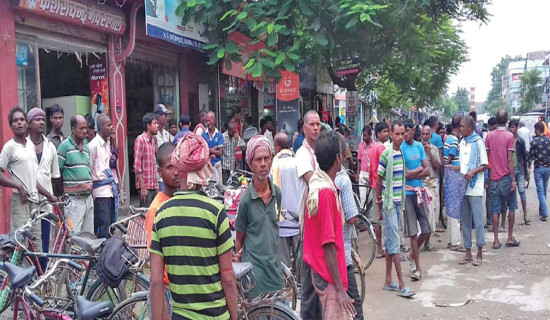
The faces and clothes of all the participants of the Parikrama Yatra, who reached Kanchanaban from Dhruba Kund on Monday morning, were glowing with colours as they celebrated Holi by dancing and singing together. Sadhus, saints, mahants, Nagas and other devotees joined in the celebrations.
After arriving in Kanchanaban, the Mahants of the Ram Temple in Janakpur and the Mahants of the Janaki Temple played Holi with each other, marking the formal beginning of Holi in Mithilanchal.
Although the Fagu festival is believed to begin on Basanta Panchami, tradition holds that Holi officially starts only after the pilgrims circumambulating Mithilanchal play Holi in Kanchanaban.
The pilgrims, who began the Parikrama from Hanumangadi with the palanquin of Kishori Ji from Mithila Bihari Kuti in Kachuri and Agni Kund in Dhanusha, reached Kanchanaban on Monday via Kalyaneshwor, Fulhar, Matihani, Jaleshwor, Madai, and Dhruba Kund.
After the Parikrama pilgrims reached Kanchanaban, the Mayor of Bhangaha Municipality, Sanjib Sah, extended a grand welcome to them.
According to Mayor Sah, as in previous years, the municipality and local residents have arranged food and accommodation for the pilgrims this year as well.
“It has been a tradition here that the Parikrama pilgrims throw colours in Kanchanaban, and only after they play Holi does the festival truly begin in Mithilanchal,” Mayor Sah said. “Since Monday morning, Holi songs, music, and a devotional atmosphere have captivated everyone in Kanchanaban. We, the residents of the city, are delighted to celebrate alongside the Parikrama pilgrims.”
There are three types of circumambulation: major, middle, and inner. The major circumambulation is completed only after encircling the Himalayas in the north, the Koshi in the east, the Ganges in the south, and the Gandak in the west; therefore, such circumambulations are not performed in modern times.
It is believed that the Madhya Parikrama has been observed since before the 18th century. Earlier, it lasted five days, but in the 20th century, Mahatma Surkishore Das extended it from five days to 15 days. As a result, there is now a large presence of sadhus, saints, mahants, Nagas, and other devotees during the circumambulation.
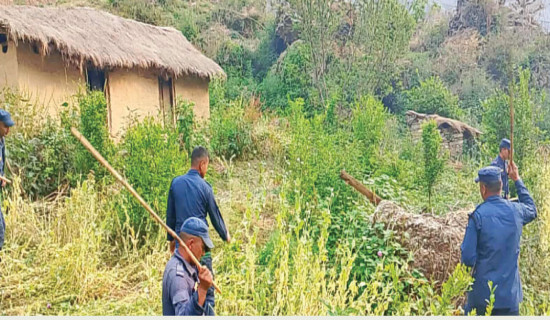
Armed forces and Nepal Police have been extensively deployed to ensure the safety of the Madhyamik Parikrama pilgrims.