- Wednesday, 20 May 2026

Corruption: Causes And Remedies

Corruption remains a major structural challenge in Nepal, affecting governance, development and public trust. Defined broadly as the abuse of entrusted power for private gain, corruption pervades multiple sectors, including government offices, public services, political institutions, judiciary, police structures and the private sector. Transparency International’s Corruption Perceptions Index (CPI) 2025 places Nepal at a low score of around 34/100, indicating a high perception of corruption relative to many countries globally. The global average is 42/100. Corruption is not merely an ethical lapse. It undermines democratic institutions, diverts investment, slows economic growth, exacerbates inequality and erodes citizens’ trust in public systems. This article is an attempt to examine the root causes, wide-ranging consequences and practical remedies to curb corruption in Nepal.
A weak institutional framework and enforcement are one of the major causes of corruption. Nepal has formal anti-corruption laws and bodies such as the Commission for the Investigation of Abuse of Authority (CIAA), but enforcement remains inconsistent. Institutional mandates are often undermined by political interference or lack of autonomy, leading to slow investigations and weak deterrence. Institutional weaknesses also extend to the judiciary, where delays and procedural inefficiencies allow corrupt actors to escape accountability.
Political wrongdoings
Political and administrative wrongdoings also cause corruption. Political financing is largely opaque, with few controls on campaign spending or sources of funds. Politicians and administrators often rely on patronage networks to sustain power, distributing benefits in return for political and bureaucratic loyalty. This systemic capture promotes nepotism in appointments, transfers and contracts, discouraging meritocracy. Lengthy administrative procedures and discretionary powers granted to officials create environments ripe for bribery. Citizens seeking basic services such as citizenship certificates, permits, and land documents frequently face red tape. To expedite such services, informal payments still happen, embedding corruption deeper in public interactions.
Socio-cultural acceptance and moral rationalisation incentivise corrupt behaviour. In many local contexts, corruption is rationalised as a necessary evil or a “normal way of doing business.” Cultural factors such as gift-giving, kinship loyalty and patronage ties blur ethical boundaries. When citizens see public officials operating with impunity, the social cost of corrupt behaviour diminishes. Furthermore, regime change also induces corruption. Nepal’s transition to federalism, intended to decentralise power, has created gaps in oversight at provincial and local levels.
The rapid expansion of government budgets without parallel development of accountability systems left room for the misuse of funds. Political instability further weakens sustained governance reforms. Weak transparency and accountability systems have given rise to corruption. Mechanisms such as the Right to Information Act exist but are poorly implemented. Public procurement often lacks full transparency and details on government contracts and project expenditures are not readily accessible to citizens. Without robust transparency systems, corrupt practices remain hidden.
Corruption has wide-ranging consequences. First, corruption imposes direct and indirect economic costs. According to some estimates, corruption may account for more than 5 per cent of GDP losses annually, implying that if Nepal’s GDP is around Rs. 6.1 trillion, over Rs. 300 billion (nearly 15 per cent of the annual budget) could be lost to corruption each year through inflated contracts, embezzlement, bribes and illicit financial flows. Second, corrupt procurement and project mismanagement lead to substandard public infrastructure and services. Roads may deteriorate prematurely, hospitals lack essential equipment and schools fail to deliver quality education.
Money meant for public goods is diverted into private pockets, leaving citizens to bear the cost. Third, corruption disproportionately harms the poor and marginalised. Those without money or influence cannot access services efficiently and must often forfeit opportunities due to bribes or nepotistic practices. Unequal access to justice and services deepens social inequality and fuels discontent.
Fourth, corruption fuels citizens’ mistrust in governance. According to Transparency International, a significant majority of Nepalis perceive corruption as a serious problem. Such perceptions contribute to political apathy and social unrest. Recent, widespread youth-led protests were triggered by frustration with corruption, inequality, and political nepotism, leading to changes in government. Additionally, countries perceived as highly corrupt tend to attract less foreign direct investment, as investors seek predictable and transparent environments. Nepal’s ranking below the global average in the CPI undermines investor confidence and hinders economic opportunities.
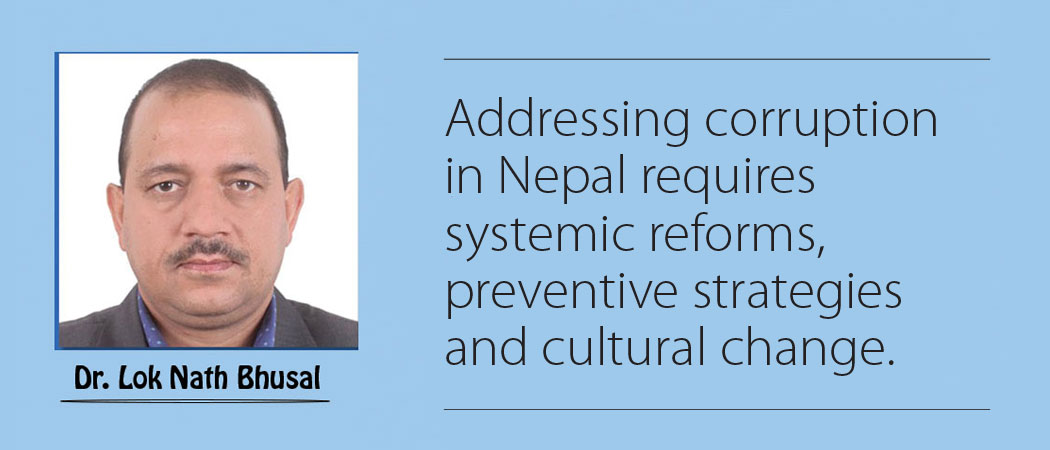
Addressing corruption in Nepal requires systemic reforms, preventive strategies and cultural change. There is a need to ensure the true independence of bodies like the CIAA. Apolitical experts should be appointed there and officials must be trained. It should be provided with adequate financial and capable human resources. Mandatory disclosure of political funding sources must be introduced alongside strict limits on election campaign expenditures. We need to encourage state financing mechanisms to reduce reliance on private money for election.
Administrative and digital reforms should get prominence to make manipulation more difficult. Cashless, faceless and paperless governance is needed. Procurement transparency and public monitoring must be strengthened. There is also a need to expand civic education and cultural change. The national integrity programme must be designed and executed nationwide. A performance-based public sector is also equally crucial to overcoming corruption in the country. Results-based management practices must be applied across all levels. Furthermore, accountability mechanisms must be functional at all levels.
Corruption is deeply embedded, shaped by political, institutional, socio-cultural, and administrative factors. Its consequences are economic losses, poor service delivery, social inequality and weakened democracy. However, through institutional strengthening, procedural transparency, digital reforms, civic engagement and political accountability, Nepal can tackle corruption. Real progress will be gauged not by isolated prosecutions, but by reductions in corrupt opportunities, stronger deterrence and restoration of public trust. Achieving such reforms demands serious political will, active citizen participation and sustained pressure for good governance. This can only harness Nepal’s development potential and fulfill the democratic aspirations of its people.
(Dr. Bhusal is a development expert.)
-square-thumb.jpg)


-original-thumb.jpg)