- Saturday, 2 May 2026

AI Impact Summit: Shaping AI Beyond Borders

India will host the inaugural AI Impact Summit from February 16 to 20 at the Bharat Mandapam in New Delhi. This summit was announced by the Prime Minister of India, Narendra Modi, at the France AI Action Summit in February 2025. This will be the first-ever global AI summit to be hosted in the Global South.
The historic summit will feature participation by Heads of States and Governments, representatives from international organisations and multilateral agencies, academia and research institutions, technology practitioners and developers, and civil society organisations.
The broad aim of the Summit is to achieve demonstrable impact and tangible progress in multilateral AI cooperation. More than 480 pre-summit events have been held globally to prepare the ground for a consequential and historic AI Impact Summit.
Foundational pillars
The AI Impact Summit is guided by the theme of Sarvajana Hitaya, Sarvajana Sukhaya, or "welfare for all, happiness for all”. This vision is anchored by three foundational pillars known as "Sutras.” The People Sutra envisions AI as a force for human progress that respects cultural diversity and preserves dignity. Responsible innovation aligned with environmental stewardship and climate resilience is symbolised by the Planet Sutra. Finally, the Progress Sutra emphasises democratising AI resources to drive inclusive growth across sectors such as health, education, governance and agriculture.
To translate these Sutras into actionable results, the summit’s deliberations are organised around seven interconnected "Chakras." These represent distinct spheres of engagement: (i) Human Capital (ii) Inclusion for Social Empowerment (iii) Safe and Trusted AI (iv) Resilience, Innovation, and Efficiency (v) Science (vi) Democratising AI Resources, and (vii) AI for Economic Growth and Social Good.
India’s role as host of the AI Impact Summit is underpinned by its rise as a global AI powerhouse. According to Stanford University’s 2025 Global AI Vibrancy Tool, India is currently ranked third in AI competitiveness worldwide.
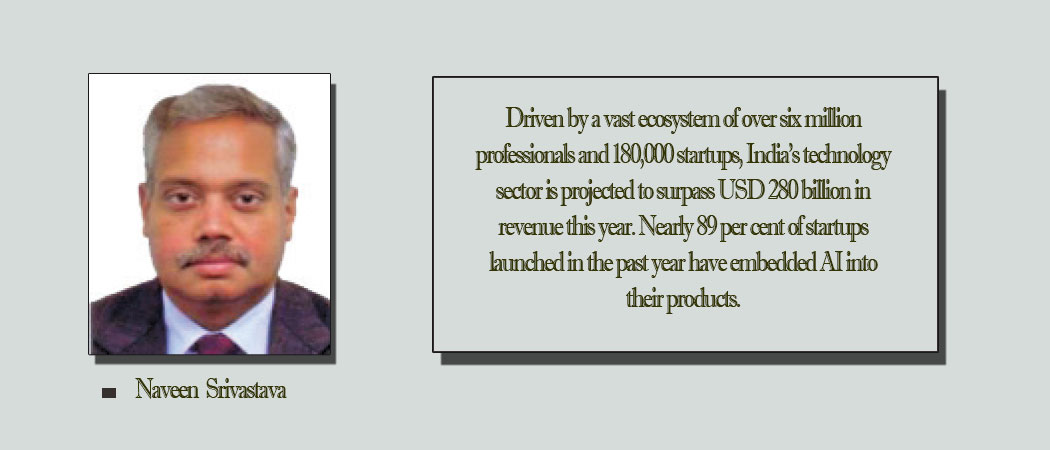
Driven by a vast ecosystem of over six million professionals and 180,000 startups, India’s technology sector is projected to surpass USD 280 billion in revenue this year. Nearly 89 per cent of startups launched in the past year have embedded AI into their products.
India is also home to more than 1,800 Global Capability Centres, including around 500 focused on AI, and is the second-largest contributor to AI projects on GitHub. Key sectors such as industrial and automotive manufacturing, consumer goods and retail, banking and financial services, and healthcare account for nearly 60 per cent of AI’s total value creation in the country.
Through initiatives such as the India AI Mission and Centres of Excellence for AI, India is democratising access to computing power and advanced research. With a strong STEM workforce, an expanding research ecosystem, and rapidly improving digital infrastructure, India is well positioned to leverage AI for sustained economic growth and development. This momentum aligns closely with the national vision of Viksit Bharat by 2047.
In the bilateral context, India and Nepal have already started exploring the potential of AI for mutual benefit. In November 2025, the Embassy of India, Kathmandu organised an event titled “AI for Inclusive Growth: Building Nepal’s AI-Ready-Future”, in partnership with the AI Association of Nepal. More than 400 participants from startups, government entities, chambers of commerce and industry, Robotics Association of Nepal, NAS IT, Fintech Alliance, AI Association of Nepal, academic institutions, think tanks and media, attended the event.
The discussions during this event demonstrated the significant interest in Nepal for collaboration with India in the domain of AI. Many participants from Nepal have already registered for the AI Summit and an official delegation from Nepal is also expected to attend the Summit.
India and Nepal are strengthening engagement in the area of startups as well, including through the launch of the India--Nepal Startup Partnership Network (INSPAN) under which the first cohort of 24 startups from Nepal underwent training and mentorship for eight weeks at IIT Madras Pravartak in December 2025-January 2026.
Multilateral initiatives
The past four years have witnessed a remarkable surge in multilateral initiatives related to AI such as the G20 AI Principles, UN and Global Partnership on AI (GPAI) Resolutions, the African Declaration on AI, and the Hamburg Declaration on Responsible AI. The AI Impact Summit to be held in New Delhi will help further strengthen and streamline these initiatives, creating a framework where innovation is open, affordable, and promotes the long-term vision of a prosperous and equitable future.
As world leaders gather at Bharat Mandapam, the focus will remain on ensuring that the benefits of AI reach all, regardless of social or economic status, while also building global consensus on safety and trust in AI. The summit will work towards ensuring that the future of AI is not shaped by a few nations alone, but through a collaborative, multilateral approach that values the voices and priorities of the Global South. We look forward to the participation of our Nepali friends in the summit.
(Srivastava is the ambassador of India to Nepal.)
-square-thumb.jpg)


-original-thumb.jpg)