- Saturday, 2 May 2026

Next Rigorous Test In Bangladesh

For the first time in 35 years, Bangladesh is without a woman prime minister in parliament. The Muslim-majority South Asian country with a population of 175 million had been led somewhat alternatively by the late Khaleda Zia, of the Bangladesh Nationalist Party (BNP), and Awami League’s Sheikh Hasina Wazed, now a fugitive exile in India.
Returning from self-exile since 2008, Tarique Rahman, Khaleda’s 60-year-old son, is the prime minister-in-waiting to be sworn in on Tuesday. Nobel Laureate Mohammed Yunus, 85, who served as the interim head of government, must have found deep satisfaction in the July Charter of political reforms, having been enthusiastically endorsed by voters.
BNP’s landslide triumph with at least well over two-thirds majority in the Jatiya Sangsad soars popular hopes that corruption will be checked, the economy improved, and the rule of law put in place.
In South Asia’s parliamentary poll history, BNP’s scintillating triumph is a record comparable to only India’s Rajiv Gandhi, who led Congress (I) to a massive majority in 1984. He rode the sympathy wave generated by his mother and sitting Prime Minister Indira Gandhi’s assassination.
(Death, caused by long health complications, snatched Khaleda Zia away six weeks before the February 12 polls, while Hasina resigned minutes before fleeing to neighbouring India at the height of the youth revolution in July 2024.)
Jamaat-e-Islami chief Shafiqur Rahman has accepted the poll verdict, now taking the role of the main opposition leader at the country’s unicameral legislature. With 68 seats, his party has registered its best-ever performance in national elections.
Banned for alleged violence against the youth movement, in which about 1600 rallyists were killed, the Awami League had no role in the recent battle of the ballot.
Interesting process
European Union’s representatives among observers described the poll conduct as the “Big day for Bangladesh’s democracy”, with nearly 60 per cent voter turnout despite the Awami League forced out of the contest. Some media sections played up the prospects of the Jamaat-led alliance as giving a stiff competition to the BNP. The 12-party alliance came nowhere close to giving any neck-and-neck competition to the eventual winner.
The interest now is in how the BNP will deliver. No election since 1991 has passed without either of the two main parties claiming vote rigging. After the 2018 election came to be dismissed as the “night’s vote”, amidst allegations that ballot boxes had been stuffed prior to the polling day, the BNP abstained from the 2024 election as “conditions for a fair contest are absent”.
The Jamaat’s opposition to Bangladesh’s independence during the 1971 war continued to affect its electoral support. A tie-up with the Jamaat might have contributed to the NCP’s dismal performance. Securing only 6 seats, according to the latest results, its setback comes into sharper focus against the background of it being among the twelve parties that formed an electoral alliance.
South Asia’s poll history rarely witnesses the traditional pattern of poll outcomes overturned by an entirely new group, except in India’s 1977 general elections. But, even then, almost all opposition parties of note cobbled together the Janata Party against the infamous Emergency Rule-tainted Prime Minister Indira Gandhi.
The Jamaat had an inherent handicap in last week’s election in its failure to reassure and convince women voters that it would address their democratic interests without discrimination in all spheres. It did not take into consideration the fact that the July 2024 uprising had recorded women’s participation in big numbers.
Awami League might break its silence, and could manifest anger and frustrations in the coming days. Creating mischief against a government is one of the most familiar and frequently used protest tactics in almost all countries with faint trappings of democracy, such as elections and the transfer of power to the winning side.
But dubious practices taint the legitimate process in many ways, such as tampering with the law, and bribing bureaucrats, politician and those in proximity to the powers that be. This is the case on a large scale in Asia or elsewhere in the developing world.
BNP leadership might find reassuring Jamaat leader Shafiqur Rahman’s pledge not to resort to obstructionist “politics of opposition”, whatever the poll outcome. Its election partner, NCP, has, however, claimed “planned fraud” in the entire electoral process.
Bangladesh has had a nightmarish experience in the past 35 years since the anti-authoritarian movement in 1990 that ended Hussain Muhammad Ershad’s military-backed nine-year rule. The losing side always claimed large-scale malpractice that deprived the opposition of its legitimate victory.
Past and future
The protest script was the same, whichever side took to the streets. The BNP, having boycotted the 2024 elections, gave an embarrassing cakewalk for Sheikh Hasina Wazed's party to secure a massive number of seats. She even supported some “opposition” candidates to avoid an almost opposition-less house.
The result: too many days of nationwide and local strikes; parliamentary boycotts; and violence attributed to malicious infiltration by the ruling party of the day. Parliament’s sittings were boycotted for days on, to be paused only to avoid losing seats for absence beyond the stipulated time period.
As is the case in South Asia in general, corruption is a major issue in Bangladesh. Prime Minister Rahman has vowed to control it, as did all his predecessors. His government is expected to investigate past scandals, which could put the focus on the Awami League leaders who ruled for more than 15 consecutive years.
Not that there were no allegations of corruption against the BNP’s government during the two full terms Begum Khaleda ruled from 1991 to 1996 and from 2001 to 2006. Much will now depend on the scope and mandate given to the probe committee. A probe against BNP leaders is anyone’s guess.
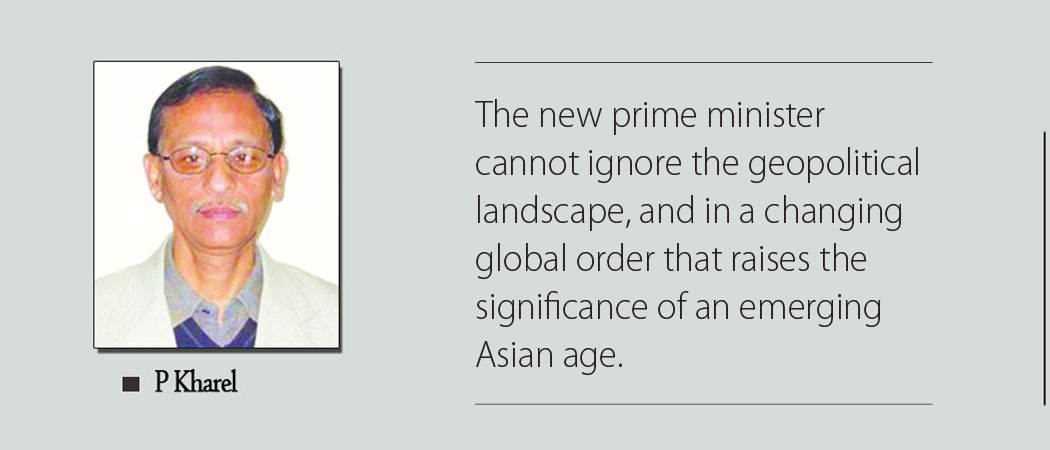
As for shoring up and sustaining the economic growth, the new prime minister cannot ignore the geopolitical landscape, and in a changing global order that raises the significance of an emerging Asian age.
(Professor Kharel specialises in political communication.)
-square-thumb.jpg)
-original-thumb.jpg)