- Sunday, 3 May 2026

Poetry Against Power
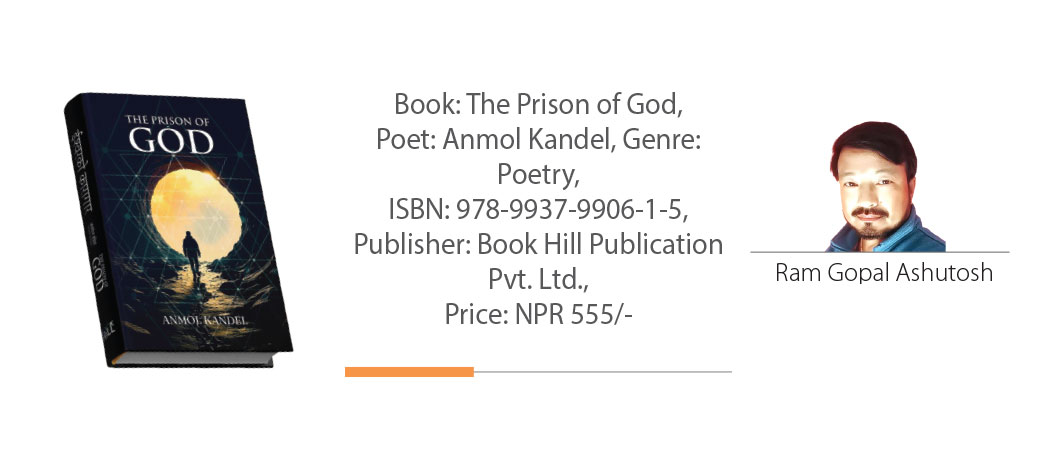

Anmol Kandel’s first poetry collection, The Prison of God, is significant for its perspectives on love, spirituality, science, society, rejection, the condemnation of unstable politics, and dissatisfaction with unequal socio-economic structures. By profession, Anmol is a scientist. Dr. Anmol, who has earned a PhD in immunology related to white blood cells, is involved in research on lymphoma cancer vaccines and immunotherapy. The inclusion of both Nepali and English languages in the same book is one of the work’s most beautiful aspects. This helps extend Nepal’s poetic landscape to all corners of the world.
In every line, his poetry allows truth to struggle to be heard. His poems shed light on the shadows of power and the depths of the human heart, where words confront conscience. From the ashes of fear and silence rises the daring voice of his poetry. Poetry becomes a battlefield where ideas, conscience, and society collide — welcome to The Prison of God. Through myth, history, and human struggle, Kandel’s poems hold a mirror to our world, refusing to let us look away.
From the perspectives of poetic strength, artistic craft, stylistic innovation, and aesthetic depth, I comment — within the limits of my own study and aesthetic sensibility — on fifteen outstanding poems from this collection that appealed to me.
‘The Wave That Kissed the Shore’ portrays the experience of an inner journey and emotional conflict. It reflects emotional and spiritual experiences, human sensitivity, the search for existence, and a profound connection with nature and time.
‘Goebbels’ exposes the truth that power sustained through lies and violence, as exemplified by Nazi propaganda minister Joseph Goebbels, ultimately destroys itself. By using historical figures as symbols, the poet artistically demonstrates the triumph of truth over falsehood through vivid imagery and dense metaphors.
‘Longing’ explores the instability and unwavering trust of the human heart in the face of enduring love, expressed through carefully structured words and emotional depth.
‘The Darkness of the Human Psyche’ is an attempt to penetrate the depths of human existence. Through three layers of darkness — night, day, and mind — the poet presents human suffering, hesitation, and fear hidden within inner darkness. The poem exposes moral, mental, and emotional conflicts residing in the human inner world.
‘I Wanna Rise Like a Phoenix’ is a poem of rebellion, self-acceptance, reflection, and transformation. By incinerating inner weaknesses, fear, and hesitation, the poet imagines a rebirth of new consciousness. The poem clearly demonstrates a coherent use of history, myth, and philosophy.
‘The Shackle of Existence’ is divided into two parts. The first part presents renunciation, liberation, and a philosophical journey from Siddhartha’s perspective. The second part, from Yashodhara’s perspective, reveals emotional depth involving love, questioning, forgiveness, and coexistence. The poem conveys the message that love and renunciation are equally important human values.
‘Experiment Mice’ is a sharp satire on the inhumanity inflicted upon the powerless in modern society. The poem presents the reality of how power, systems, and invisible forces limit human beings.
‘The Guy Is the Slaughterhouse’ represents compassion, inner conflict, and rage. The line, “As if someone had tied me with a rope and was slaughtering my own child before my eyes,” does not merely raise the issue of animal rights but also poses profound questions related to human ethics.
‘Lost Forever’ documents emotional states born from the loss of love, dreams, property, and trust. Through sexuality and love, stars, the address of a madman, Cleopatra, Yashodhara, and Buddha, the poet exposes relationships, trust, and human sensitivity.
‘Self Realisation’ portrays an individual’s inner journey of self-exploration and understanding the reality of life. The central theme of the poem is self-realisation — living fully in the present and embracing both joy and sorrow with equanimity.
‘Let’s Not Act Today’ is a balanced poem of self-purification, honesty, and existential contemplation.
‘The Headless’ is a philosophy-driven symbolic poem reflecting a corporate age stripped of consciousness, emotion, and identity.
‘Oppenheimer’s Fear’ lies at the core of contemporary human civilisation’s anxieties and existential insecurity. The poet connects war, violence, and terror with mythological figures such as Prometheus and Sisyphus, Plato’s Allegory of the Cave, and contemporary events.
‘Socrates’ Ghost’ reflects history’s suppression of knowledge, truth, and conscience. Through examples of Socrates, Mansur Al-Hallaj, and Galileo, the poem reveals how centres of power cripple and kill those who speak the truth.
‘Waking Up from the Matrix’ presents death not as the end of consciousness but as a gateway to transformation.
In Anmol’s poetry, new perspectives of experimentation and innovation mesmerise the reader. Although some clichés and mythological figures are used, new viewpoints, risk-taking, and innovation are expected from a young poet. The prose-like style and rhythm fluctuate between modern and traditional forms. Readers naturally expect risk-taking from an emerging poet. A poet must be aware of the rhythm and tempo of poetry; otherwise, reading may become difficult due to a lack of metrical harmony in some lines.
If figures such as the Phoenix, Sisyphus, David Hume, Anne Frank’s diary, Julius Caesar, the city of Rome, Goebbels, socialism, communism, political figures, and technical terms had been clarified contextually within the poems rather than through footnotes, the poems might have gained new dimensions.
Overall, this collection is rich in poetic power, beauty, craft, and style. The poet’s emotions, symbols, and stylistic choices offer readers a deep and resonant experience.
(Ashutosh is a poet and RJ.)





-original-thumb.jpg)