- Sunday, 3 May 2026

A Rebel Voice Against Structure
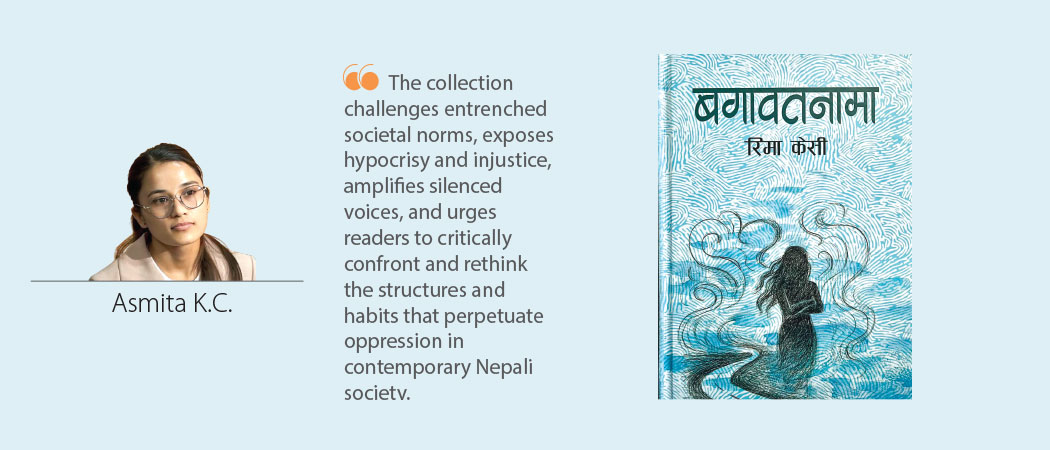

I recently read the poetry collection Bagawatnama by Rima K.C., a powerful and thought-provoking work that addresses social stratification based on caste, ethnicity, and gender. In this book, the poet boldly raises her voice against these forms of inequality and the violence, discrimination, and oppression that often accompany them. Through her poems, K.C. brings attention to the struggles of marginalised communities, challenges entrenched social norms and values, and exposes the structural injustices that continue to divide society. Her writing goes beyond mere observation, serving as both a critique of societal hierarchies and a call for reflection and change, encouraging readers to acknowledge these issues and question the systems that sustain them.
The book is divided into four sections, each focusing on a different theme and style. The first section, Muna Kavita, presents poems that are deeply personal and reflective, exploring emotions, everyday experiences, and subtle social observations. The second, Drishya-Paridrishya, emphasises visual imagery and perspectives, inviting readers to see society and life through unique lenses. The third, Premankur, centres on love, relationships, and emotional connections, while the final, Bidrohako Rang, embodies the spirit of rebellion, challenging societal norms and structures with boldness and intensity. The book contains forty poems, each distinct yet interconnected through themes of social critique, human experience, and activism.
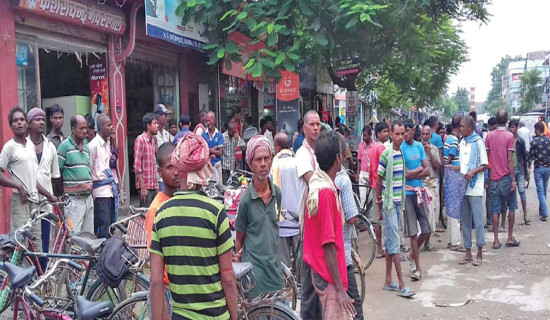
Among all the poems, I was particularly drawn to Chiya Majdur, which vividly portrays the life of labourers, their struggles, and the hardships they endure. The poem highlights issues such as insufficient wages, physical exhaustion, and the often-overlooked difficulties of labour-intensive work. Through this poem, K.C. raises her voice for the labourers, expressing empathy for their suffering while also holding the government and society accountable. She stresses the urgent need for fair treatment, better working conditions, and recognition of the labourers’ dignity and contributions. The poem is not only a moving depiction of struggle but also a compelling plea for justice and social awareness.
Another poem that I found particularly striking is Aadat. In this poem, she draws a powerful comparison between deeply ingrained human habits and the catastrophic impact of the Hiroshima bomb attack (August 6, 1945). She suggests that habits such as greed, deceit, flattery, and dishonesty can be even more destructive than the bomb dropped on Hiroshima. In this context, she portrays the Hiroshima bombing as a symbolic and metaphorical representation.
The poem 'Aamaharuko Desh' highlights the current state of Nepali society, with a particular focus on the challenges faced by women. In contemporary society, women encounter numerous obstacles across every sector – social, political, economic, and cultural. Through this poem, the poet raises a powerful voice against the violation and marginalisation of women, advocating for their rights and recognition. She confronts both sociological and biological theories that have historically been used to justify inequality, questioning the social norms and pseudo-scientific reasoning that perpetuate discrimination.
What makes Aamaharuko Desh especially striking is her use of sarcasm and irony. By presenting serious social critique in a sarcastic tone, she exposes the absurdity and hypocrisy of societal attitudes towards women. The poem does not merely lament the challenges women face; it actively challenges the structures that enforce gender bias, forcing readers to reflect critically on the ingrained prejudices and systemic barriers in Nepali society.
Through her incisive language and satirical approach, the poet transforms the poem into both a mirror and a provocation, urging society to recognise and rectify the injustices that women endure daily.
Another powerful poem by her is Badnam Aaimaiko Bidroha-Ghosh, in which she critiques the hypocrisy and double standards prevalent in society. In this poem, she particularly focuses on men who publicly raise their voices for women’s rights but fail to support women in practice. Through sharp observation and pointed critique, she exposes the gap between words and actions, highlighting how performative allyship often undermines genuine progress for women.
In addition to this, several of her other works, such as Anuhar, Shristiko Prayogshala, and Yes Yugki Drupadi, continue to explore themes related to women’s lives and experiences. These poems address social inequalities, gender oppression, and the struggle for recognition, presenting women’s perspectives in a nuanced, reflective, and often provocative manner. Across her body of work, the poet consistently challenges societal norms, calls out injustice, and amplifies women’s voices, blending literary artistry with social critique to make her poetry both intellectually engaging and socially relevant.
Another notable poem by K.C. is PR Prem, which explores themes of love and the pain of heartbreak. In this work, she delves into the emotional complexities of romantic relationships, portraying the intensity of love as well as the anguish that follows separation. The collection also includes several other poems centred on love, each reflecting different facets of affection, longing, and loss. Through these poems, K.C. demonstrates her versatility as a poet, showing that her literary vision is not limited to social critique and women’s issues but also embraces deeply personal and emotional human experiences.
K.C.’s Bagawatnama is a powerful and multidimensional poetry collection that intertwines incisive social critique of caste, gender, and systemic inequalities with deeply empathetic portrayals of marginalised communities, labourers, and women, while also exploring the emotional complexities of human relationships, love, and heartbreak. Presenting forty poems across diverse styles—from personal reflection and vivid imagery to satire, rebellion, and emotional intimacy—the collection challenges entrenched societal norms, exposes hypocrisy and injustice, amplifies silenced voices, and urges readers to critically confront and rethink the structures and habits that perpetuate oppression in contemporary Nepali society.
(K.C. is a journalist and poet.)

-original-thumb.jpg)