- Sunday, 7 June 2026

Government revises budget for current fiscal year, downsizes by 14.06 percentage point
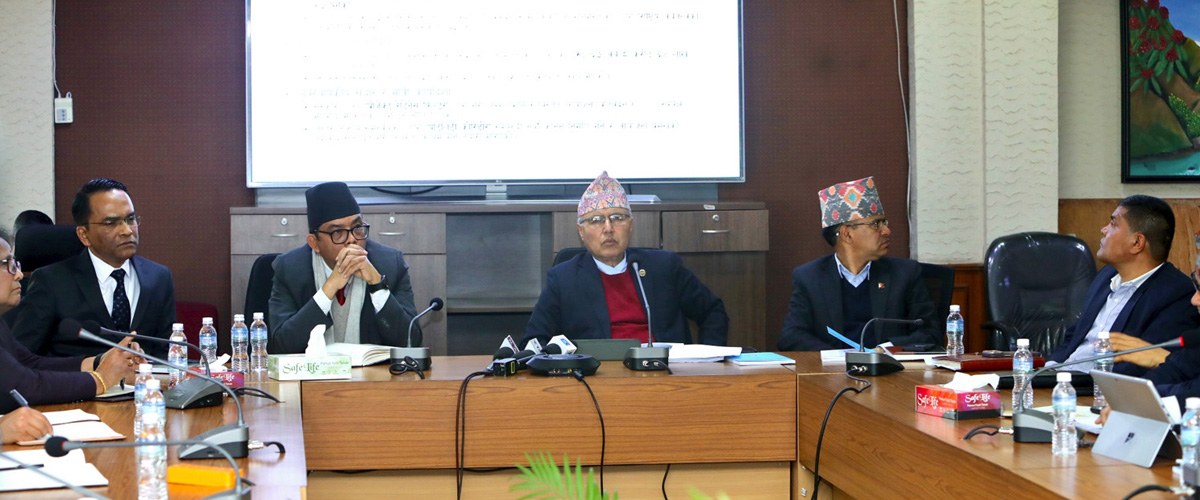
FM Rameshwor Khanal, Planning Commission Vice-Chairman Dr Prakash Kumar Shrestha and Governor Prof. Dr. Biswo Nath Poudel unveiling the mid-year review of fiscal budget
Kathmandu, Feb 10: Through a mid-year review of the budget for the current fiscal year 2082/83 BS (2025/26), the government has revised downward both revenue and expenditure estimations.
The Ministry of Finance unveiled the half-yearly budget assessment report today.
The government had initially presented a budget of Rs 1,964.11 billion for the current fiscal year. Of this, Rs 1,180.98 billion was allocated for current expenditure, Rs 407.88 billion for capital expenditure, and Rs 375.24 billion for fiscal management.
According to the revised estimates, current expenditure has been reduced to Rs 1,125.97 billion, capital expenditure to Rs 243.30 billion, and fiscal management to Rs 319.04 billion.
With these adjustments, the total size of the budget has been revised to Rs 1,688.32 billion, which is 85.96 percent of the original allocation. Overall, the budget has been downsized by 14.06 percentage points.
Out of the initial budget of Rs 1,964.11 billion, revenue mobilization was estimated at Rs 1,480 billion. Of the total projected revenue, Rs 1,315 billion is earmarked for federal government expenditure, while the remaining Rs 165 billion will be allotted to province and local governments through revenue sharing. Revenue is thus expected to finance about 67.49 percent of the total federal budget.
For fiscal year 2082/83, tax revenue is estimated at Rs 1,325.58 billion, accounting for 89.57 percent of total revenue, while non-tax revenue is projected at Rs 154.41 billion, or 10.43 percent. Of the total tax revenue, direct taxes are estimated at Rs 407.03 billion and indirect taxes at Rs 918.55 billion. Accordingly, direct taxes constitute 30.70 percent of total tax revenue, while indirect taxes account for 69.30 percent.
The Ministry of Finance has stated that the budget has been revised with the target of achieving six percent economic growth in the current fiscal year and limiting consumer price inflation to five and a half percent.
The adverse situation that has come about after the Gen Z movement on September 8 and 9 last year, the re-prioritisation of the projects, and the Cabinet's decision to cut expenses have been considered as the basis for the revised estimate.
Similarly, the report states that current expenditure has increased due to the upcoming House of Representatives election costs, social security cost, employee dearness allowances, and relief to be given to the families of those injured and deceased in protests.
"The quality of capital expenditure has not improved as expected due to the lack of preparation for the event, difficulties in land acquisition and the use of forest areas, and delays in payment to contractors," stated the report.
It is reported that the main priorities of expenditure have been set on the reconstruction of physical structures damaged by the movement, payment for strategic projects under construction, and mandatory obligations (salary, allowance, pension etc).
The Finance Ministry has also stated that a policy has been adopted to withhold the budget for unprepared, fragmented, and unproductive programmes with uncertain outcomes and to redirect it to priority projects.
Similarly, it is mentioned that the aim is to control current expenditure through measures such as not providing meeting allowances, not engaging external consulting services, controlling foreign visits, and not creating new posts.
Similarly, it is mentioned that the aim is to control current expenditure through measures such as not providing meeting allowances, not engaging external consulting services, controlling foreign visits, and not creating new posts.
High priority has been given to agreeing on the source and managing the necessary budget for the security agencies and the Election Commission for the House of Representatives election to be held on March 5.
The Ministry of Finance has also stated that, considering the decline in foreign aid and the pressure on revenue collection, efforts have been made to maintain budget balance by maximizing the use of domestic resources (revenue and domestic debt).
The report stated that to make the budget system results-oriented, the implementation of project banks, the expansion of digital payment systems, and timely reforms in public procurement law will be carried out.(RSS)