- Sunday, 3 May 2026

Critical Review Of Nepali Political Economy
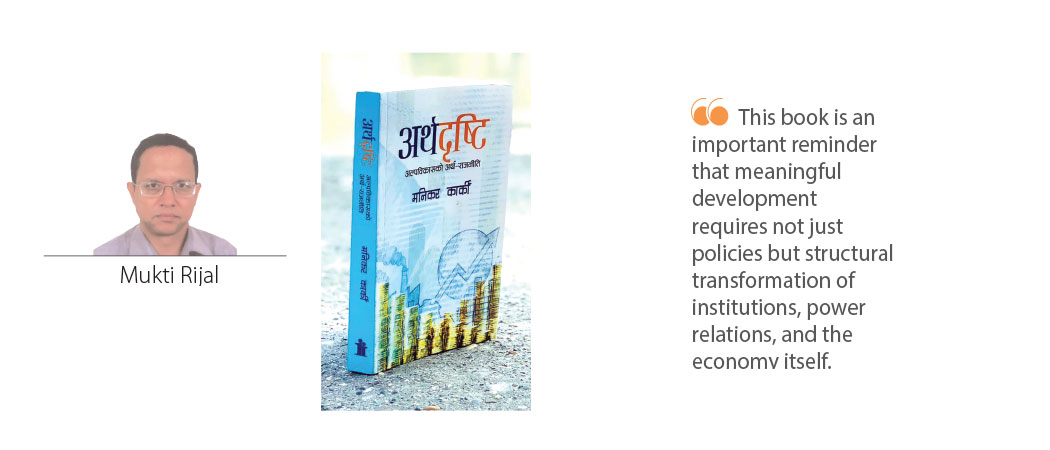

Manikar Karki is a young and upcoming contributor in the domain of political economy in Nepal. Based in Butwal currently, he has been a columnist for several national dailies and online media and wrote specifically on the topical issues of political economy. A quick review of his published articles, especially in the national newspapers, shows his grip, deep curiosity and interest in the issues of political economy, with particular attention to Nepal’s case of retarded development and economic stagnation. The book introduced in this column is not only a testimony of his relentless pursuit of the subject but also a clear indication of the ever-expanding contours of his insight into the political and economic development of the country. The question of why Nepal has remained persistently underdeveloped has occupied scholars, policymakers, and political actors for a considerable length of time, including Sardar Bhim Bahadur Pandey, Devendra Raj Panday, Dr. Babu Ram Bhattarai, Dr. Harka Gurung, and so on. This 352-page book by Maniker Karki is a valuable addition to this long-standing discourse, and it draws heavily on the authentic works and documents on the theme.
It situates Nepal’s economic stagnation within a historical framework while engaging with major propositions of economic development and underdevelopment. The book’s central contribution lies in demonstrating that Nepal’s underdevelopment has been not only the result of policy failures but also the manifestation of historically embedded structural constraints and bottlenecks.
The author of the book argues that Nepal entered the modern era with severe structural handicaps and hindrances. Unlike many postcolonial societies like India and other South Asian nations that experienced direct colonial rule, Nepal was not a colony but languished in “semi-isolated” status under different regimes spanning over the period. This long isolation produced a different—but equally debilitating—form of economic distortion. The Rana oligarchy, spanning from 1846 to 1951, entrenched a feudal agrarian structure. It had monopolised state power and deliberately restricted education and infrastructure to preserve the oligarchic dominance in and plunder of the state resources. From an economic-historical perspective, the Rana Period reflects what institutional economists describe as the dominance of extractive institutions designed to transfer resources from the people to the oligarchic ruling elite. Land tenure systems, taxation practices, and forced labour constrained productivity and prevented the emergence of a dynamic domestic market.
The book rightly emphasises that political absolutism and economic stagnation reinforced each other. The book engages, though implicitly, with modernisation theory, which catalysed Nepal’s development planning after the 1950s. Fifteen periodic plans, foreign aid inflows, and bureaucratic expansion were expected to propel Nepal along a linear path to development. However, the author shows that these so-called socio-economic modernisation interventions failed to transform the productive base of the economy and deliver corresponding results. A particularly commendable dimension of the book under review is looking into the subject from a political economy approach. According to this approach, underdevelopment is not treated merely as an economic activity or outcome. But it is analysed as a politically reproduced condition.
Whether under the Panchayat system or the multiparty era after 1990, including the contemporary federal republic time, ruling elites are wont to capture state resources while avoiding meaningful reform and transformation in industrial policy, the taxation of wealth and so on. The book’s major strength lies in its historical references and contextual clarity. In chapter five the author makes a critical assessment of the global economic situation, characterising it as the crisis of capitalism that has resulted into economic recession, burgeoning inequality and economic deprivation.
By avoiding statistical, infographic or purely technocratic explanations, it situates Nepal’s underdevelopment within enduring institutional and political constraints and limitations. Its interdisciplinary approach that combines history, economics, and political analysis tends to make it accessible and comprehensible to a wide range of readership. The interesting part of the book is the concluding chapter that proposes alternatives to the existing global economic policies that are lopsided and have given rise to the unequal world. The alternatives sound similar to the ones discussed in the well-known book Road to Freedom by Nobel laureate Joseph Stiglitz.
According to Stiglitz, globalisation can benefit society—but only with fair rules and practices. It is an obvious fact that current global systems favour corporations over workers and poor people. However, according to Nobel laureate Stiglitz, progressive capitalism balances markets with democratic governance to promote shared prosperity, real freedom, social justice, sustainable growth and so on. The book could have been more relevant if it could have engaged more explicitly with contemporary development discourses comprising the role of institutional infrastructures, the digital economy and ICT, regional value chains, or climate and ecological economics.
Greater attention to sub-national inequalities between hills, plains, and marginalised communities with reference to the federal reorganisation of the state would also have enriched the political economy analysis. For scholars, students, and policymakers seeking to understand Nepal beyond surface-level diagnoses, this book is an important reminder that meaningful development requires not just policies but structural transformation of institutions, power relations, and the economy itself.
(The author is presently associated with Policy Research Institute (PRI) as a senior research fellow.)


-original-thumb.jpg)