- Saturday, 6 June 2026

Can Old Habits Overcome New Challenges?

Nepal continues to spiral under the complexity of a new hope of people, social psychology of existential anxiety and boundless doubt about the nation’s stable future. Keeping the hope of people alive requires the creative and analytical capacity of leaders to solve problems. The bubbling of sudden youth revolt can generate optimism if it can address the cycle of political paralysis. They are leveraging new technologies to overtake the self-righteous impulses of senior Nepali leaders.
The central questions that haunt the public minds are: Will Nepali leaders forge a new ground of cooperation ahead with full maturity or, as usual, roll over political factionalism, split, defection, syndicate and power-sharing regardless of its consequences for democratic values, constitutional spirit and moral ambiance? Will the new political forces rationally plan the nation’s future to uplift the well-being of people or only mobilise their passion and emotion without an exit from the habits of it is now our turn mentality? Do the new political forces come up with a new vision to shape national perspective or continue with the old-style close-minded political culture?
Doctrine of necessity
As long as the new forces do not disclose their tangible public policies and muster political will to implement them, Nepalis will have no better choice against the doctrine of necessity, a doctrine that only derails the democratic rules of the game and opens space for free-riders for whom the state is an enemy. Politics reduced to regime interest, not the state’s imperative, turns rough and rudderless. The constructive competition among political parties of various shades in the coming parliamentary elections within the frame of the state can legitimately structure political relations, build a common political sphere and muster personal maturity and institutional legitimacy of governance.
A beam of hope thus requires the leadership to restore the national integrity system of the state institutions, political parties, market institutions and civil society for normative conduct, social peace and order. It can enthuse them with public morality, transparency and accountability, the qualitative traits of democracy. Institutional culture is vital to set an intelligent path of political change, aiming to address national challenges and stabilise the amazing outpouring of public disquiet about the nation’s future. New challenges entail innovative responses as per shifting values and interests.
Without alteration of consumerist cultures where elites live off the toil of workers’ remittances, which comes with huge human costs, leaders can hardly excite the hope of building the nation in the historic light of national sovereignty. This means they must evolve basic national preconditions to hone Nepali entrepreneurship, as they are the nation’s sustainable future. Other positive steps are:
Healthy national integrity: Partisan distribution of all constitutional and public posts has cut the Nepali state’s autonomy from dominant political parties and acquired a monopoly of power with respect to basic state services beneficial to people. One cynical side is the erosion of power separation and checks in the polity while the other is staggering effects on the reduced size of local self-governance. The patronage character of political superstructures has watered down democratic autonomy and effective participation of people in local institutions.
The lack of monopoly of power of the state has confiscated its creative role in social modernisation and sustainable progress. Each election has produced more losers of power than beneficiaries, contributing to a politics of resistance, politicized public admin and the spur and stir of subsidiary identity politics. Only a robust national integrity system can put off the corruption of political and economic power and deploy social surplus to productive investment for nation-building.
Depersonalised polity: The centralised and personalised nature of party politics comes into conflict with the principle of popular sovereignty and subsidiarity. In Nepal, charismatic politics, like the electoral and traditional ones, have confronted popular sovereignty as leaders became paramount in decision making, candidate selection and organisational growth over people’s aspiration for the choice of leadership, social equality and self-rule.
This marks the resilience of old politics of top-down representation, not deliberative and participatory ones, where policy issues are mutually decided. Nepali leaders have to synchronize all forces and orient to achieve national tasks in the rhythm of social integration under a common conception of justice and authority. Only brokering alliances with power fixers cannot overcome the old habits of accumulating challenges and trapping oneself in their heat.
Habit-breaking political culture: Democracy is an open-access, receptive rule. Nepali leaders are required to evolve a culture of listening to people, solve their problems, engage them in policy making and create conditions for the production and supply of public goods at minimum costs. Now they are mired in cronyism, impunity and corruption of power, facing a loss of public trust in governance. Continuity of negation of the rival and coalition building of all sorts, irrespective of popular revulsion, has bred voters’ swing from the mother party and become independent, rational and reflective, not conformist.
A disparity exists between increased people’s participation and the institutional ability to absorb them. The growth of leader-oriented support, crack and unity shows weak political institutions devoid of consensual leadership, policy and organisational discipline. As a result, party building and democratisation of their inner life suffer. Post-modern impulse denies their meta-narrative of ideology and spurs the spirit of sub-national culture, not tuneful national progress.
Direct communication with people: Nepali political leaders have a tendency to demonstrate impersonal crowds as a show of strength to outshine and attract the mass as an image-making strategy against the de-massifying impact of information technology and the value of individuals in opinion formation. The information-driven shift of social sites amply shows a non-ideological scale of breakup of political forces, thus catching each other in a Hobbesian trap where leaders and cadres are engaged in a cycle of mutual rancor and acquisitive behaviour, not a civic process of cooperative action. Digital platforms play a key role in its twist.
They have failed to socialise leaders and cadres in the fundamental human nature of decency. In the display of the crowd, Nepali leaders show an inflated diversity of partisan identities and instrumental manipulation of cultural differences with harmful effects on civic order. This has trapped people in a gyration of old habits of pre-state mood, unable to cope with new challenges.
Power calls for public responsibility: The search for public goods is the vital task of political life. In Nepal, a protracted fight exists between recently formed power blocs for electoral gamble, neither of which is fully sure of defeating the other or consuming its punch. It has made politics spirited without any hint of policy, ideology and organisation choice. It even cares less about its effect on the political order vital for security, the rule of law and the institutional muscle of creating a sense of justice for the people. It is vital to sustain the assertion that all Nepalis are legally and politically equal despite disparity in education, technology and income. But public morality calls the leadership to accept due process of law and reason, and assume public duties.
Policy harmony: Both new and old political forces of Nepal do not mark an exit from neo-liberalism, an invalidated canon of progress. It ditches ecological and social sustainability and equity and reflects a disharmony between the constitutional vision of social justice and the social Darwinism of the globally linked market. Nepali leaders’ lesser emphasis on agriculture modernisation, industrialisation and investment in the productive sector indicates its shadow over them. If public policies are divorced from the egalitarian spirit of the constitution, the nation can realise neither freedom, nor justice, nor even stability. This signifies that electoral competition in Nepal over personality, not policy alternatives, turns its politics phony.
The interest of new political forces to negate the old without any sense of innovation in no way makes them moral. As a result, policy focus on class interests is becoming weaker while interest groups are stronger. It has failed to balance between the partisan prejudices with the common good and offer Nepalis better life prospects. Nepali societies progressed through a series of evolutionary paths that required policy harmony with the division of labour, professionalisation and specialisation of social tasks. Education and technology can add value to it.
Vigor
The vigor of leaders lies in finding sensible solutions to problems. The essence of modern politics is to patiently mobilise diverse aspirations of Nepalis into a cohesive course to achieve collective social emancipation. It can release the energy for political stabilisation and institutional consolidation. Only the lawfully constituted civic organisations can promise well-being for all. Strengthening state structures financed from their own revenues is vital to resolving the ongoing geopolitical fracas in national politics. A rentier state dependent on external resources for its survival and progress cannot muster ample independent sources of authority. It will not be innovative, no matter whether its leadership is young or old.
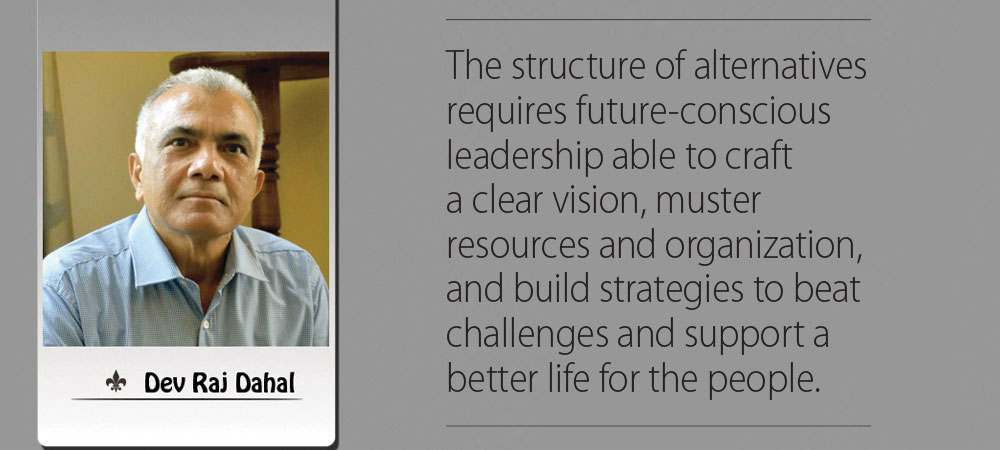
It is absurd to assume that a system of patronage with shaky coalition culture can put a tap on the crisis of governability. The structure of alternatives requires future-conscious leadership able to craft a clear vision, muster resources and organization, and build strategies to beat challenges and support a better life for the people through evidence-based achievement, not just flagging differences in style of publicity and personality.
(Former Reader at the Department of Political Science, TU, Dahal writes on political and social issues.)