- Sunday, 24 May 2026

Dancing Under Tear Gas
 Katharina Wilhelm Otieno
Katharina Wilhelm Otieno
Katharina Wilhelm Otieno
A letter has come from Jomo Kenyatta and Jaramogi Odinga, who, among others, are considered the founding fathers of independent Kenya. They asked if everything was okay here. “I replied: Kenya is a disaster,” sings Bien-Aimé Baraza in the opening lines of the song “Tujiangalie” (which means, approximately, “Let’s take a look at ourselves”). The artist who goes by the name Bien is one-fourth of Sauti Sol, arguably Kenya’s best-known band. The Afropop group wrote “Tujiangalie” with the rapper Nyashinski back in 2019, but the song could hardly be more fitting for the situation in their country half a decade later.
In what is probably their most political song, Sauti Sol sing about debts owed to China, which are being used to build streets and railroads, and about corruption, poverty and tribalism. They sum up: “We’re worse off today than we were yesterday” and “Vision 2030 will probably remain just a story”. It’s no wonder that “Tujiangalie”, even though it strikes a quiet, almost resigned tone, quickly became one of the unofficial anthems of the protests.
Some songs on Kenya’s unofficial protest soundtrack, which encompasses almost all genres and generations, express anger and sorrow; others are decades-old patriotic anthems. Others still capture the youthful spirit of the movement. “Anguka Nayo” by the duo Wadagliz Ke is actually a simple party track, but it was reinterpreted by the Gen Z movement. The song’s title, which loosely translates to “fall down with it”, became a battle cry and expressed the hope that repealing the 2024 tax bill that ignited the protests would also topple the entire government.
Some songs that were specifically written for or about the protest movement also address finance and legislation. In 2024, Sabi Wu sampled a beat from Kendrick Lamar’s diss track “Not Like Us” to write “Reject Hio Bill” (“reject this bill”). Wu told the music magazine Rolling Stone that he improvised the chorus and first verse in less than fifteen minutes. He then uploaded his freestyled version to social media with no intention other than simply sharing his thoughts. It resonated so strongly that Wu decided to finish the song and release it.
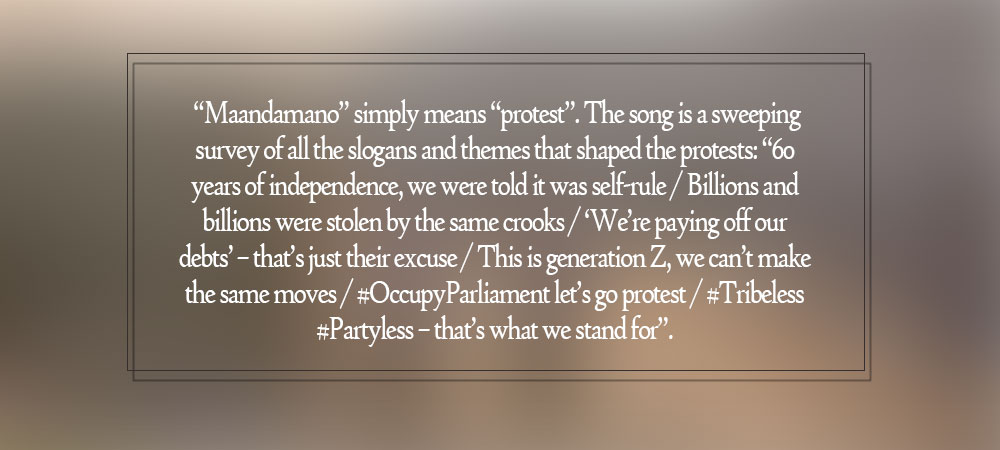
“Sauti Sol lead singer Bien now performs primarily as a solo artist and did not miss the opportunity to contribute his own song to the protest soundtrack, together with Breeder LW. “Maandamano” simply means “protest”. The song is a sweeping survey of all the slogans and themes that shaped the protests: “60 years of independence, we were told it was self-rule / Billions and billions were stolen by the same crooks / ‘We’re paying off our debts’ – that’s just their excuse / This is generation Z, we can’t make the same moves / #OccupyParliament let’s go protest / #Tribeless #Partyless – that’s what we stand for”.
The accompanying video is also composed of protest scenes and social media clips that went viral: in one, protest icon Shakira Wafula holds a Kenyan flag as she screams at a police officer; in another, a protester inhales tear gas from a canister and calls to the police that they should bring him strawberry flavour next time. But in most clips, the protesters are dancing, sometimes right in front of heavily armed security forces. The end of the video reveals, however, that the party has taken a dramatic turn: the person filming has to hide from gunfire behind a row of concrete pipes. The last few seconds are dedicated to the names of people who died in the protests. There are many.
-Development And Cooperation