- Wednesday, 27 May 2026

Water harvesting revives Bandukedanda's orchards
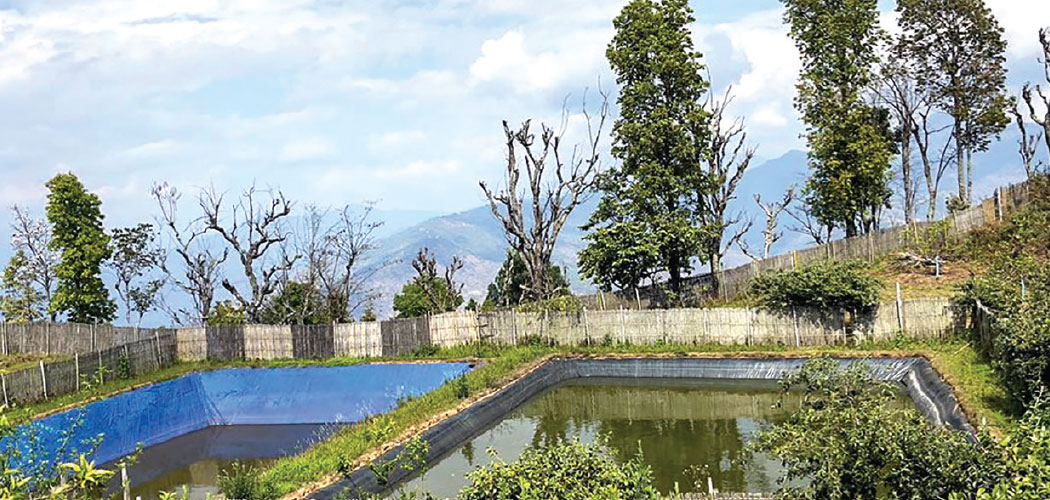
A lush view of Bandukedanda

By Kokila Bhandari,Dhankuta, May 3: Land in Bandukedanda of Chaubise Rural Municipality-3 in Dhankuta district, once barren and deserted due to a lack of water, has now turned green and the trend of people leaving the area has begun to decline.
Bandukedanda has become an example of how sustainable thinking, collective effort and proper use of natural resources can bring change. Through water harvesting and organic farming on previously degraded land, agricultural tourism has become possible.
At this site, Tamor Permaculture Farm has been irrigating land throughout the year by collecting 3.4 million litres of water in ponds and using a lifting system, producing around 35 varieties of fruits. Inspired by joint efforts from organisations and locals, residents have also started building ponds to collect water. Locals said the village has found a new life.
A few years ago, Bandukedanda, located above Kurule Tenupa, was dry and cracked, with little hope for the future. “People used to think nothing could be done here, but now they see a future on this very land,” said farm treasurer Dirghaman Tamang.
The hills are now covered with fruits such as apples, plums, walnuts and avocados. Even during April/May, apple trees are laden with fruit.
Local Ram Bahadur Rai said that after the 1988 earthquake, natural water sources began to dry up, turning fertile land barren and triggering migration. With the return of water, however, the land has regained its productivity.
According to Lokendra Kumar Yakkha, chairperson of Tamor Permaculture Farm, farming and preventing migration would not have been possible without solving the water problem. A pond with a capacity of 3.4 million litres has been built to collect rainwater, ensuring irrigation throughout the year.
In addition, water is lifted from a local stream and distributed through a tank with a capacity of 100,000 litres. Local Tika Koirala said that with determination, hard work and access to appropriate technology, people can find employment and income opportunities within the village itself, without needing to go abroad.
The farm was established in 2016 (2073 BS) with the support of the KTK-BELT organisation, on the initiative of Rajiv Goyal, an American citizen of Indian origin. Spread over around 96 ropani of land, the farm now grows more than 35 varieties of fruits. What began with 250 plants has expanded to more than 500, including over 350 apple trees.
All produce is organic, with no chemical fertilisers or pesticides used. The success of the farm has inspired the local community.
Following its example, more than 100 households have built their own water collection ponds, each with a capacity of about 100,000 litres, according to local Purna Rai.
Where people once depended on market-bought vegetables, the same land now yields fruits and vegetables. Locals have begun earning by selling apples, avocados, walnuts and other produce.
Last year alone, the farm earned Rs. 300,000 from fruit sales and Rs. 900,000 from its nursery, said Tamang. Agricultural technician Binod Puri said that, in addition to fruit production, experiments are also under way to develop new varieties through cross-breeding.
With water and production increasing, job opportunities have also grown, and people are beginning to return to the village.
According to Sneha Shrestha, MIS operator at the National ID and Registration Unit of Chaubise Rural Municipality, 56 households migrated in 2021, while only one returned.
In 2022, 35 households left and one returned, in 2023, 21 left and one returned. In 2024, the number of those leaving decreased further, with only 10 households migrating and two returning. In 2025, 25 households left while two returned.
Although challenges remain, these figures show clear signs of improvement. Madan Tumsa, Ward
Chairperson of Chaubise-3, said the concept of collecting rainwater in ponds has proved effective, encouraging others to adopt similar practices and turning the area into a
learning site. Farmers, students, journalists, cooperative members and researchers from across the country visit to see how barren land can be revived.